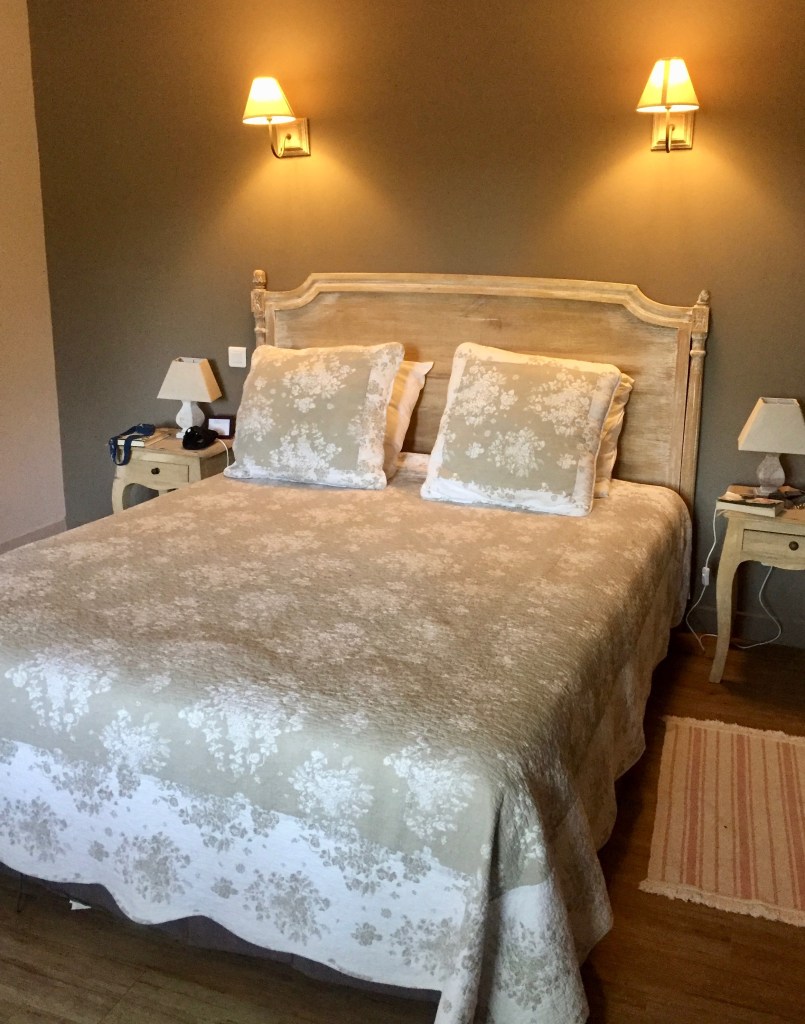
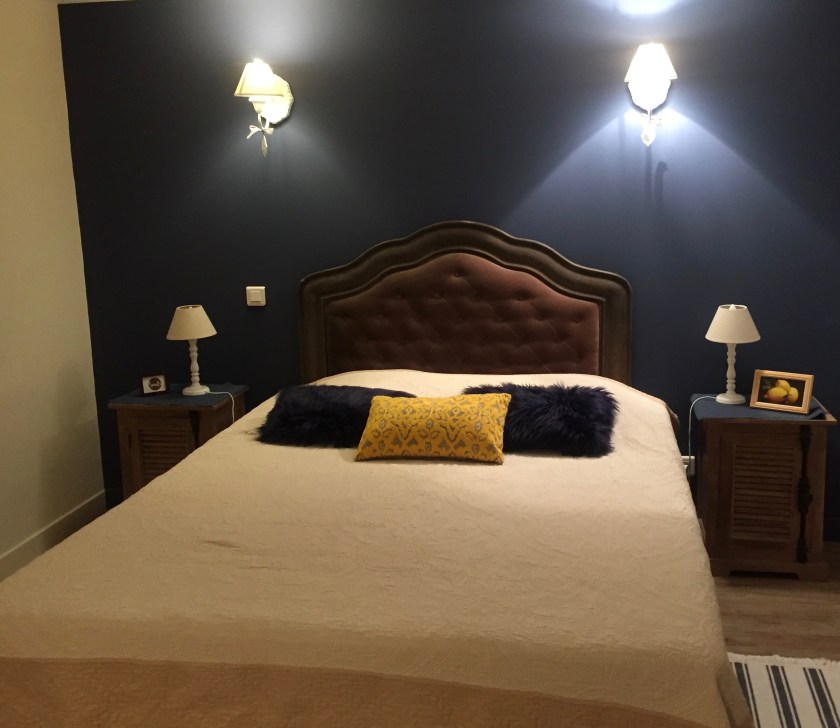
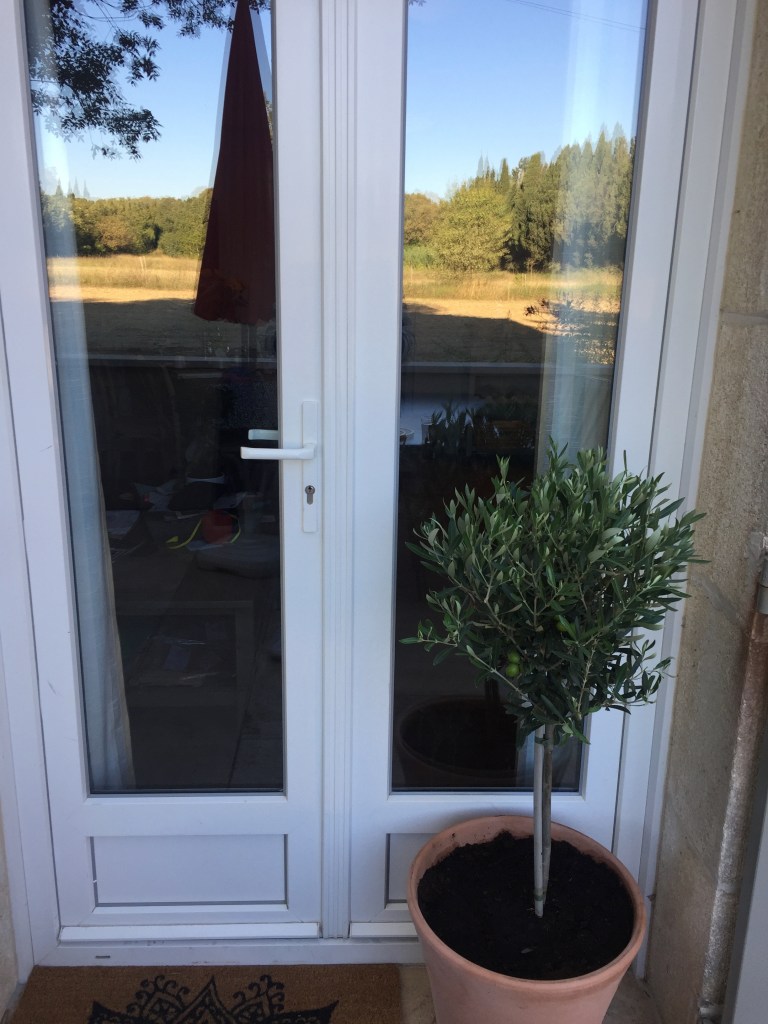
Getting Out Of Dodge…

Following the last post we made about some of our favorite places in Provence, two different friends called to say “We want to hear the story of how you got back!”. So, as we continue to think about our next blog posts, here is the story of our return.
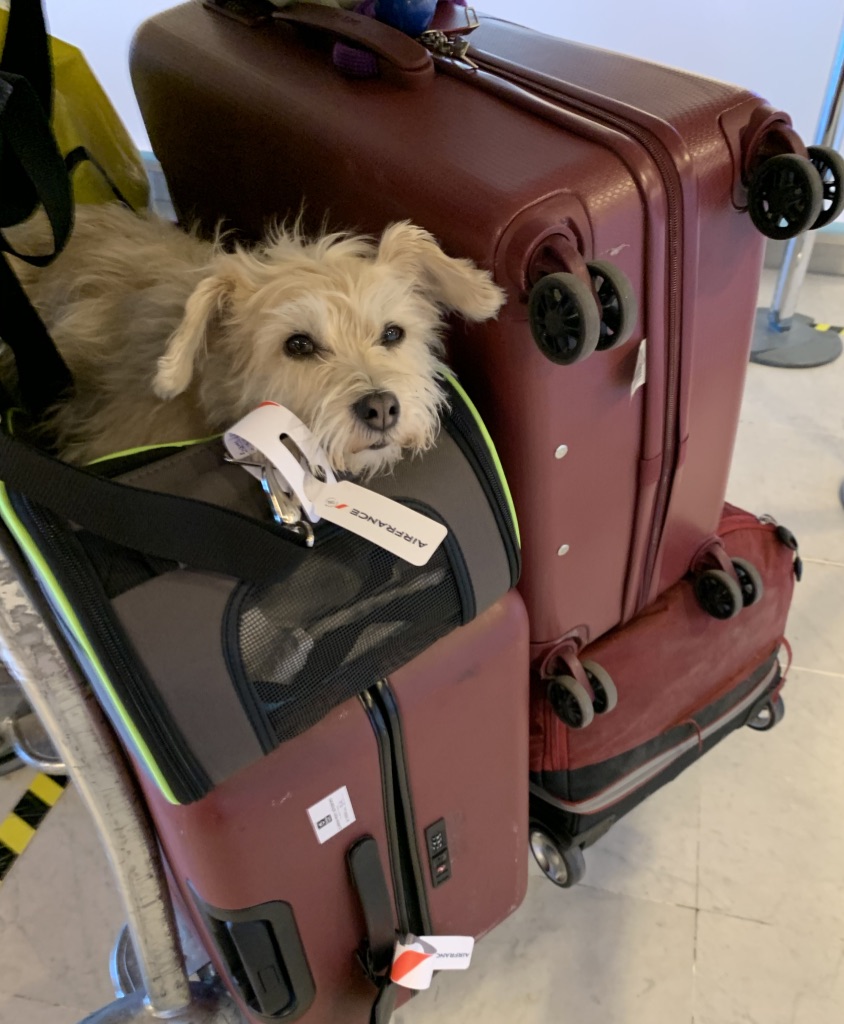
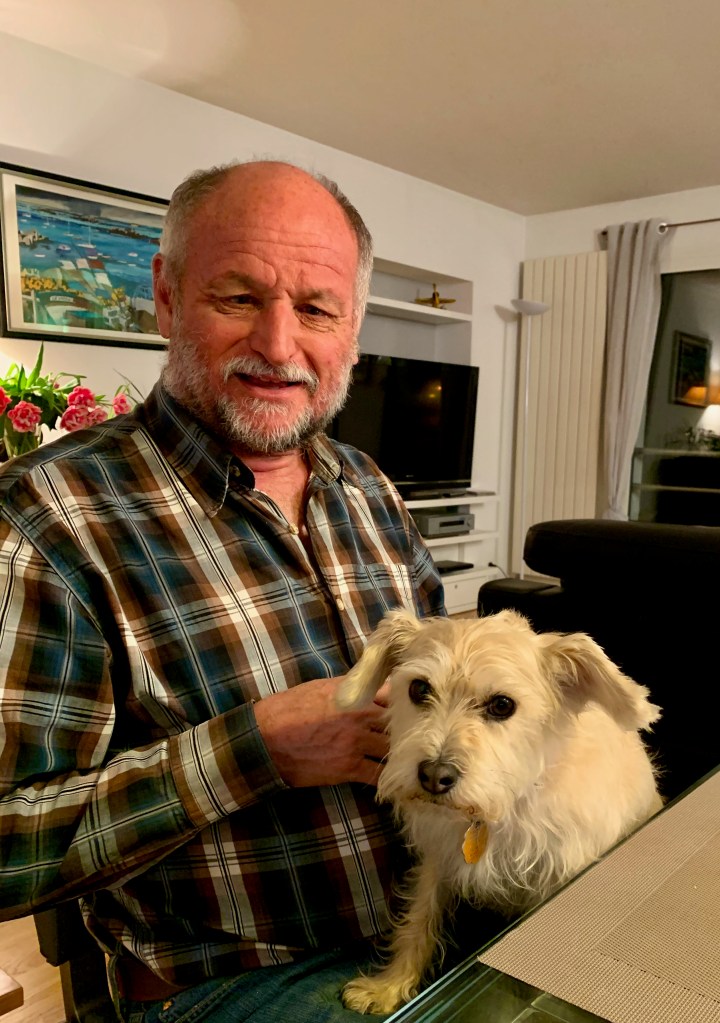
LuLu, patiently waiting, at Charles DeGaulle Airport in Paris.

After the French government announced le confinement on March 14, it was clear that our decision had been made for us! Luckily, we were in Granville, France. Philippe and Armelle had assured us that the apartment was ours for as long as we needed it. They did not have guests coming until May – and surely this wouldn’t last THAT long! Ha! So we were very happy to consider that we were staying in a beautiful part of France, a country with excellent health care. And living downstairs from some lovely friends. The circumstances seemed ideal for what was a very obscure situation.

And then, on March 19, we received the following memo from the American Embassy in Paris:

Travel Advisory: Level 4 – The Department of State advises U.S. citizens to avoid all international travel due to the global impact of #COVID19. In countries where commercial departure options remain available, U.S. citizens who live in the US should arrange for immediate return.

Wow! We promptly commenced trying to figure out how to get home, and more than that, where to go once we got (spoiler alert) here!

Because our flights had been arranged by CorpTravel for Volvo as part of the overseas delivery package with the new car, we called them first. Their search for new flights was hampered by the hordes of people leaving Europe. So even getting the same itinerary we had scheduled for May on a date in March was impossible. SAS – Scandinavian Airlines – was a) originating flights only from Scandinavian cities and b) was no longer flying to San Francisco. They would take us only as far as Newark. And in order to take the Volvo-subsidized flight, we would have to get to Stockholm from Paris. So it took a couple of days for the great folks at CorpTravel to even come up with an itinerary and we would not be able to leave Paris until March 26th.

Next hurdle: Getting to Paris. Easy Peasy, right? Take a train from Granville to Caen to Paris. It would be a three and a half hour trip that would go right to CDG Airport. Except… Two trains got cancelled! It became apparent that there was not going to be a train that we could count on from Caen to Paris. So Philippe suggested that he drive us to Rennes and we could take the TGV from there to Paris. We apprehensively made a reservation on the TGV for March 25th, and kept our fingers crossed that we would not get an announce d’annulation – announcement of cancellation.

Thus commenced three days of packing and preparing. Our wonderful friend Laurie, an Airbnb host herself, took it upon herself to find us a place to stay in Oakland. And the lovely host, Clarice, agreed to take on 2 possibly corona-compromised travelers and a dog! So all we had to do was Get There!

Upon arrival at the TGV station in Rennes, we discovered that we had left LuLu’s carry-on in Granville! So as soon as we got to the hotel in Paris, we set about searching one out. Donna took a fruitless trip on the AirTrain to CDG trying to find an AirFrance desk open to see what could be done. Finally a man in the Odd Size Baggage department told her that the pet stores were still open, being considered an essential service. Formidable! A 130€ taxi ride later and 86€ for the carry-on and we were all set! Whew….


This is identical to the bag we left in Granville, except it cost twice as much! And that doesn’t even take into account the taxi ride!

We were up early the next morning and at the AirFrance counter in plenty of time for our flight to Stockholm. Because of the scheduling – due to fewer flights the AirFrance flight would land in Stockholm after the SAS flight to Newark had departed – we would have to stay overnight in Stockholm. So we had reservations in a hotel near the airport. But, as we were standing at the counter, word came that only persons with Swedish passports would be permitted to leave the airport! Not looking forward to a night in an airport, but not having any other options – despite Sam’s 3% portion of Swedish genes – we resigned ourselves to the inevitable. Then, within minutes, we were told that Sweden was now not allowing anyone who did not have a Swedish passport to even fly into Sweden! So that flight was a no-go for us! We had to start from scratch!

After several more possibilities were found to be unsuitable – including one flight that disappeared off the computer as she was booking us on it – the Air France check-in staffer sent us to another terminal to the AirFrance sales office.

Nerves were fraught here. Everyone including passengers and AirFrance staff were a little on edge. Security guards enforcing social distancing, tape and tables and plexi-glass screens that prevented one from getting too close, masks that impaired hearing what was said in French (like a game of Telephone). It all felt designed to make Donna, and the clerk, more nervous. But finally we had a direct flight to Los Angeles from Paris departing that evening at 6:10 pm. But – little hiccup here – LuLu could not be Donna’s emotional support animal. She would have to stay in the crate for the entire flight! Eleven hours! We asked why. Well, one would have to notify the airline 48 hours in advance! When asked if a décision exceptionelle could be made, Donna was met with a sharp “Non!” It seemed we might not be able to go that night! And anxiety was rising about possible border closures and more cancelled flights! Then, happily, Donna recalled that LuLu was scheduled on the flight to Stockholm as an emotional support animal! After more consultations and phone calls, that changed things, an unexceptional decision was made and they booked us on the flight!

What remained of the day was about 8 hours in an airport that we were sure was a veritable petri dish of viral droplets! Although there were amazingly few people in the terminal, there were a lot of apparently homeless people seemingly living there! We managed to find seats where we could distance ourselves from others while we waited to board the aircraft. Happily there was a Presse open which had newspapers and books in English, sandwiches and drinks. All the other restaurants, cafés and food vendors were closed and a guard recommended that we take advantage of what was available before we went through security, as there was not much available on the boarding gate side. And there was a pharmacie open also where hand sanitizer, disinfecting wipes and thermometers were available! We hadn’t seen any of that in France for over a month! Donna spent the last of the Euros on French creams and serums that she had come to like very much!
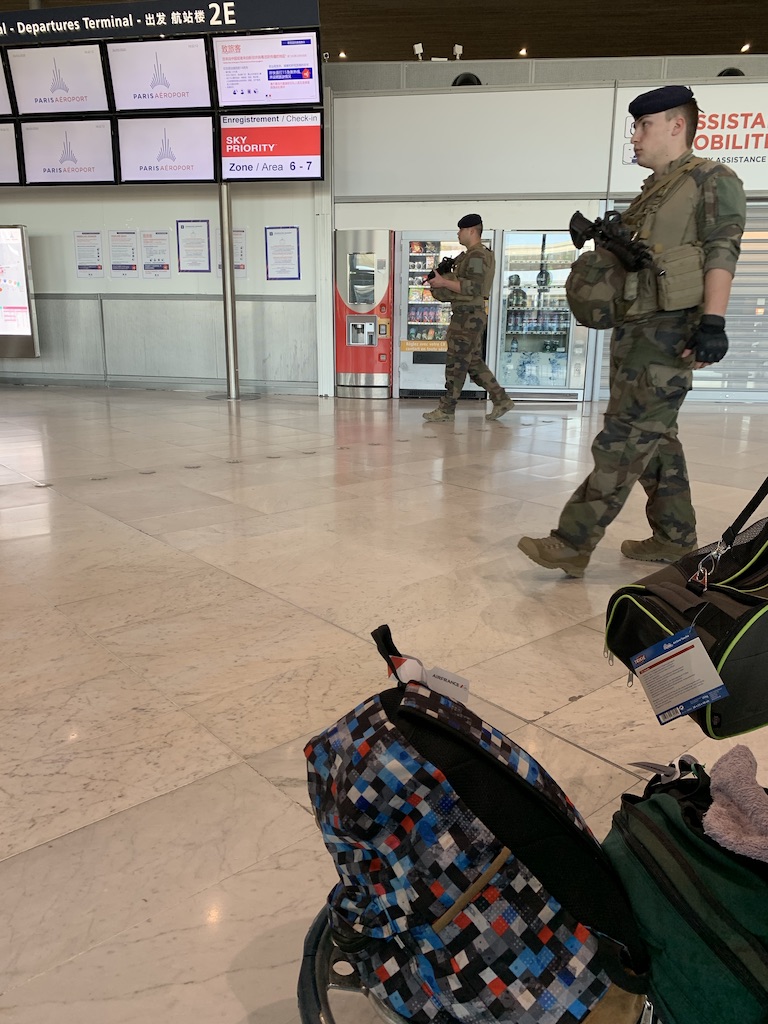
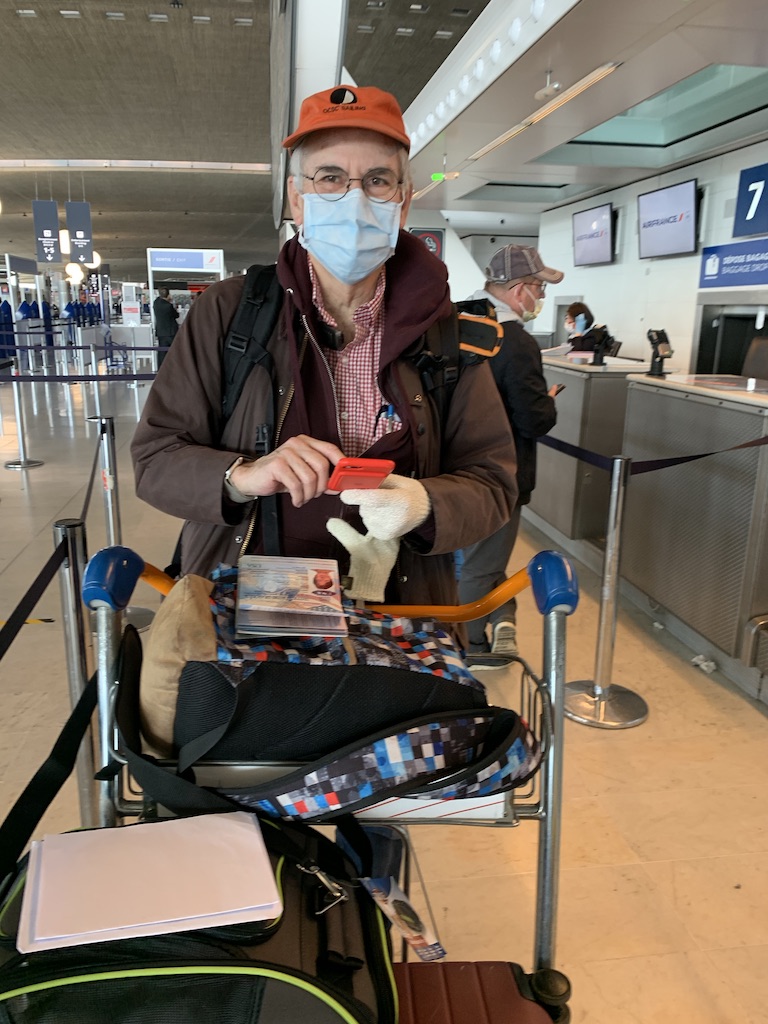
There is more than one happy ending here! The flight was AMAZINGLY empty. Sam estimates it was only 25% full – with a full flight crew! Social distancing was great! We each had our own row and other passengers were several rows away from us. The attendants were wonderful. They were very happy to be dealing with a nearly empty flight. The pre-packaged meals were pas mal. The entertainment was bi-lingual so we watched Once Upon A Time in Hollywood by syncing the screens in separate seats And then Donna got to watch a French comedy she had missed when it was in St. Rémy – Joyeuse Retrait. We could stretch out to sleep. LuLu was a very popular passenger with the flight crew, who came by every so often to say hi and give her a little caresse. She slept a lot and managed to hold her bladder until we were through Customs and ALMOST out of the building–two long hallways to go, but she, we confess, went. It was a great flight overall!

We were a bit hampered arriving in LA by not having cell phones that worked. Our Orange cell phone account wanted us to pay $15 for coverage in the US, which we declined. But a very nice LAPD officer let us use his phone to call the hotel to get the shuttle, and soon we were collapsed in a heap in the LAX Westin!

Next happy ending – Benjamin came over the next morning to take a socially distanced walk with us. He had been very concerned about the virus exposure we experienced while traveling and suggested that we cancel our flight to SFO and rent a one-way car to drive to Oakland. Which we did. We were both still tired from the trip, but we took turns driving and napping and made it to our Airbnb by about the time we would have arrived if we had flown. And far less exposed to bugs! (Thanks to Benjamin for great thinking!)

So we woke up the next morning in our Quarantine Retreat. Clarice is our thoughtful host at a lovely small Airbnb space a little under 2 miles from our house.
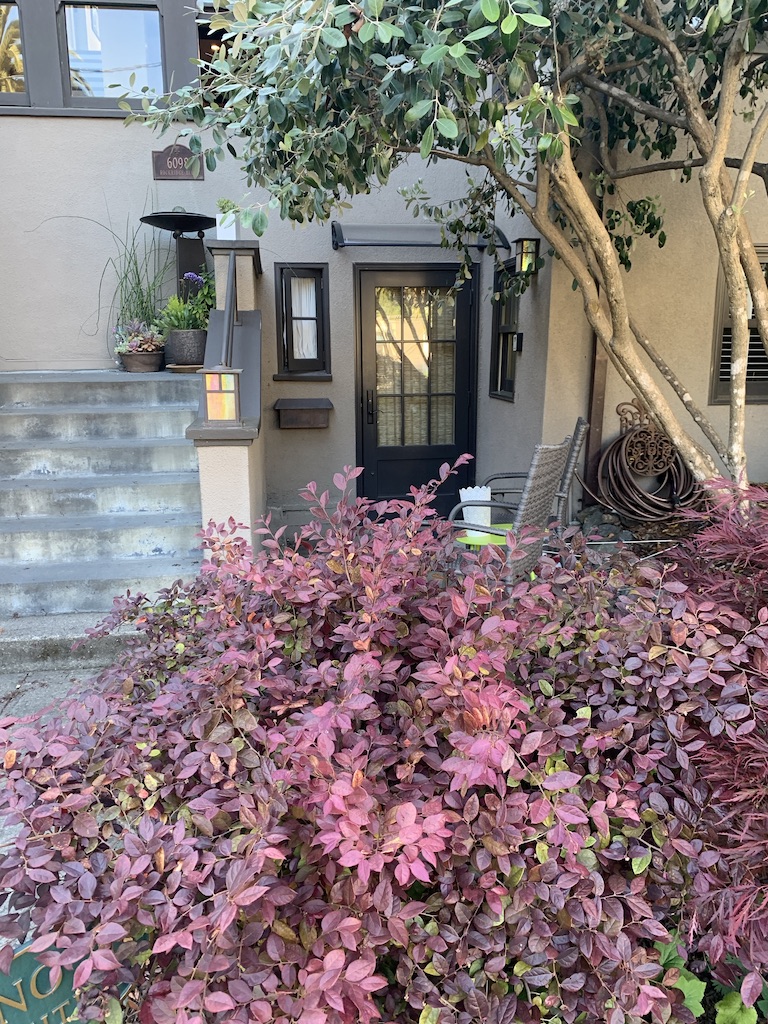
We finished our 14 days with no signs of illness – no fever (varied temps but all below normal–98.6 F or 37 C), no coughs, no difficulty breathing. Donna spent part of each day walking with LuLu. Sam got caught up on politics. We had a couple of Instacart deliveries and our friends Shelley and Beamie brought food by when they made a trip to the market. Peggy brought us raw frozen dog food and yummy cupcakes. Our lovely neighbor Jan made some fabulous pot stickers and is now perfecting her burrito recipe! Thank you Jan! We’re glad to be on your beta test team. Rainey sent cool homemade masks! We cannot begin to thank our friends enough for all the kind care we have received.

So – our house is still rented out until August, although we hear that the tenants may decide to leave earlier. But we are vagabonds for the next few weeks at least. Now that we are out of quarantine, we are trying to take socially distanced walks with folks and catch up on their last 10 months! And there are several blog posts still to be made – including and amazing drive from Digne-les-Bains to Nice and trying to cover a month in Paris! Also hoping to capture Sam’s photo collection of Doors of the European Union and Shengen countries! Doors just popped into our cameras everywhere we went it seems.

Please let us know how you are doing! We will be excited to be in touch.

Love to you all,

Sam, Donna & LuLu

April 14, 2020
Puddling Around Provence

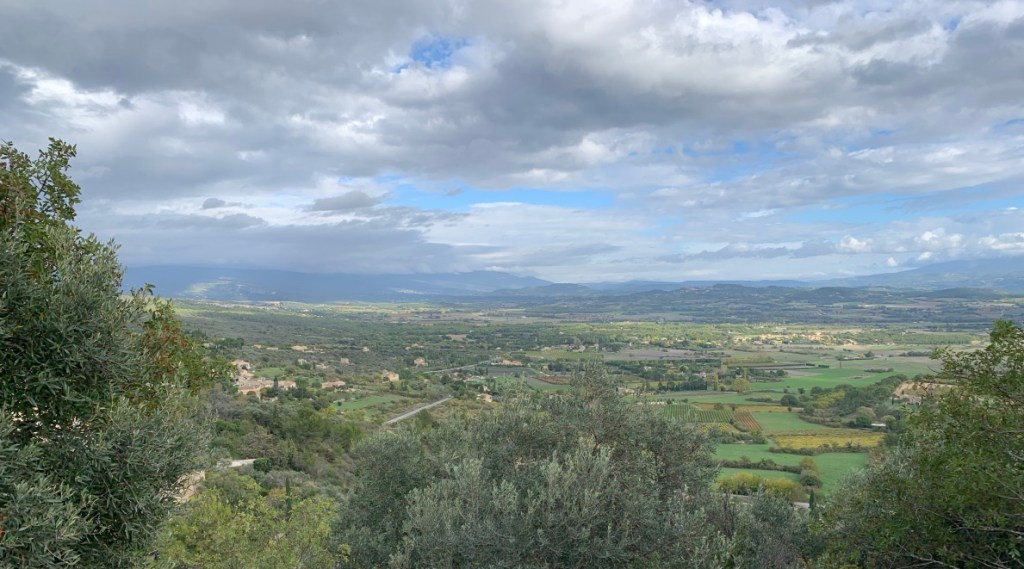
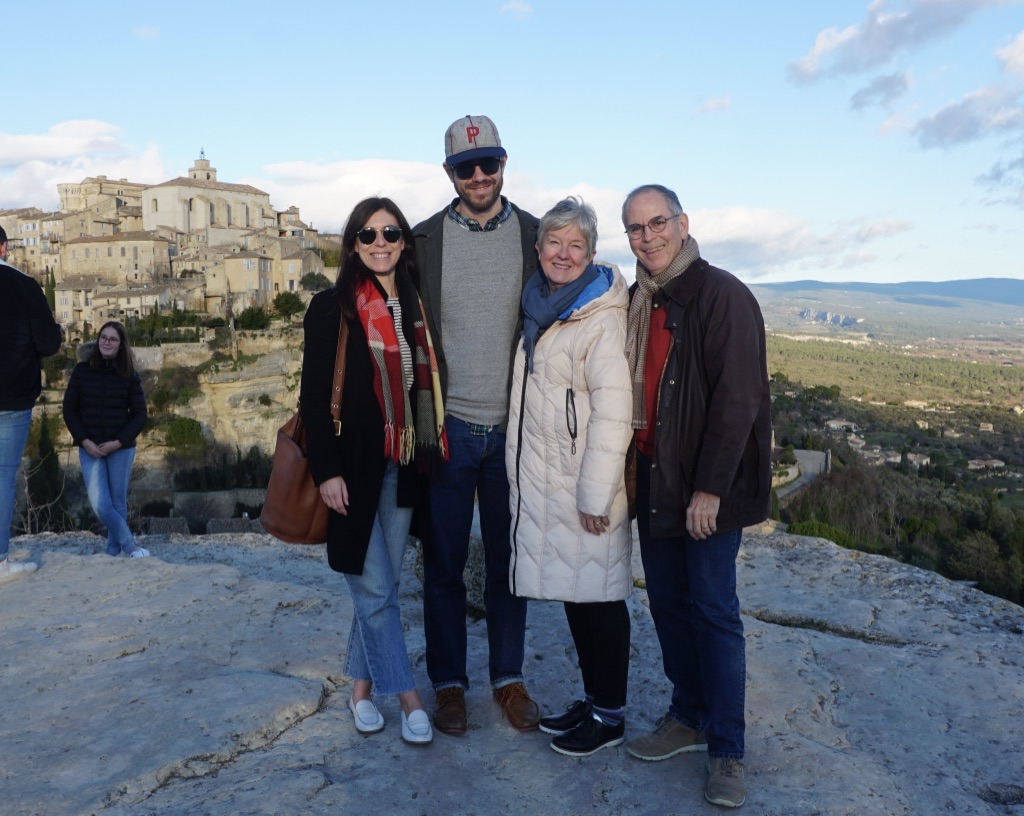
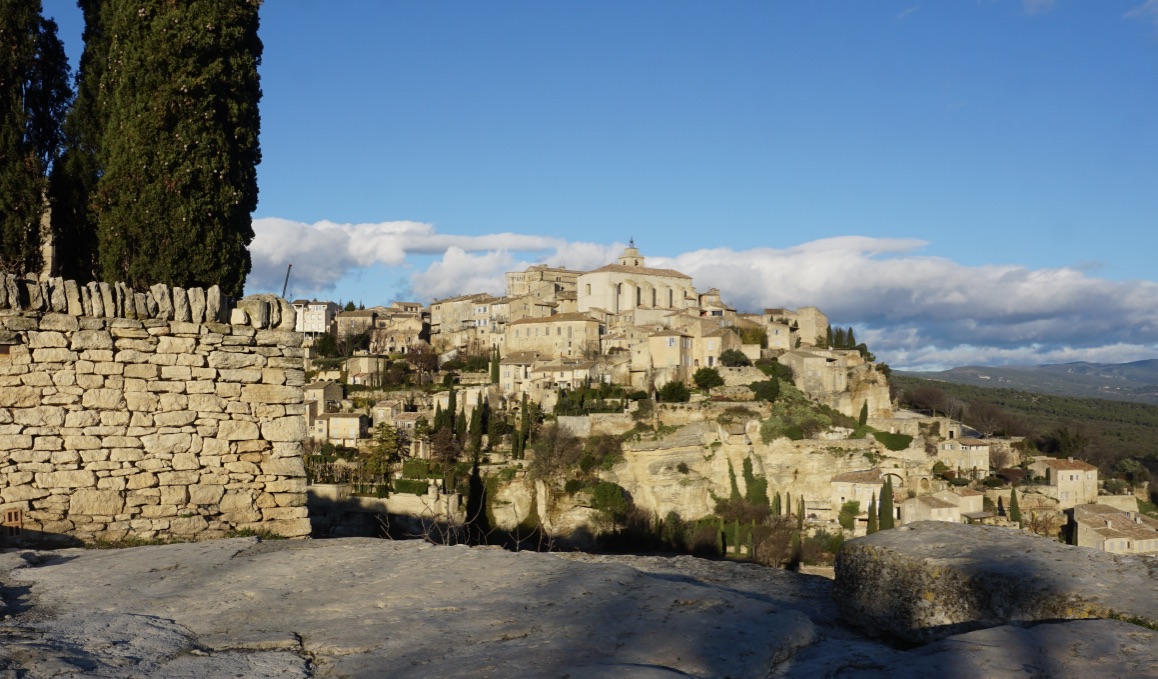
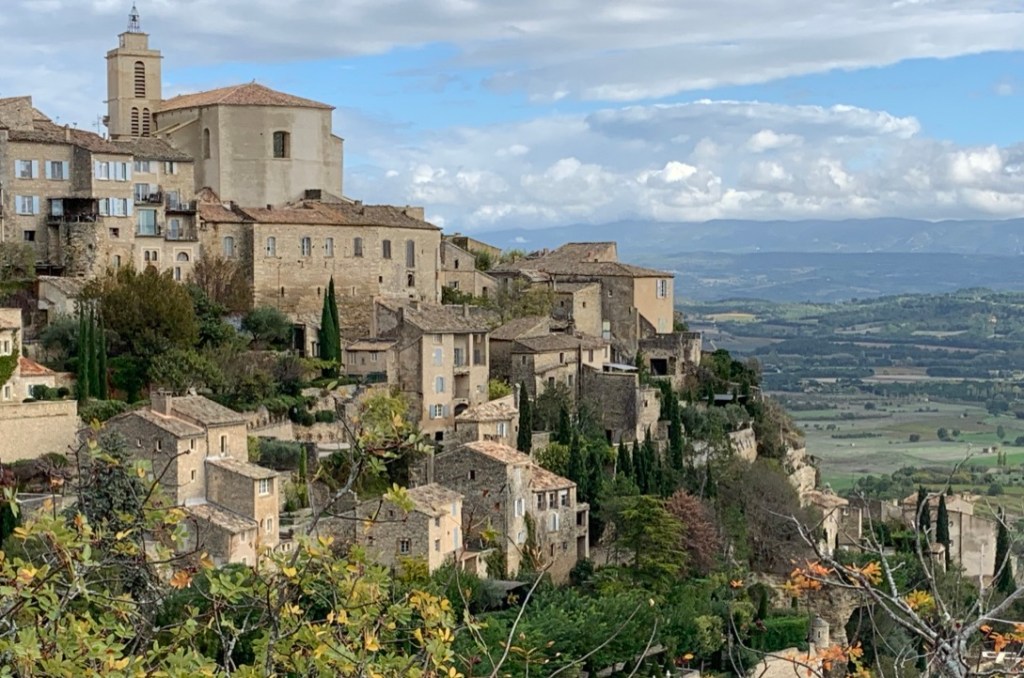
A view of Gordes, overlooking the Luberon valley. This is absolutely the most common view of this little gem!

Living in St. Rémy de Provence for five months was a delight! We didn’t feel like tourists most of the time. We went to the gym, did the shopping, hung out with the neighbors…all normal things one does when one is a resident. No need to go see the tourist sites because we’re not tourists!

But every once in a while, it seemed important to explore our little corner of Provence, so here are some of the places we enjoyed during our sojourn

Gordes

Built on the foothills of the Monts of Vaucluse, facing the Luberon, Gordes is one of the most well-known villes perchées in the region, and one of the most beautiful in France. Its houses and buildings of white stone root themselves into the sharp cliff of the mountain, its labyrthinth of “calades” (narrow cobblestone streets) can leave one swooning. And the views over the Luberon valley as you wander thought the streets are breathtaking!

The origin of Gordes begins when the Celtic people of Vordenses built a defensive settlement on the rock where the village is now located, to defend Cavaillon. There is evidence that Gordes was part of the Roman occupation of this area. The Roman Road ran nearby going from Carpentras to Apt. And there are excavations of Roman era columns, amphorae and skeletons.

Gordes is well known as the site of two abbeys: The Abbey Saint-Chaffert, built in the 8th century on the ruins of a Roman temple, and the Romanesque Senanque Abbey built in 1148 by Cistercian monks from the Mazan Abbey in the Ardèche.

Another prominent feature of Gordes is the castle, visible across the canyon as you drive in. The castle was built in 1031 and reinforced and made into a castle of nobility (castrum nobile) in 1123. In 1525 the castle was partly rebuilt in the Renaissance style.

The main agricultural products of the area are – wait for it – wine grapes and olives! But tourism leads the way as the economic engine that supports the town – restaurants, hotels, B&B’s, gites – all available to keep the tourist comfortable. The two times we visited, in the fall and winter, the town was fairly subdued with only a few shops and restaurants open. That said, it was nice to wander the streets without a horde of other tourists crowding us! We enjoyed some meals, drank some local wine and delighted in being in a place that we had dreamed of visiting for years!

An interesting note about Gordes: It was the site of a very strong Nazi resistance movement. In 1948 the entire village was awarded the Croix de Guerre with Silver Star for being “one of the most active centres of German Resistance under Occupation”. After a German coastal patrol was attacked, the Germans retaliated by entering private homes and shooting villagers. Homes were bombed, blasted, burned and looted.They also burned down the building which housed the town’s records. Thirteen villagers were executed and twenty others fell under enemy fire. Five villagers were deported to prison camps. The resistance fighters who were executed are honored in the town cemetery as Les Martyrs de Gordes.

Aigues Mortes

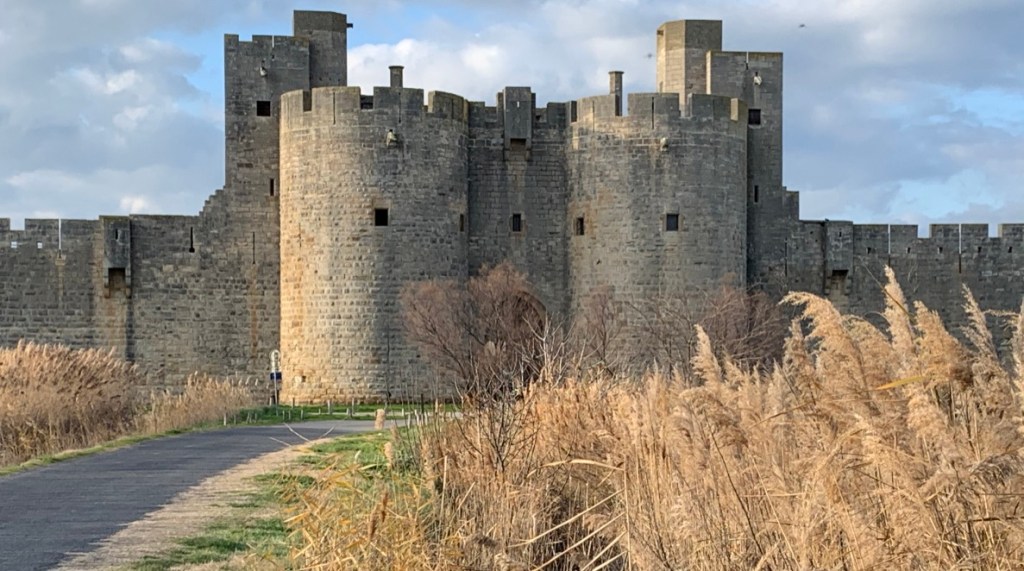
This lovely little walled village rises up from the salt marshes of the Camargue. It is located at the intersection of Canal du Rhône à Sète and Canal de Bourgidou.

Aigues-Mortes was conceived by King Louis IX in 1240, and the walls were finished by his son in 1302. It was built to give Louis and his armies access to the sea and a launching point to head out on the Crusades and conquer the Holy Land. Charlemagne, France’s great post Roman king, had erected a tower on the site in the 8th century to provide security to local fishermen. And monks had run salt-production operations in the area for centuries. But Louis is the true father of Aigues Mortes, as his little town became an important strategic point on the Mediterranean. King Louis departed on three crusades from Aigues Mortes, unfortunately dying in Tunis of dysentery before he could complete the third one. (Maybe not so unfortunate for those who were being crusaded against!)

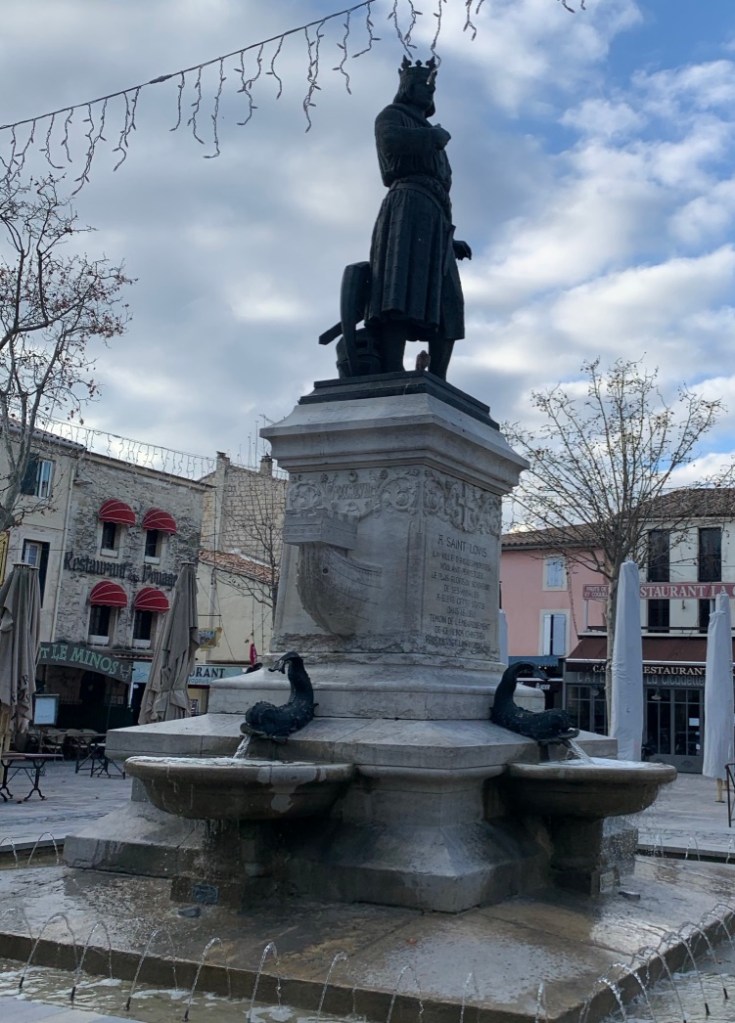
Left: The Tower of Constance. This powerful circular keep, some 131 feet high, was built from 1240 to 1249. Templars and rebels accused of treason were imprisoned here. Right: A four-dolphin fountain honoring King Louis IX.

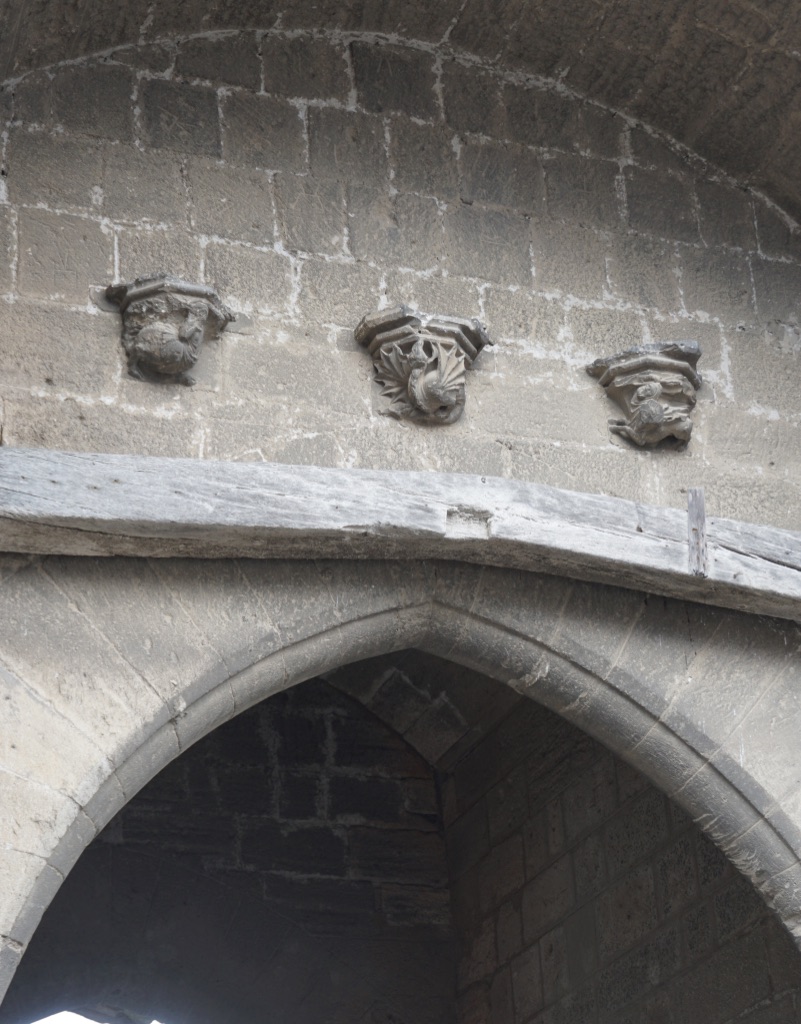
Aigues Mortes remains girded by its wall and ramparts. Although one is able to walk around the entire wall on the ramparts, LuLu was interdite and so we declined the opportunity and stayed grounded. We explored the gates and gargoyles and wandered around a largely deserted town. Of course, it was January!

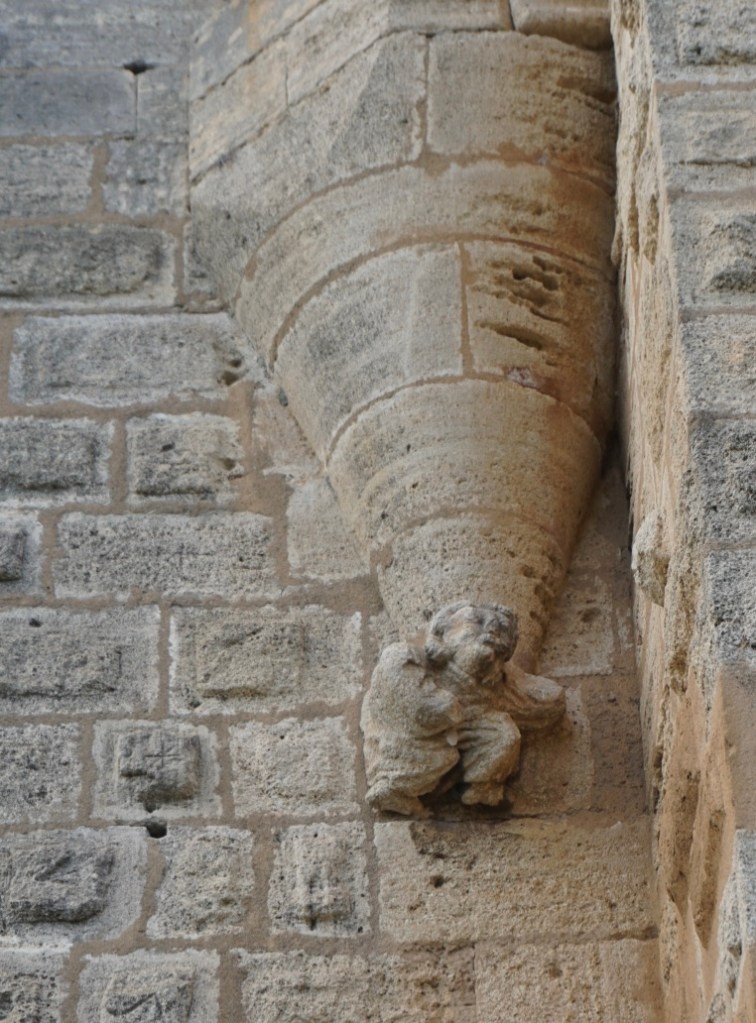
Gargoyles are more than decorative. The also serve as spouts to direct water away from the building.

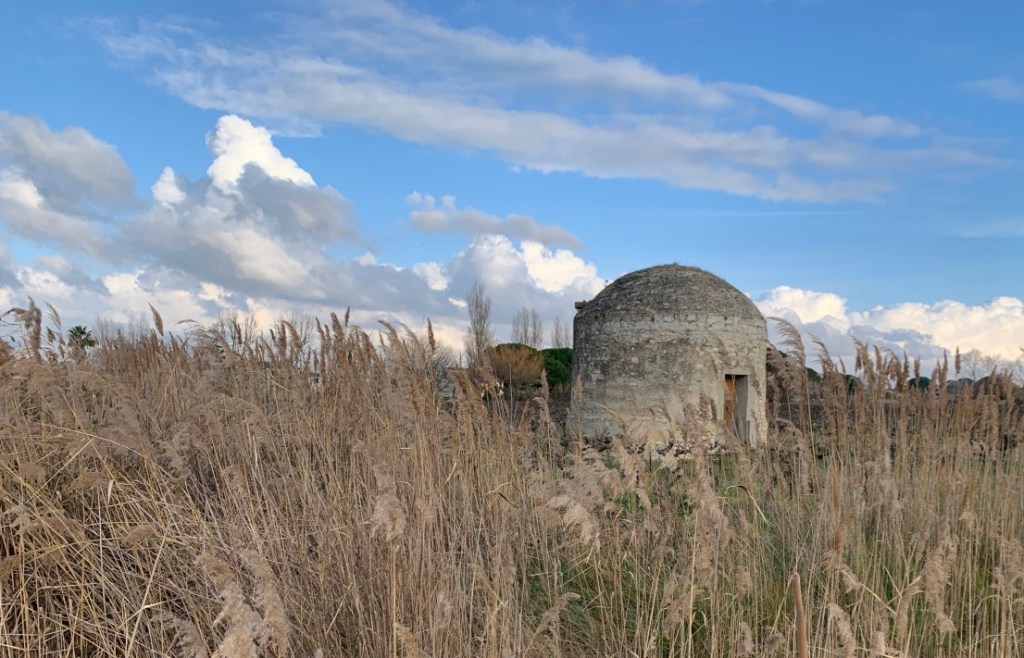
L to R: 1. Walking outside these walls their defensive capabilities are evident. 2. A small stone hut, known as a bourie. These were used for a variety of purposes including storage, stables, housing for shepherds and later small weekend get-away homes! 3. Another view of the Constance Tower from outside the walls.

L’Isle-sur-la-Sorgue

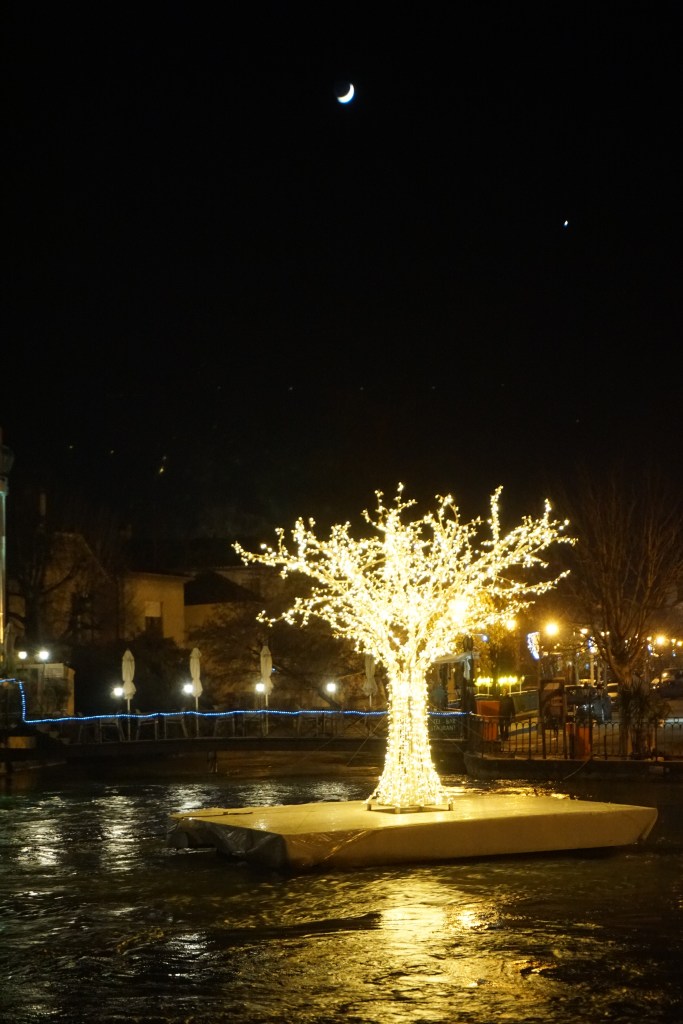
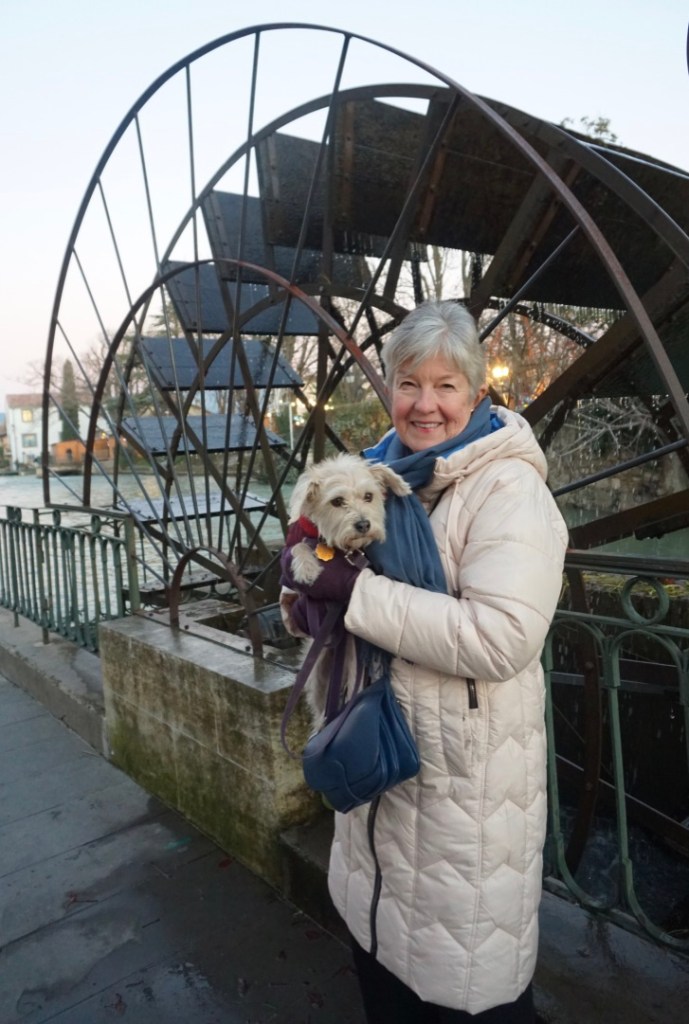
Floating on the Sorgue River, we loved this holiday tree! But the combination of the tree with the moon and Jupiter floating above was irresistible!

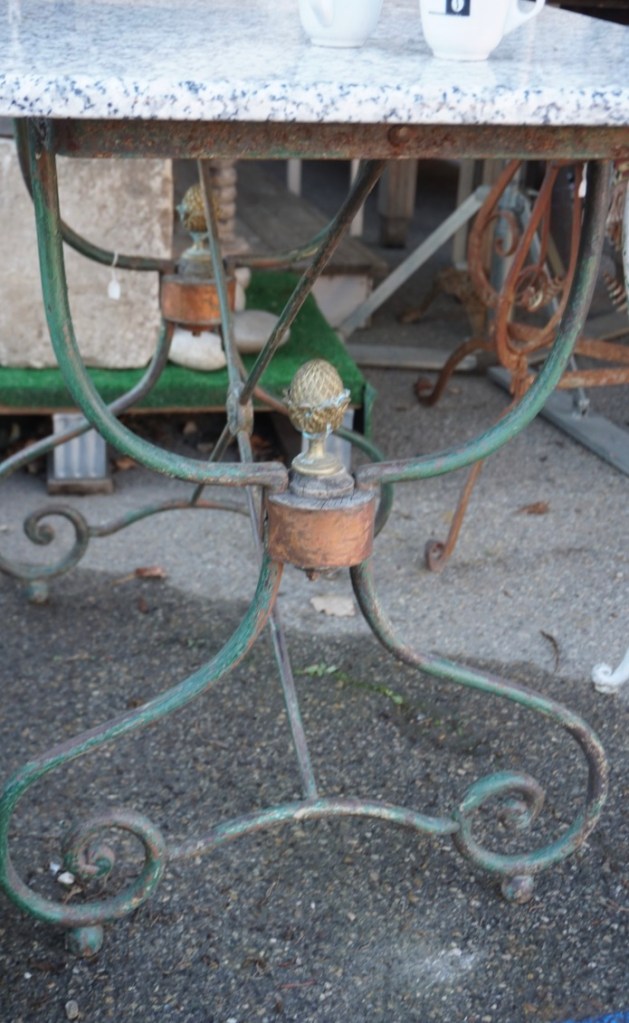
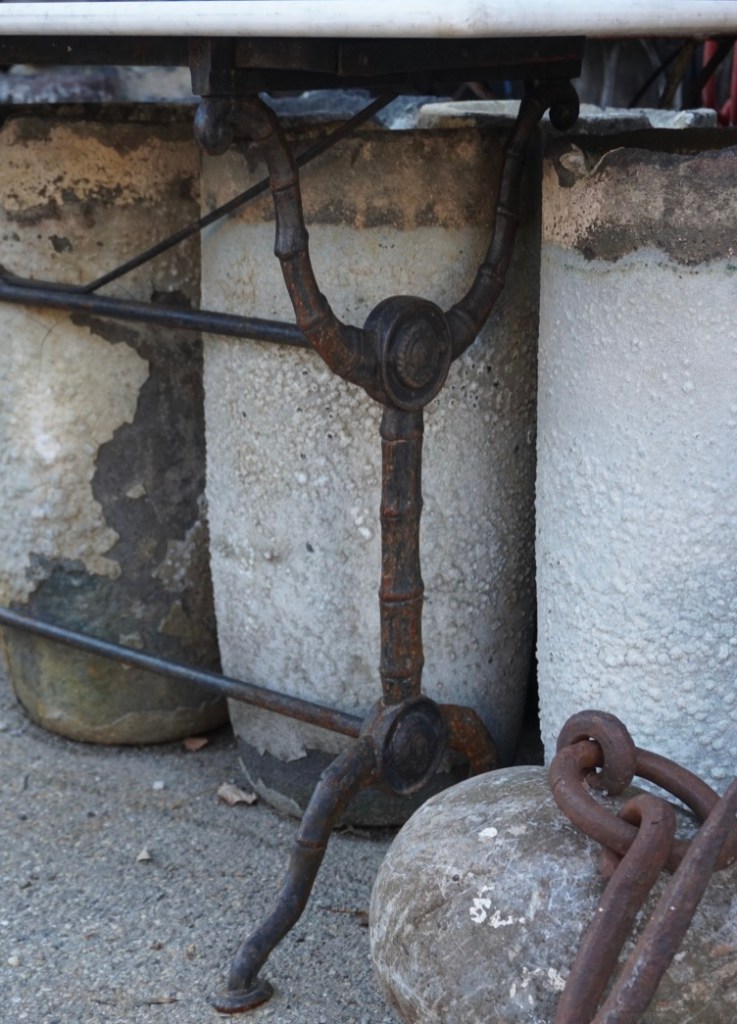
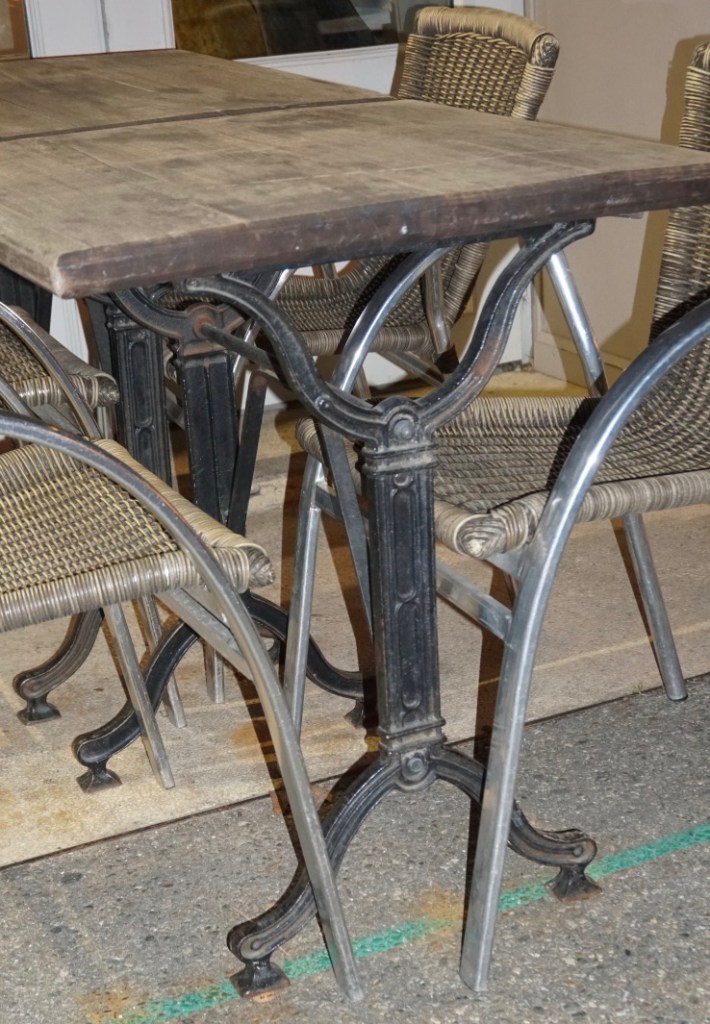
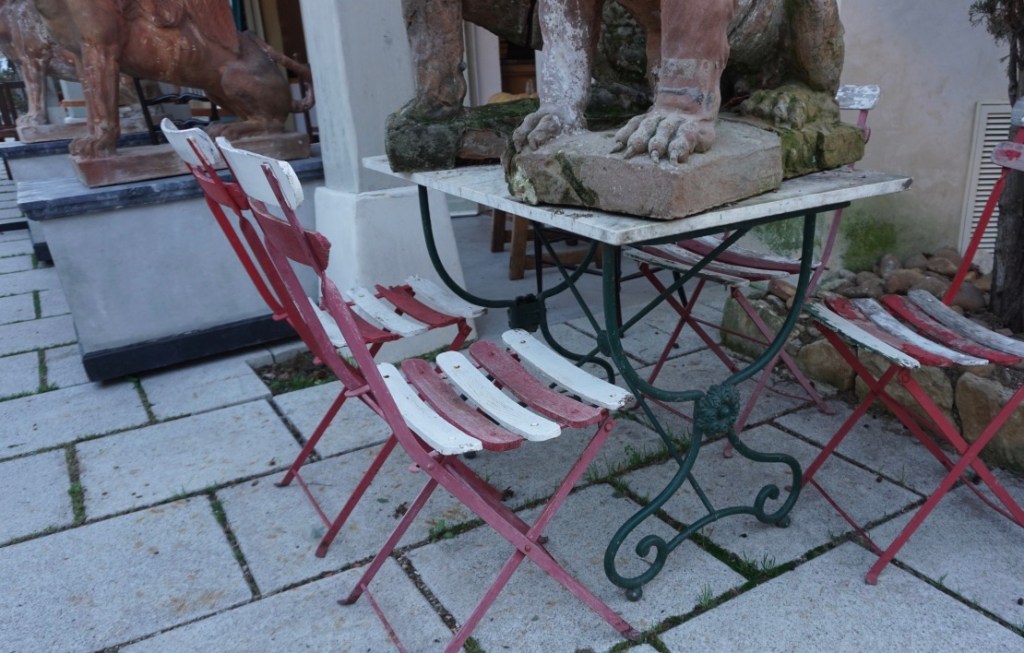
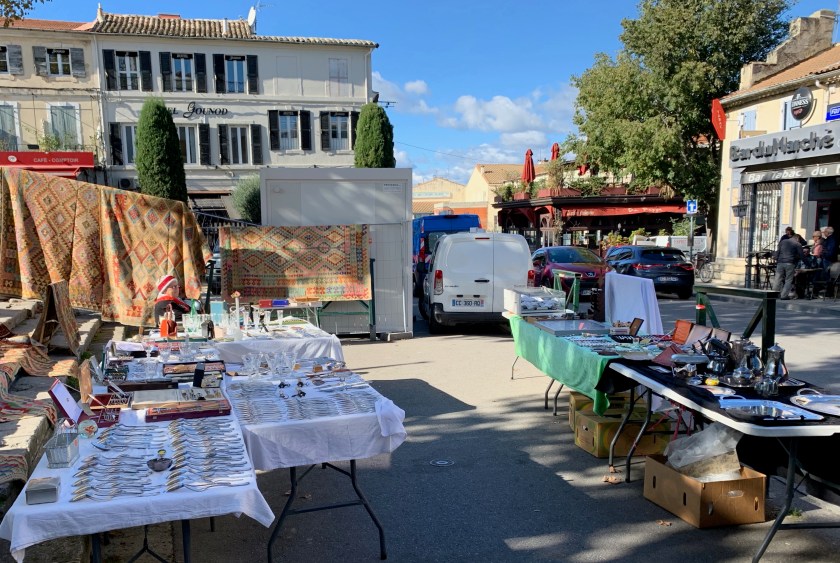
Patrick, the owner of Bar Tabac des Alpilles, one of our favorite restaurants in St. Rémy directed us to l’Isle-sur-la-Sorgue when we admired (and lusted after) his cast iron, marble topped bistro tables. He, of course, had gotten a deal on them from a friend, and could offer no other source. But, he said, if you go to l’Isle-sur-la-Sorgue on a Sunday, there is a huge brocante market! Brocante is one step down from antiquité. Not quite as polished, no guarantee of provenance, probably a little worn out and rusty. More second hand, if you will! Just what we were looking for!

So, off we rambled one cold Sunday after Christmas. And HUGE does not begin to describe what we found!

L’Isle-sur-la-Sorgue is a kind of an island city, surrounded by the river Sorgue. There are many little bridges to cross and mossy waterwheels decorating the ancient winding streets. Previous generations lived off the abundant crayfish in the river. The paper and silk industries made good use of the hydraulic power of the River Sorgue.

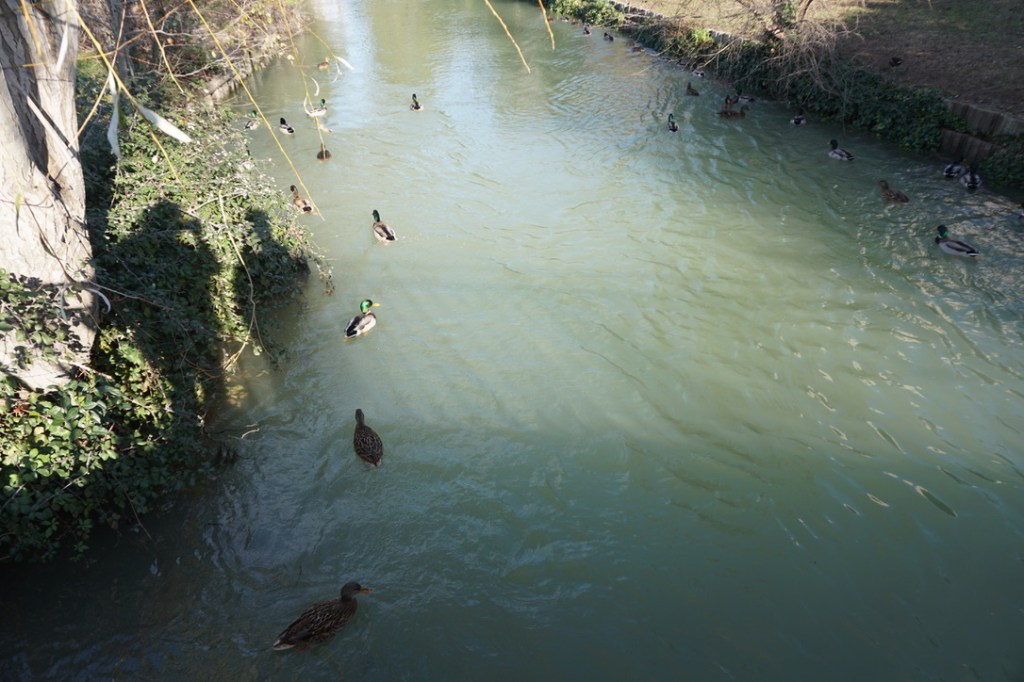
As close as we ever came to having our ducks in a row. Donna comforting LuLu after telling her we were going to ride the ferris wheel. A sculpture of three herons dancing in the turbulence.

Today, there are about 300 permanent antique and brocante shops in Sorgue itself. And the town hosts antiques’ fairs at Easter and over the August 15th holiday that have given a worldwide reputation to this small city. More than 500 antique and second hand dealers gather here to show their treasures to customers from all over the world. But in between these well known fairs, every Sunday brocante and antique dealers from all over the area show up with their wares and line the streets with tables and stalls.

We were mostly looking for bistro tables, although a few other items were purchased. After several hours of looking at table bases and researching the feasibility of cutting down a base to a coffee table height, we decided to let this idea go for a while. We found an outdoor café with a heater near the river, and had apéros before we toddled off home to St. Rémy. We will definitely go back there!

We’re Coming Home!

Big change of plans! After reading the State Department recommendations and consulting again with Benjamin, we have decided to return home. The idea of not knowing when we would be able to return within the next year to 18 months did not appeal.

So we are dealing with travel agents and airlines and anticipate being back in the US by next Thursday, March 26th, fingers crossed.

We will be screened upon arrival on US soil and a determination will be made about next steps. Assuming we are healthy, we will still have to self-quarantine for 14 days. And because our house is rented out, we have no idea where we will do that.

In any case, we are now looking forward to getting home and reducing the uncertainty we are dealing with at present.

Stay healthy, dear friends!

Sam, Donna & LuLu

March 20, 2020
Granville, France

Love in the Time of CoronaVirus

Self-isolating in Granville

When the COVID 19 crisis erupted in January, it was clear that our journey might be altered radically. We made the decision to continue to move forward until we couldn’t move forward any longer.

And so it was, after a week in England with friends, we arrived in Granville on March 12th – right on schedule! We had planned to spend a few days with our friends Armelle and Philippe before heading to Portugal and Spain and back to France for the end of our year. Those were the plans, although we knew at this point that moving forward was becoming unlikely.

We met Philippe and Armelle when we did a home exchange with them some 15 years ago. So we love Granville and are very familiar with this little town and its amenities! And we have had quite a few visits with the two of them in the years since. They met us in Paris for Donna’s Umptieth Birthday in 2008 (you do the math). We met in London when we went to the UK while Ben was studying in Dublin. They have stayed with us in Oakland at least twice while on US sojourns. Philippe and Armelle welcomed us warmly and let us know immediately that we were welcome to stay as long as necessary. And then the French lockdown was announced!

LuLu adores Philippe! Évidement!

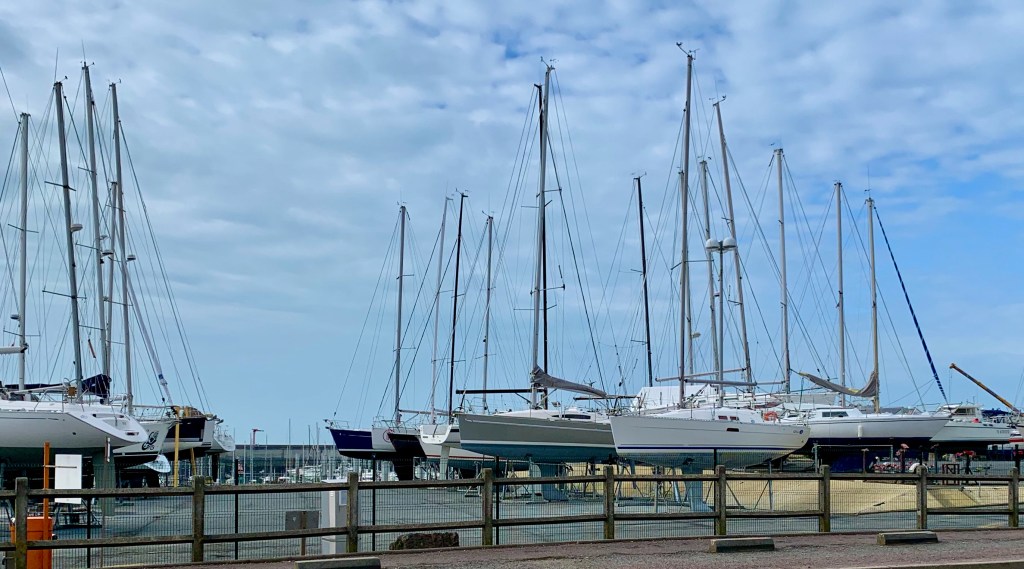
All shops, restaurants, bars and cafés are closed – if you can even imagine that being the case in France! Only groceries, boulangers, gas stations and tabacs are open. Our friend Théo in St. Rémy, is a plumber, but he can only work in “cas d’urgence “ – emergency situations. The banks are open, but Philippe and Armelle’s son-in-law, who is a banker, says that half his staff works from home one week and the other half goes in and they will flip the following week. Today they announced that pleasure boating will not be permitted! No sailing out of Granville for the moment! It’s dry dock season in the sailboat harbor so Philippe’s boat is out of the water and won’t go in until the lock-down is lifted! And, of course, to the great dismay of the French, no kissing! The typical 2, 3 or 4 kiss greeting is forbidden! Pas de bises! (And no-one ever heard of 1 bis here anyway.)

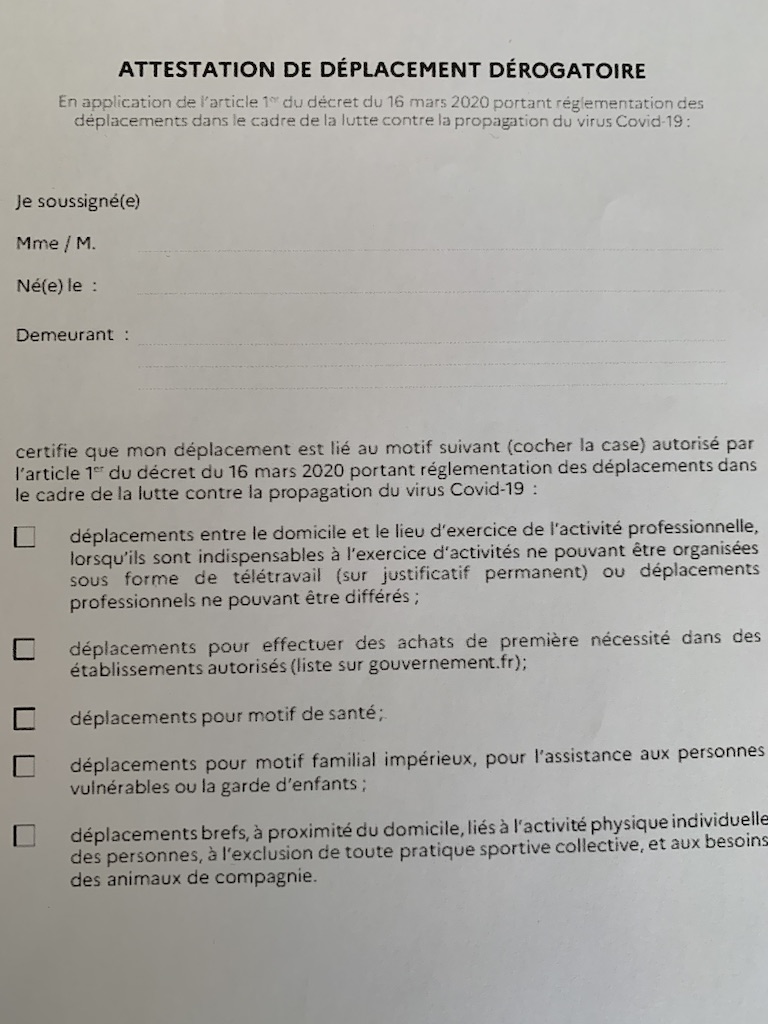
People who circulate must be able to justify their movement. Anyone in France can only leave their homes for certain so-called “essential” reasons: travel between home and work (if teleworking is not compulsory), purchases of first necessity (food, sanitary), travel for health reasons, travel to take care of family members or to assist vulnerable persons or care for children and/or brief travel outside for physical activity–alone–or care of pets. To leave your home for one of these reasons, you must have the French Attestation certificate, above, that specifies your identity, your place of residence and the reason for your trip. If you leave without the certificate, you risk being fined between 38€ and 135€!

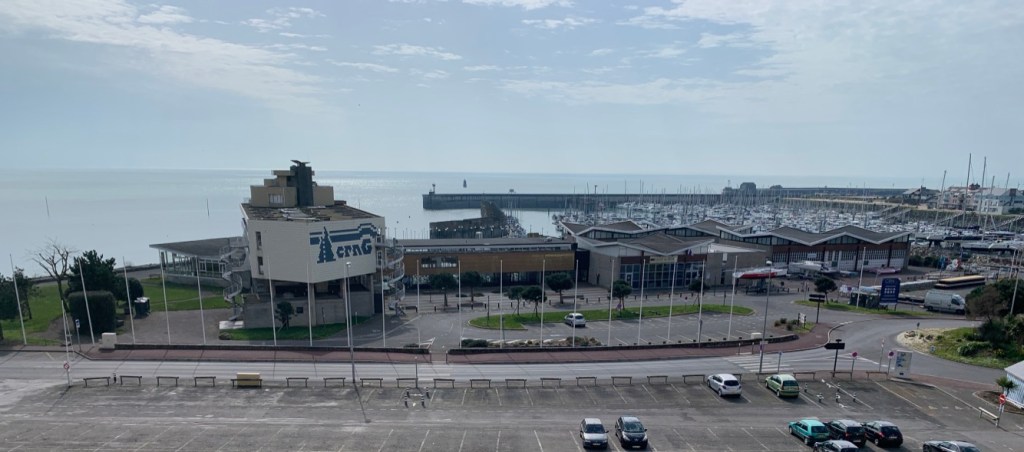
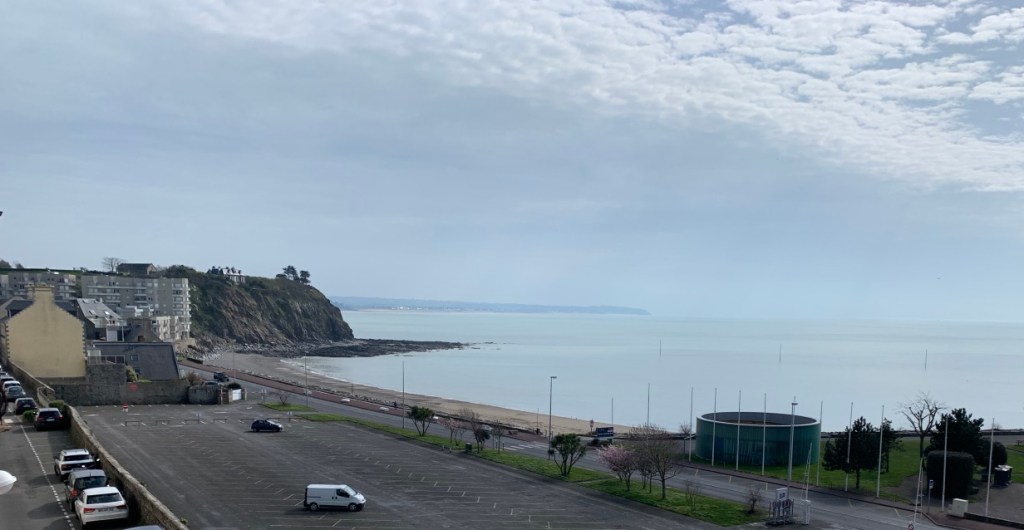
All that said, we are so happy to be in a comfortable and safe spot! Philippe and Armelle own a building overlooking the pleasure harbor in Granville. They live in the apartment on the top two floors and they have 2 rental units on the bottom two floors. We are in the one bedroom apartment on the rez de chausée – ground floor.

The view from Armelle and Philippe’s apartment, facing south, top, and southeast.

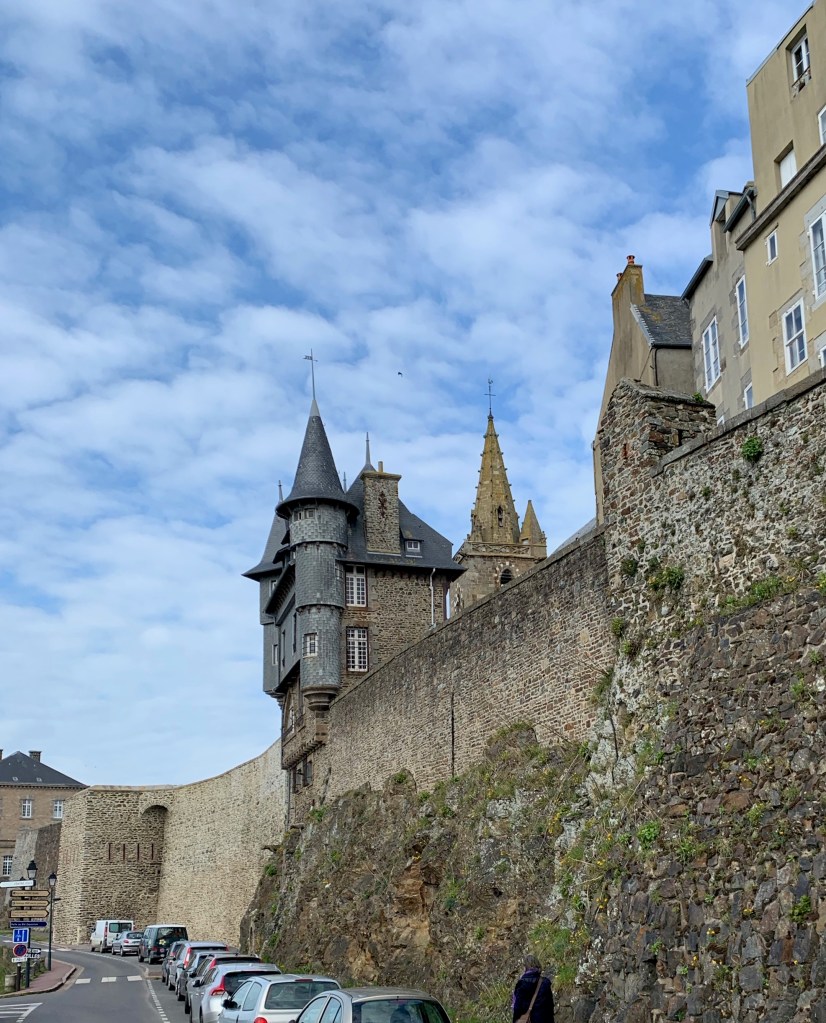
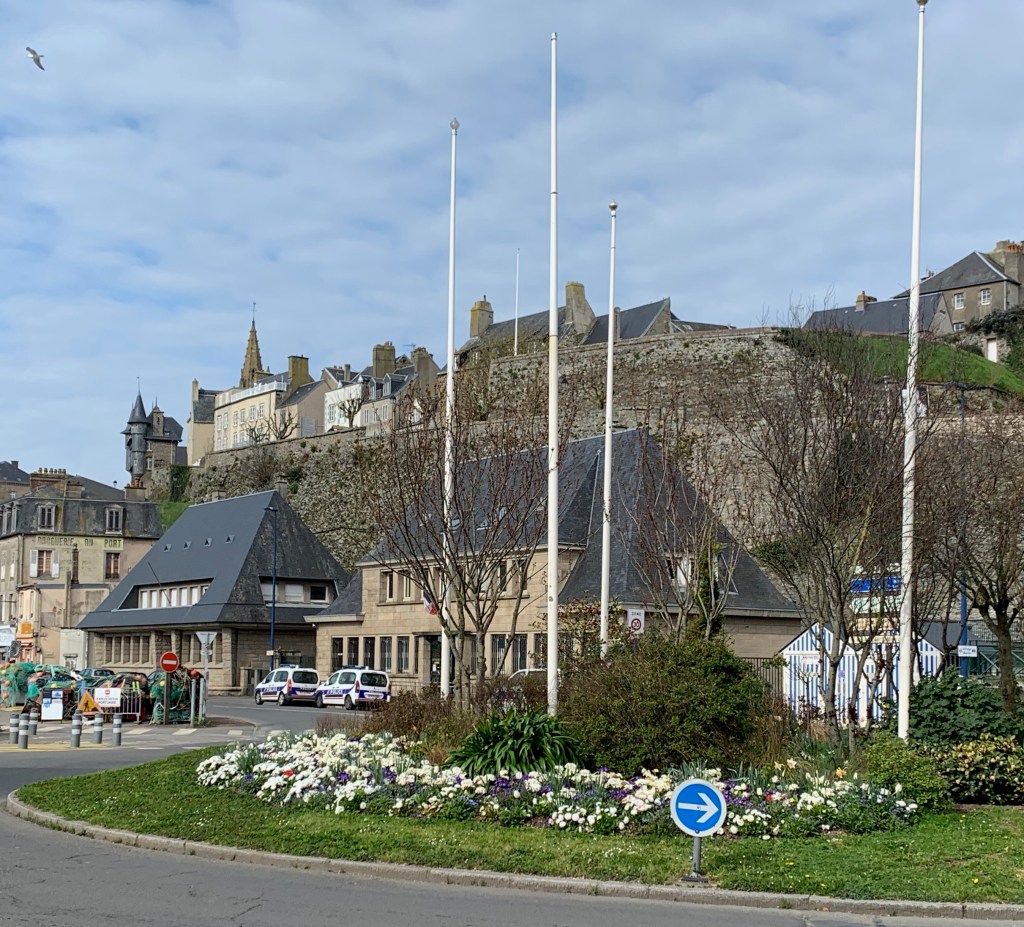
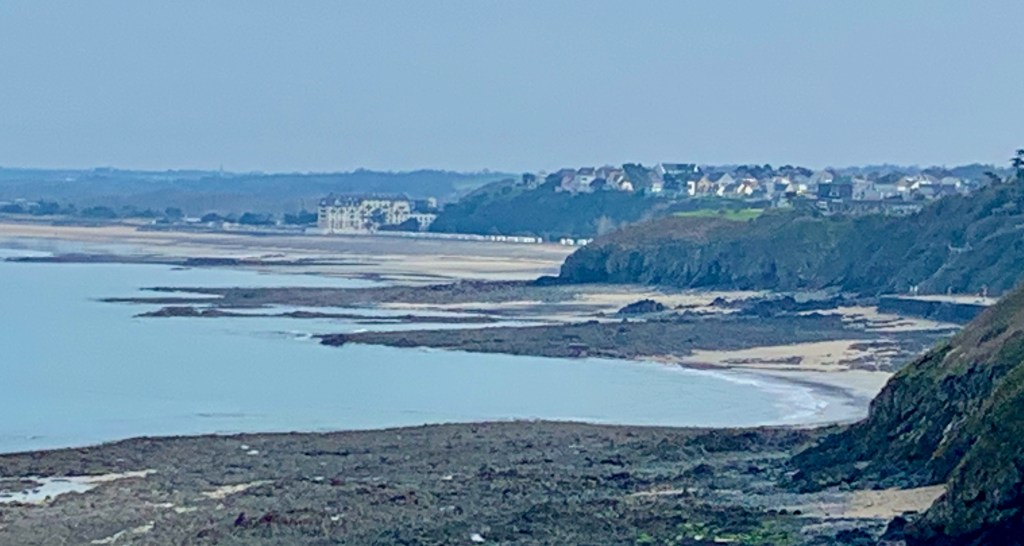
Granville is a lovely little town of 13,000 inhabitants. The primary industry is fishing with tourism coming in a close second. It was founded by a vassal of William the conqueror on land held by the Vikings in the 11th century. Situated on the edge of the English Channel at the top of the Bay of Mont St. Michel, it became a seaside resort in the 19th century, frequented by the elite of Europe and equipped with a casino, a golf course and a horse racing track. Christian Dior was born here in 1905 and his lovely home is now a small museum.

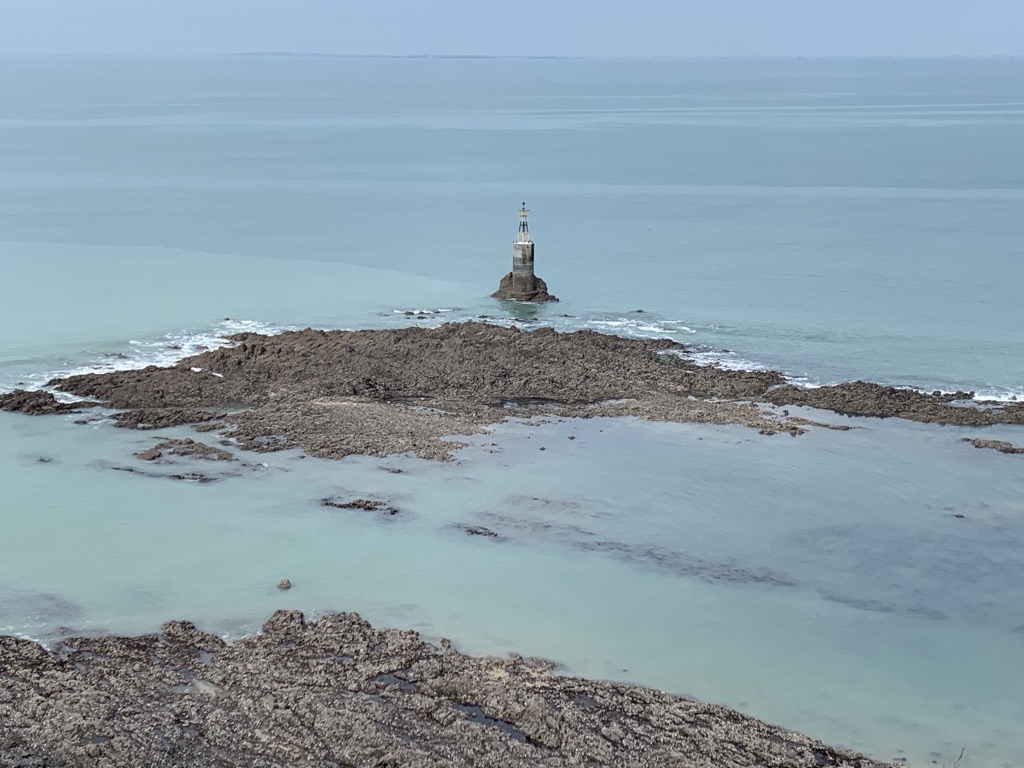
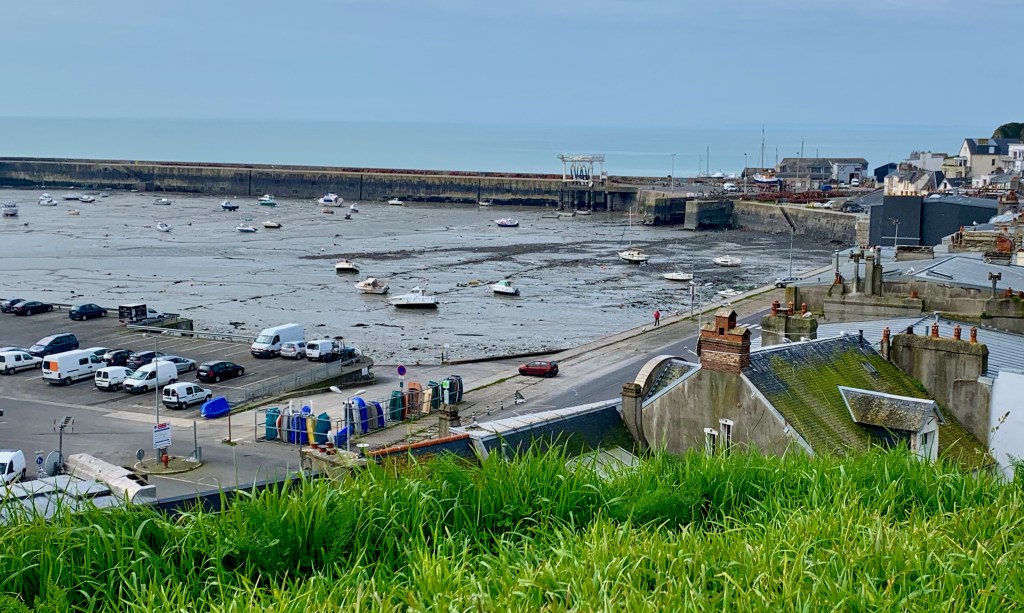
Clockwise from top left: 1. Dry dock season in the sailboat harbor. Philippe’s boat is out of the water and won’t go in until the lock- down is lifted! 2. 3. 4. 5. 6.

So, our days are beginning to develop a rhythm. At present we have lunch and dinner with our generous hosts. So far, Armelle has done most of the heavy lifting, as Donna spent 3 days in bed with a cold. But Donna is beginning to do some of the cooking and of course we always take an offering – flowers, wine, dessert. Philippe is an eager English speaker and Armelle understands quite a bit and often corrects his grammar. So Philippe and Donna go back and forth in English and French – translating for the partners – so everyone is in on the conversation! LuLu wanders from person to person, looking for a lap!

We can take our constitutionals each day, and getting out for some exercise in the sea air, as the weather warms a bit, is a delight! Grocery shopping always makes Donna happy, so she is content to “faire les courses” – do the shopping. No other shopping to be done other than leche-vitrines – literally “lick the windows” (window shopping)!

Plans are in the works to add posts about some of the lovely places we visited in Provence, as well as our amazing and exhausting month in Paris. We have good wi-fi here, so that’s a plus! Watch this space!

For now, we are thinking we will be here for at least a month, probably longer. At this point, nearly 10 months into the trip, we are missing our friends and family, but Benjamin keeps in touch and he is encouraging us to stay as well. We will be watching what happens in the US with the virus, but we certainly feel safe here. And going through two airports to get home seems like a dangerous risk at this point! Granville is a small town with a good hospital, so that’s a comfort. We may be the only tourists in town at present, so that’s an advantage also – fewer strangers coming in from more affected areas.

Let us know how YOU are doing in this crazy time! We are thinking of you all!

Gros bisous! (From a safe distance of course!)

Sam, Donna and LuLu

March 19, 2020

Clearing Up the Fusion about ITER

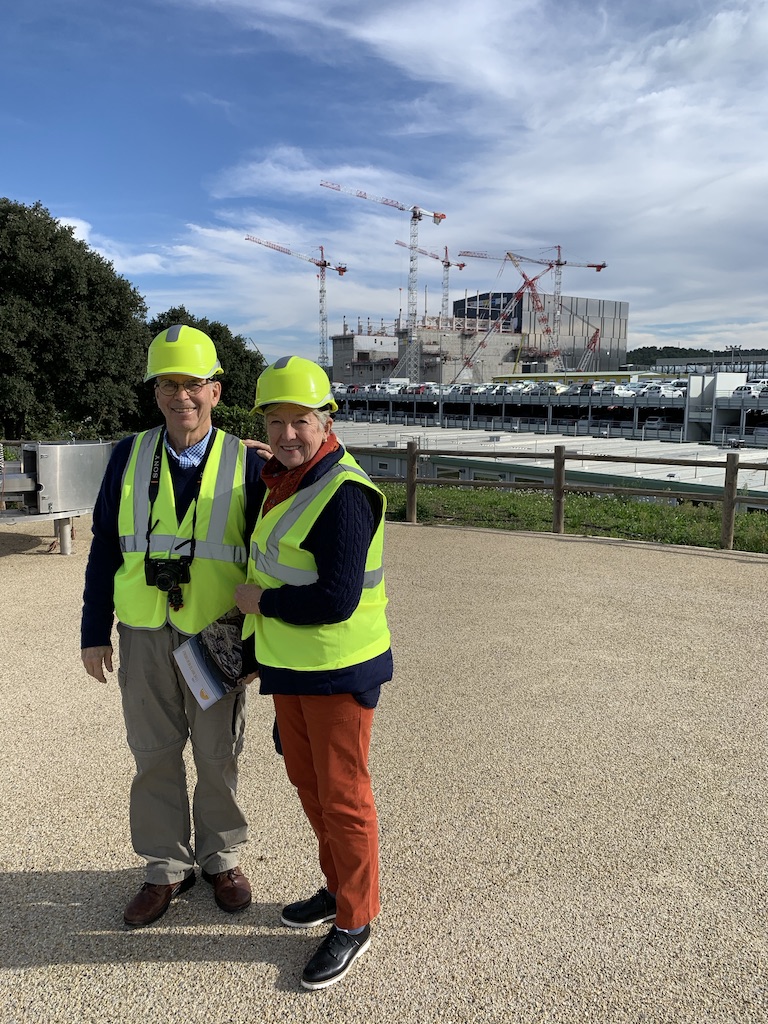
At the onset of planning this journey, we knew we wanted to stay in France for six months, including one month in Paris. When the idea of a five month stay in St Rémy de Provence was first floated, Sam was over the moon! Seems that St Rémy is a mere 90 minute drive from the ITER, an international project to create and harness fusion energy. His enthusiasm may have tipped the balance!

Fusion is a nuclear process. Local, independently-proven examples are Alpha Centauri, The North Star and, locally, our only energy source, the Sun. Do we need it, you ask? Here is a concise explanation, quoted from literature regarding a plant being built here in Provence, France.

Fusion is the process that occurs in the core of the Sun and stars. What we see and feel as warmth is the result of fusion reactions: Hydrogen nuclei collide, fuse into heavier helium atoms and release considerable amounts of energy in the process. Fusion is the source of life in the Universe.

http://www.iter.org

1. Current Project There are many machines around the world that are in the quest for creating and harnessing fusion. We happen to be one and a half hours from one existing one and one being built. They are the Cadarache and the ITER. “Iter” is a Latin word meaning, “the way,” and in this instance is also an acronym for International Thermonuclear Experimental Reactor. The machine within this facility where fusion will be studied and tested is a “tokamak.” In turn,“tokamak” is an acronym for “toroidal* chamber with magnetic coils” (originally in Russian). What will it do? The website (ITER.org) lists five principal goals. (NB, I do not know this material in any scientific sense, but paraphrasing helps me develop my understanding.)

  • The ITER machine will produce 500 megawatts (MW) of fusion power and be the first facility to yield more power than is used in the fusion process. The highest output of another reactor in 1997 was lower than the cost of input. ITER aims to have an output:input ratio of at least 10:1. However, as this one is an experimental unit, no power take-off will take place. The ITER complex is tied into the French power grid but only for the purpose of drawing power.
  • ITER’s size and scope are geared towards experimentation and testing various technologies that must be harnessed to work together: heating, control, diagnostics, cryogenics and remote maintenance.
  • The science says that the ideal mix of elements calls for deuterium and tritium in order to sustain longer periods of thermonuclear reaction–ie., fusion. The heat generated during the reaction will be captive within the plasma and that, in turn, will enable it to be sustained longer. Plasma is the fourth state of matter after solid, liquid and gas. The Sun has lots of it.
  • While deuterium is common, tritium is not. A goal is to harvest tritium during the operation of the tokamak to provide for part of future “fuel.” Manufacturing tritium will be a critical element to feed fusion reactors of the future.
    Aside: Does the creation of tritium, enabling ever-more fusion, push up against the immutability of the second law of thermodynamics? Jus’ askin.’
  • One intention of the ITER plant is to demonstrate that fusion power has negligible environmental impacts. With safety designed into the machine and a process that does not and can not produce the hazards inherent in fission reactors, the facility has already been licensed to become a nuclear operator in France.
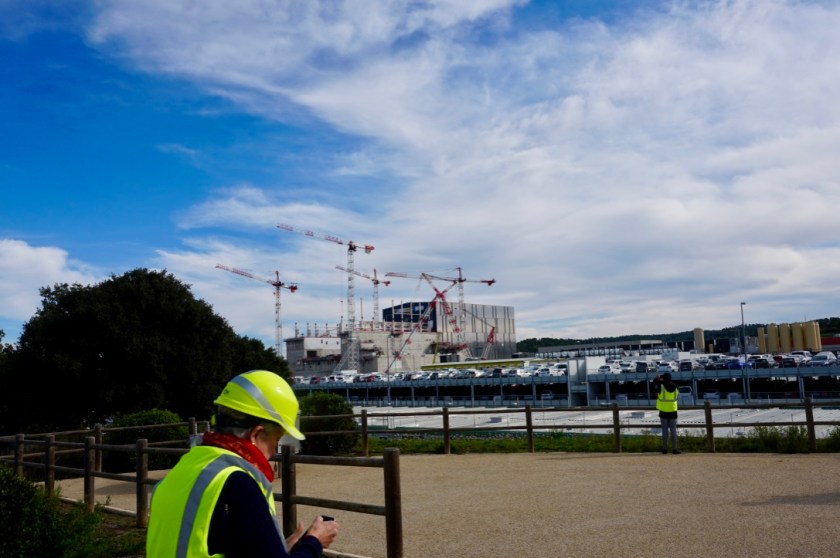
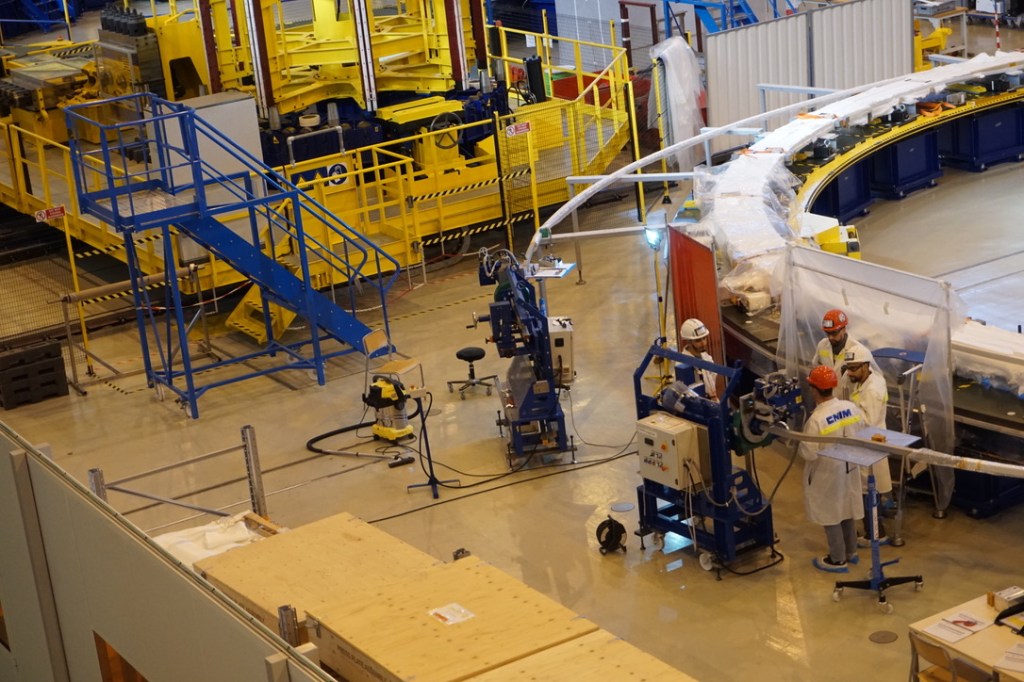
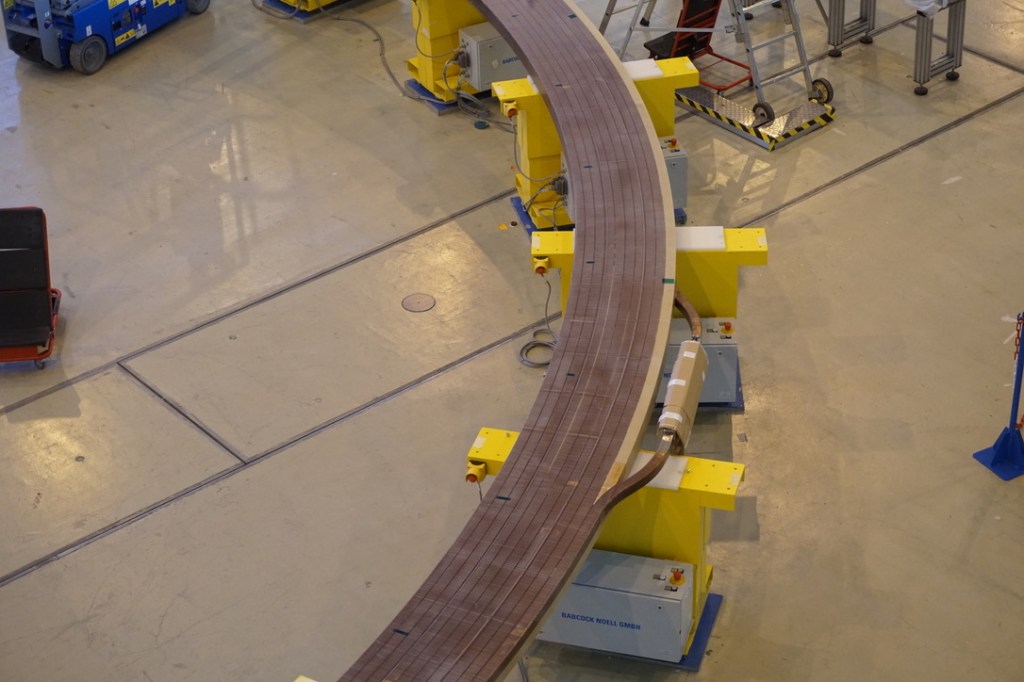
Tokamak and Assembly Hall, Annotated

Hydraulic crane on floor tracks will load the poloidal coils onto trucks at the right-hand end of the Winding Facility for a short ride to the tokamak. Très petite, non?

  1. The Next, Future Project. Projected for the near future is to step beyond experiment and build the prototype for energy-producing tokamaks. It will be one-third larger and fusion energy will produce electrical current by heating water and driving turbines. It will also be studied for any refinements in the design. As prototype it may be the final design for replication or it may undergo changes towards creating a “final” design.
  2. Crunch the physics. E=mc2, energy equals mass times the square of the speed of light. Because the speed of light is a very large number to start with and it gets squared, the amount of fusion fuel mass needed for a sustained reaction is tiny. A few grams of material is all that is employed. The energy released is the “e” side of the equation. The mass side of the equation is the “m” of the hydrogen neutron times the speed of light times the speed of light (i.e., c2). This speed is 186,282 miles per second (300,000 kilometers per second). I don’t understand the units of a squared speed, but the value of the number itself is very large, around 90,000,000,000, or ninety billion. Multiply this times the mass of the neutron freed in the fusion reaction and that’s the energy released. It is 4,000,000 times more than the corresponding energy we get from burning a fossil fuel. 
  3. Crunch the numbers. The efficiency is around 90%. In other words, the ratio of energy generated against energy expended is >10:1, expressed as Q>10. Or, the energy needed to power the tokamak operation including the giant magnets is 1/10th or less of the electricity generated.
  4. The Raison d’Etre (hey, we’re in France). As the worldwide economic growth model persists, energy demands are slated to triple by the end of the century. Urbanization in both developed and developing countries coupled with continued population growth will require sustainability both in abundance and being non-polluting. The ITER literature lists the following advantages that nuclear fusion generation has to offer.
  • Abundance.
  1. Fusion beats the chemical reaction of burning fossils by 4,000,000 to 1.
  2. Fusion beats fission-generation by 4 to 1.
  3. These efficiencies make it ideal for carrying the forthcoming vast, basic demands.
  • Sustainability.
  1. Deuterium is abundant and can be distilled from all forms of water.
  2. Tritium will be as an on-going by-product. Liberated neutrons can be made to interact with lithium to manufacture tritium. While the lithium component is not a renewable substance now the resource is sufficiently ample for a millennium. 
  3. No greenhouse gasses.
  4. Neither carbon dioxide not any other greenhouse gas is released during a fusion reaction.
  • No long-lived radioactive waste.
  1. Nuclear fusion reactors do not produce high-activity waste. Waste is not long-lived. 
  2. Nuclear waste from fission reactors has been a monumental problem facing fission-based plants, and is still largely unresolved.
  3. No proliferation.
  4. As fissile materials play no part, there is no threat of such material falling into the wrong hands.
  • No risk of melt-down
  1. During operation the plasma cloud reaches enormous temperatures, but as there is little mass involved, whenever there is any disturbance, the plasma cools in seconds and the reaction stops.

The ITER.org website is astonishing. It captures an astonishing project and very generously keeps you abreast of a technology that is likely to be a keystone in the portal to a sustainable future.

Who is building the ITER? Seven international entities are putting science, engineering, manufacturing, transportation and labor into the project. Six are sovereign nations and one is the European Union.

How did I first hear about it? An article in The New Yorker magazine, “A Star in a Bottle,” written by Raffi Khatchadourian, and published on March 3, 2014, three years after construction started and five years after the international agreement was inked. Beyond announcing ITER to The New Yorker reader, he gets into the weeds of the difficulty of design, engineering, cost control, worry about cost-cutting and the math. Some of the math differs from the current documents published by ITER. 

Editor’s note: This was written in St. Remy but published in Paris without modifying the relative geographical references.

*Toroidal refers to the configuration of the chamber where the nuclear fusion plasma comes into being. A donut is a toroid. The chamber is a void that corresponds to a missing donut, or put another way, the interior of a donut, might also be known as the dough. 

Christmas in Provence Part Deux

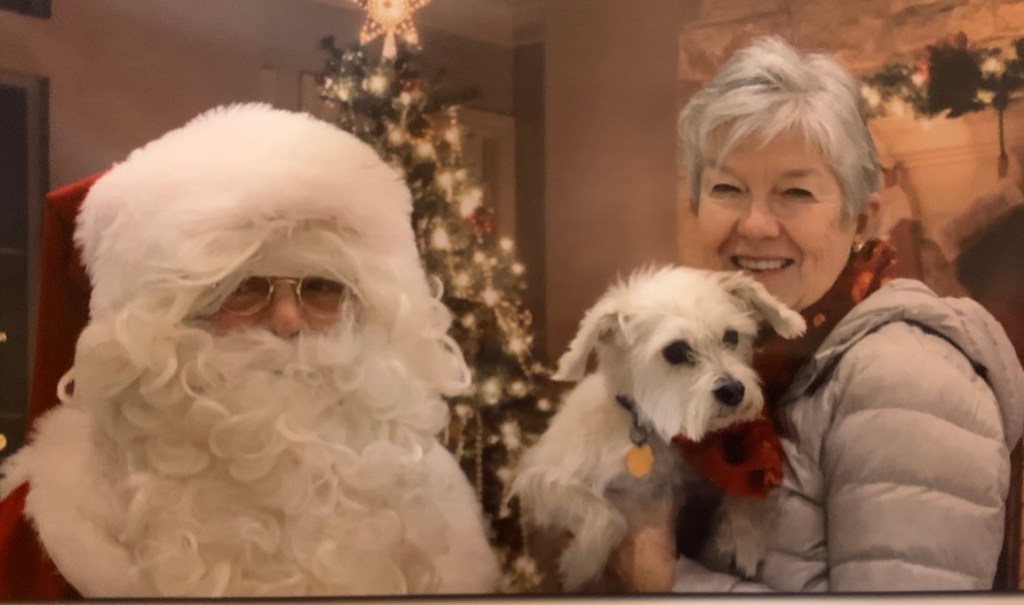
LuLu gets her visit with Père Noël.

Something we forgot to include in the last installment of this blog were some of the Provençal Christmas traditions we enjoyed. 

The Christmas season begins on December 4th, the day of Sainte Barbe. This is the beginning of the Calendale, which isn’t over until the Chandeleur on February 2nd. The tradition is to plant le Blé d’Esperance (the wheat of hope) on December 4th.  We found our seeds in the Librairie-Presse de St. Rémy. Not quite up on every detail, we planted only one bowl of seeds instead of the prescribed  three! The plants are to be placed in the family crèche – along with the santons. But, having no crèche, we placed our near the window.  The tradition states that if the seeds germinate and grow by December 25th, the harvest will be a good one! Happily, ours germinated nicely, so we are anticipating a harvest of many good memories! In the Provençale language it is said “Quand lou blad vèn bèn, tout vèn bèn”. When the wheat goes well, everything goes well. 

This Blé de Espérance is a bit peaked. But it grew nicely and we are expecting a good harvest!

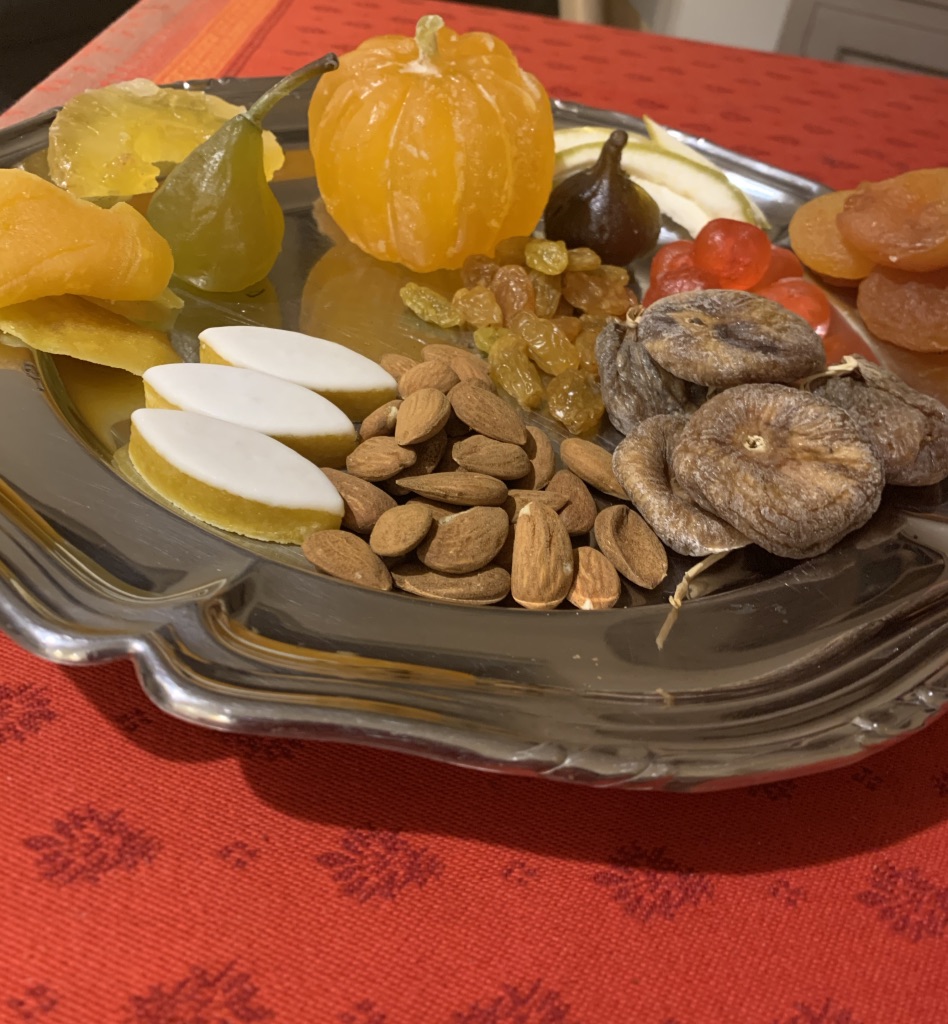
The other tradition we enjoyed was Les Treize Desserts, the thirteen desserts.  On December 24, Christmas Eve, the tradition is to celebrate with Le Gros Souper, which is paradoxically, a modest meal, followed by midnight mass. In different areas of Provence, there are different traditional dishes for this modest meal – celery, omelette, garlic soup, snails spinach or cauliflower. After mass Les Treize Desserts are enjoyed, the only sign of abundance on Christmas Eve. As you’ll see, we did not have a Gros Souper, but we did have the Treize Desserts!

The candied fruits shine like jewels and taste like jam! The pumpkin is an actual candied pumpkin!

We were excitedly awaiting Benjamin and Rachel’s arrival in St. Rémy on Dec. 23rd. They were flying in to Paris, spending a couple of days there, and then taking the TGV down to Avignon- 30 minutes from us! The first glitch occurred about a week before their departure. SNCF (Société Nationale de Chemin de Fer) notified us that the train from Paris to Avignon was cancelled due to the Grèves Nationales – nation-wide labor strike. They reserved a car and planned to drive down and take the train back. But, no!  A few days later, the other shoe dropped. The return train trip was cancelled! That meant they would lose 2 entire days of their six day visit with us. Everyone was disappointed.

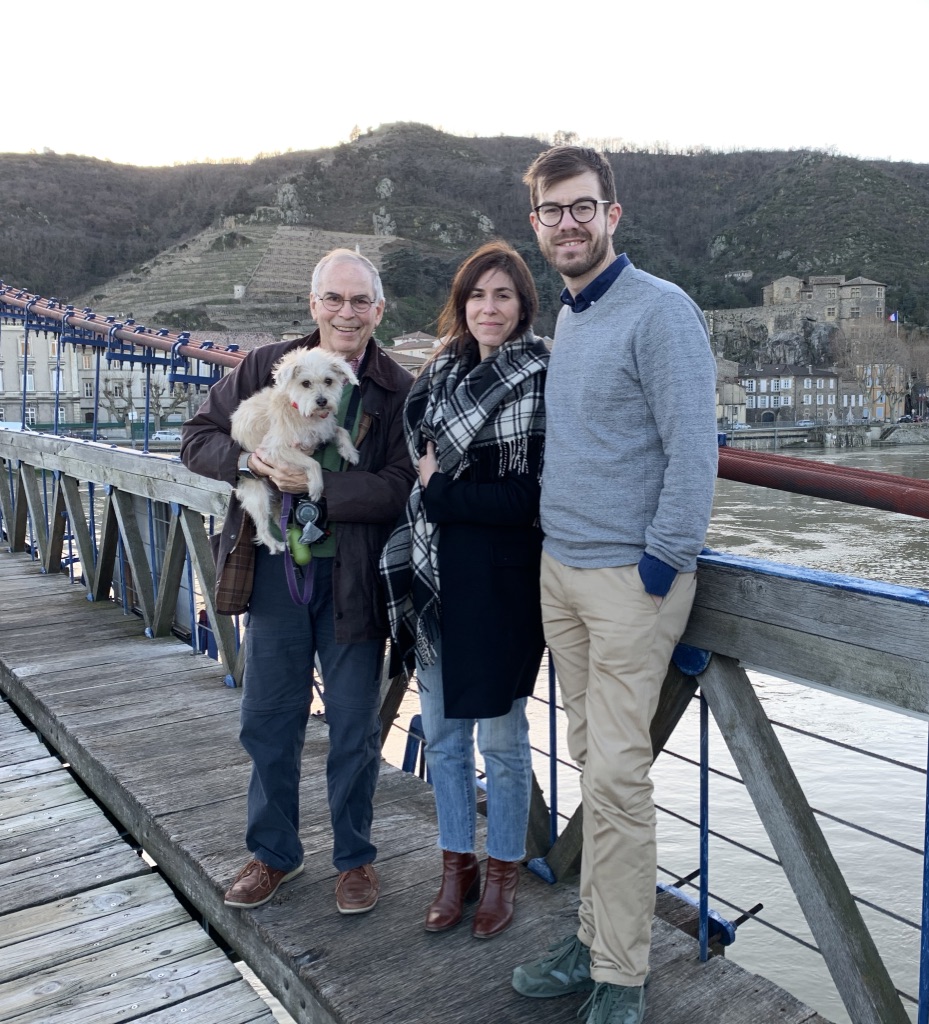
Then mid-day, Dec. 23rd, Ben called from the road and said they were planning to stop at Tain-l’Hermitage, a town renowned for its Côte du Rhone wines, about 90 minutes from us. Did we want to join them there? A hard yes! We were in the car and on our way in a flash! 

Tain-l’Hermitage is located on the left bank of the Rhone river, about an hour north of Avignon. It is a notable wine-producing commune. Red wines are produced from Syrah and the whites from Marsanne and/or Roussanne grapes. The economic engine of the town is powered by the wine production and tourism. As you drive into town, you are surrounded on all sides by terraced hillsides covered in grapevines. The sight of castles and forts, vineyards and the mighty Rhone is a stunning combination – even on a cloudy day!

The hills surrounding Tain-l”hermitage are all covered in terraced vineyards.

We convened with Ben & Rachel at Maison Chapoutier, the vendor of Chapoutier wines, an internationally recognized wine producer. We had hoped to visit the caves, but reservations were required, so we did our wine tasting at the shop and purchased a few bottles. 

Then on to St. Rémy for apéros, dinner and a walking tour of our little town. And home to get settled and prepare for Christmas Eve!

Chez Harrison, Christmas Eve is The Big Day. No Gros Souper for us! We usually host a group of friends and family for a big holiday feast. To keep the tradition, we planned a feast that was conceivable to prepare in our tiny kitchen – a foie gras for the first course (which we purchased at Bar Tabac des Alpilles, one of our favorite restaurants), a rack of lamb with Romano beans and sweet potatoes for the main course,  accompanied by some of Sam’s amazing rolls. For dessert, we  purchased a tarte aux poires – pear tart – from Patisserie Hache – oh yum!

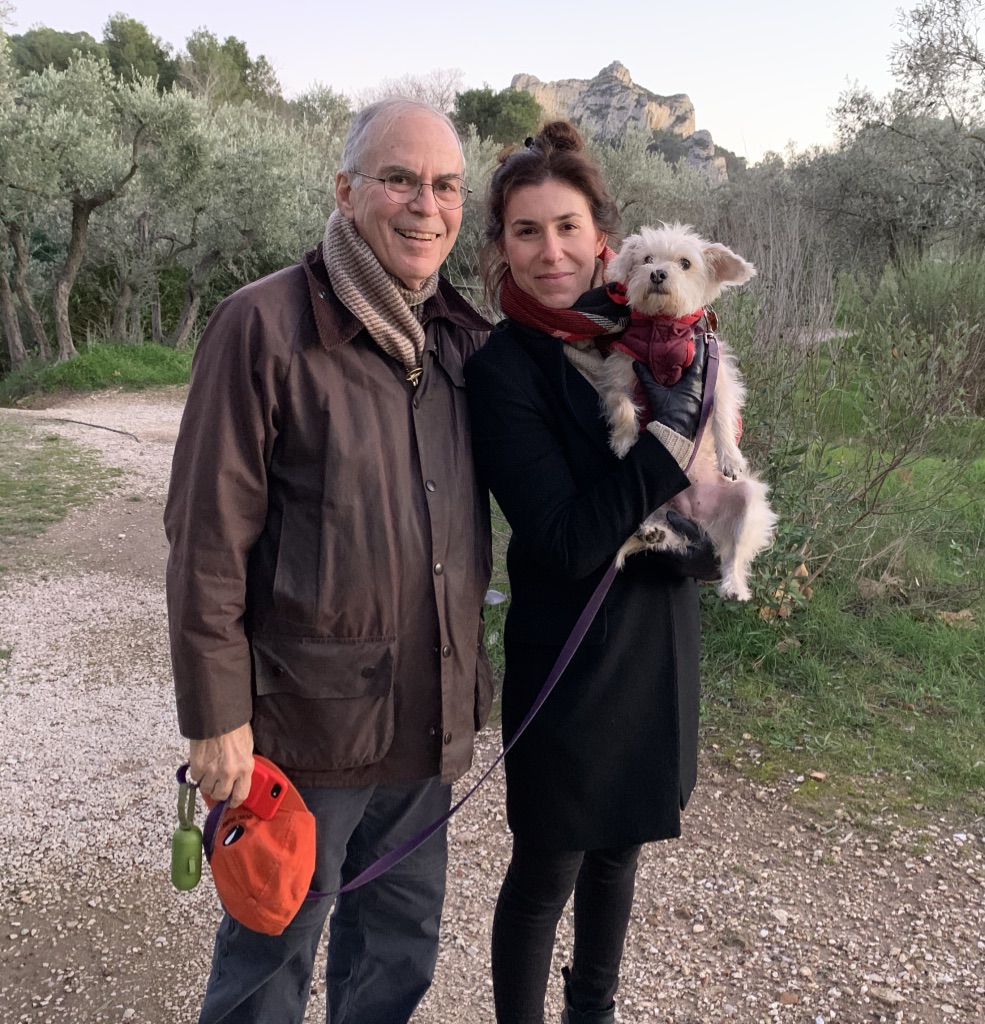
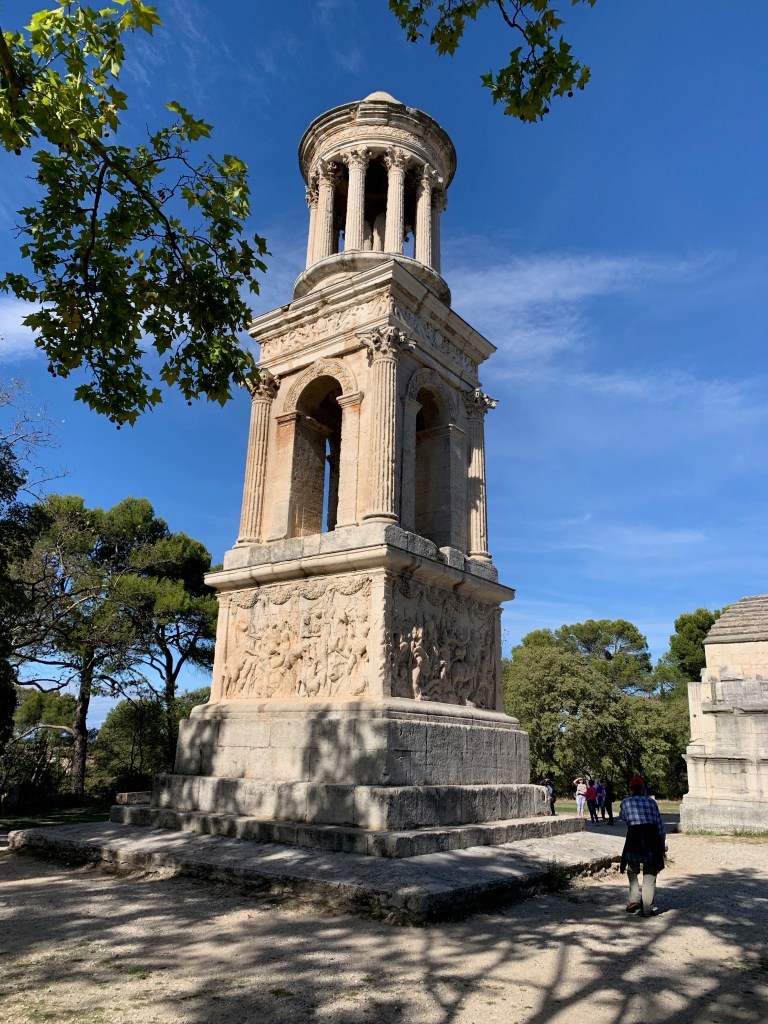
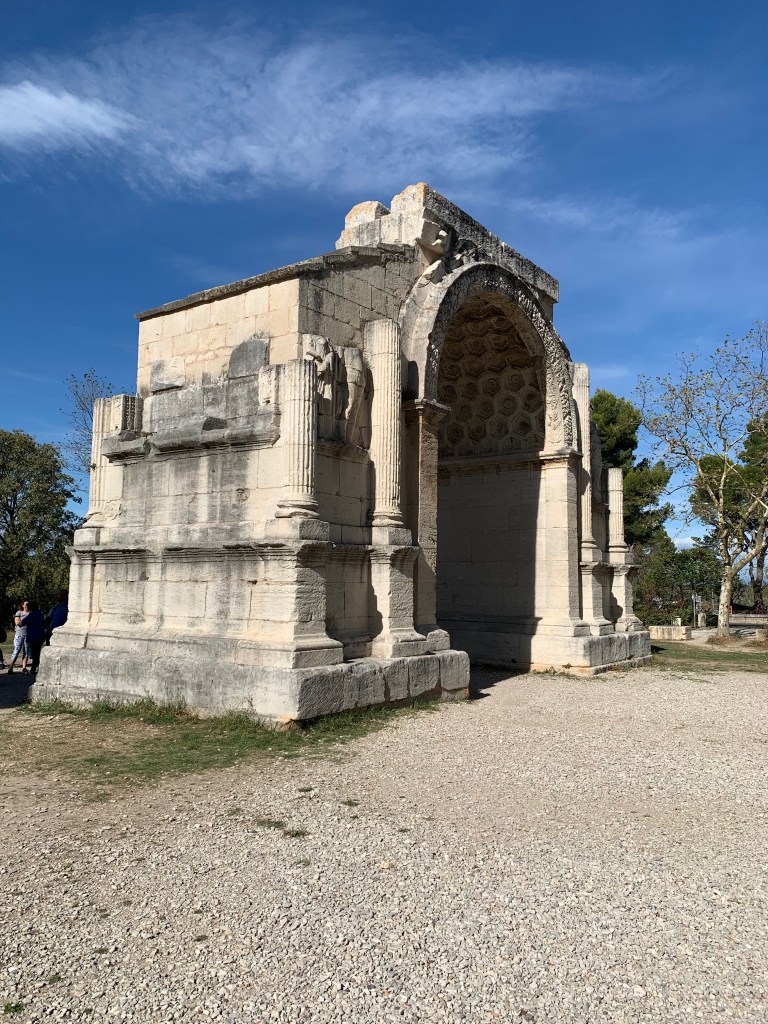
Alas, glitch number two: Just as dinner preparations commenced, Benjamin started feeling ill. He managed to do his part in preparing the rack of lamb. And he ate some dinner. But soon after that, he was laid out flat by a wicked stomach bug. It wasn’t a restful night for him and he was not feeling great when Christmas Day dawned. He managed to get up to open gifts, went back to bed while we ate breakfast and re-emerged for the stockings. But he was one sick puppy.  And sleep seemed to be what he needed. So Donna, Sam, LuLu and Rachel headed out for the traditional Christmas Day hike. We walked out through St. Rémy on Avenue Van Gogh to the Asylum St. Paul and the mausoleum and Triumphal arch of Glanum. It seems if one is going to get sick at Christmas here, Christmas Day is the day to do it. Nothing is open, there was nothing to do and nowhere to go. We were all nervously monitoring our stomachs, but Rachel, Donna and Sam seemed to escape any adverse events. We were all content to just relax!

Christmas Day hike! Sam, Rachel & LuLu on the Avenue van Gogh, near the Asylum St. Paul

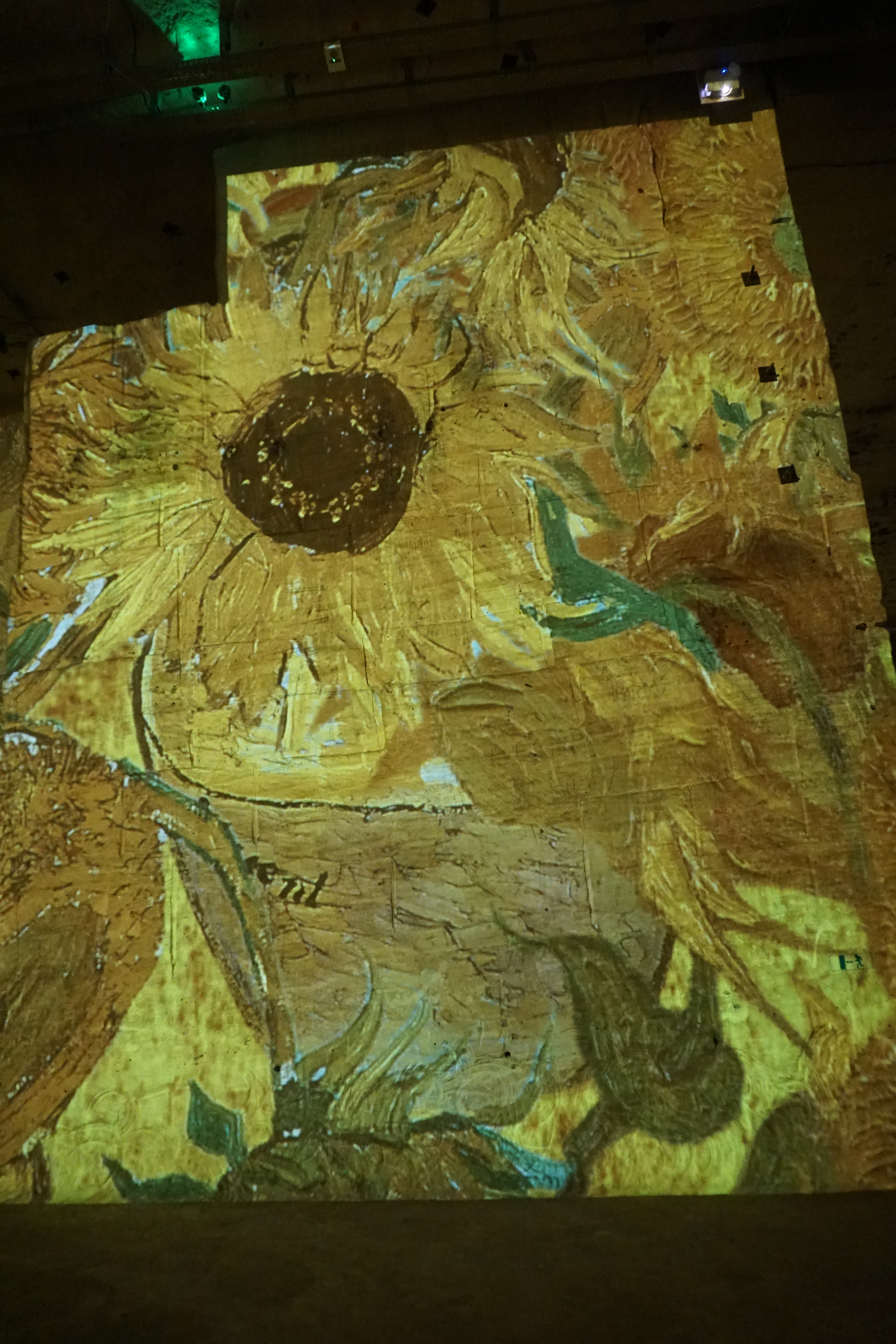
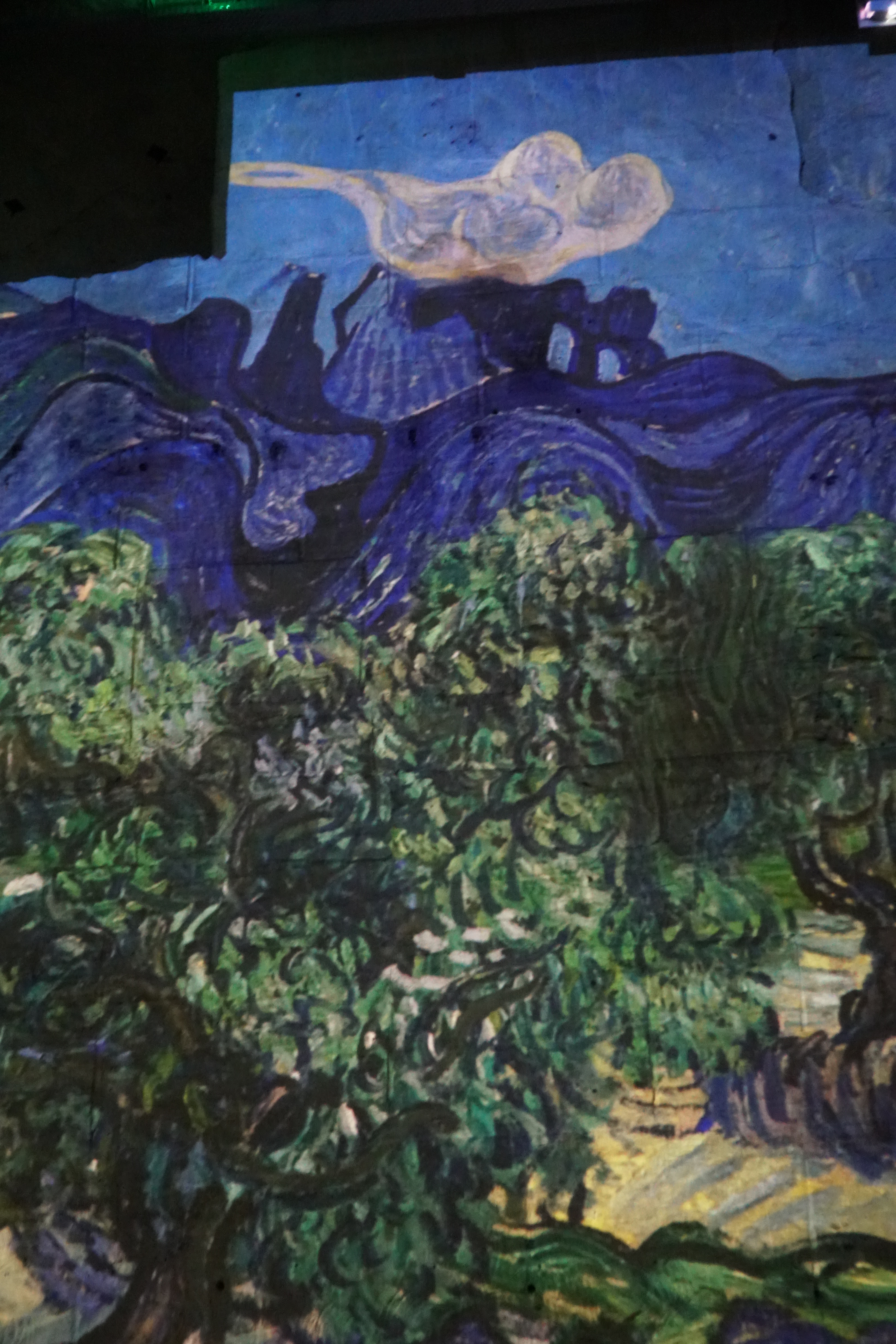
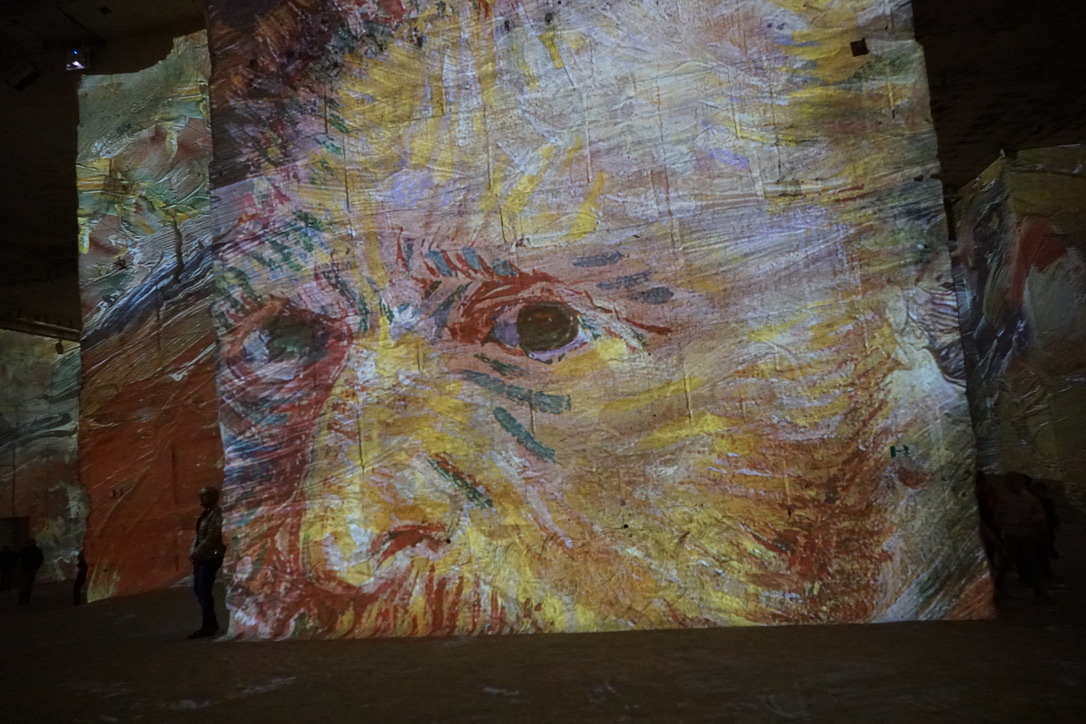
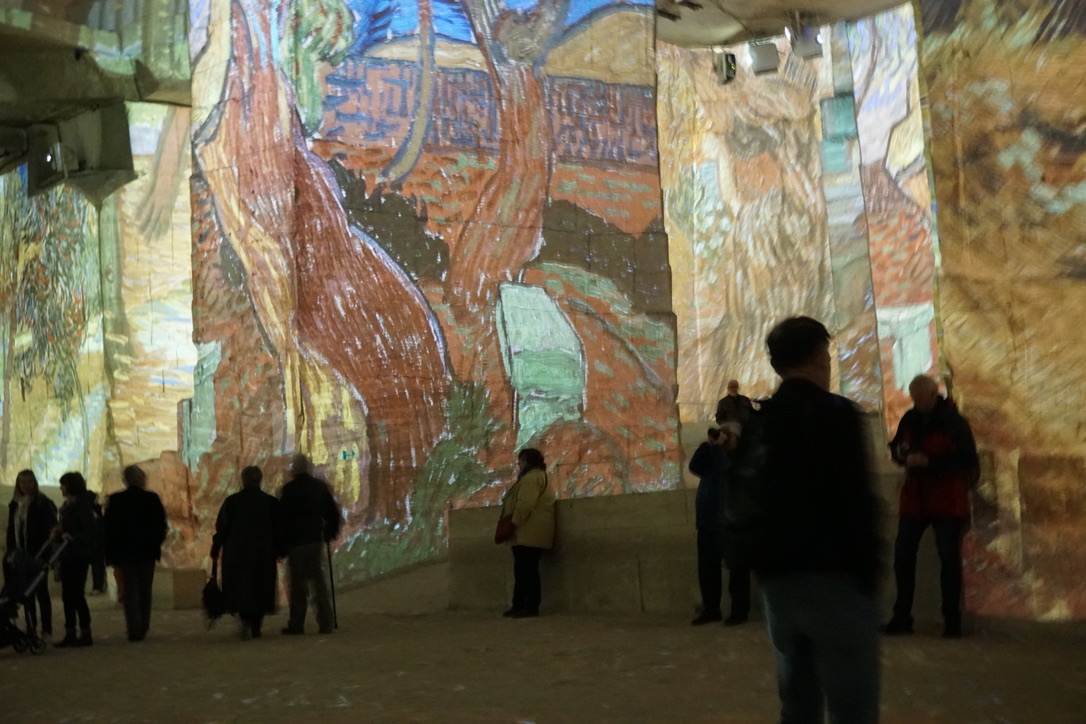
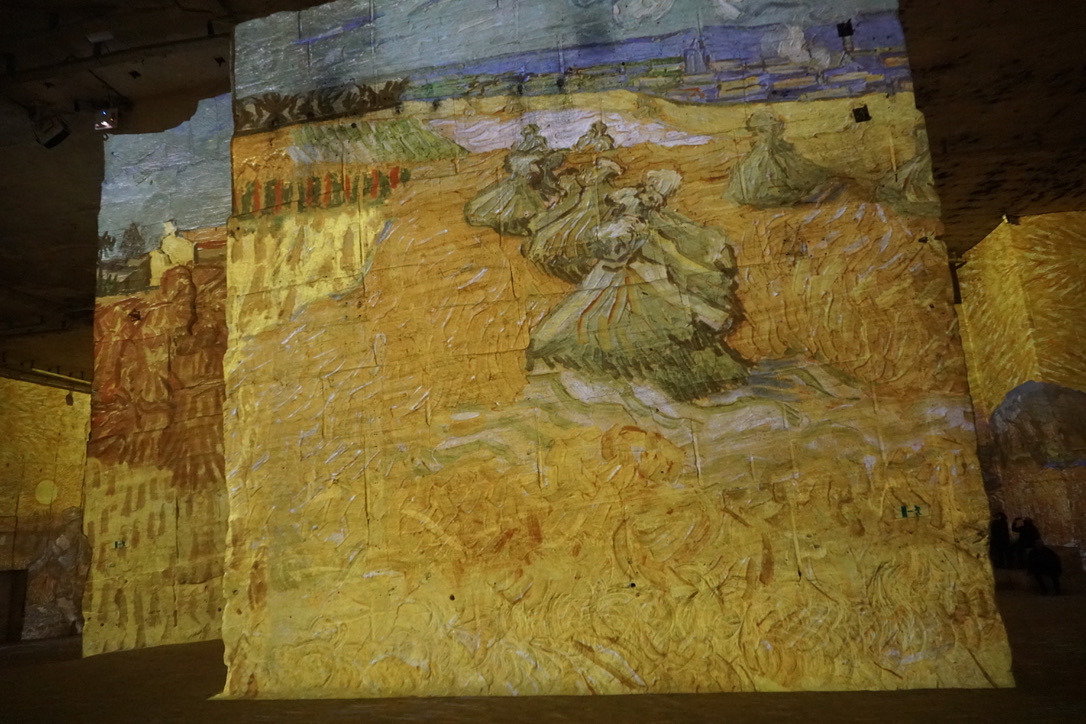
On the morning of the 26th, Ben was feeling pretty chipper. We had reservations that morning for the Van Gogh Starry Night exhibition at Les Baux. This is an exhibition of Van Gogh’s paintings projected on and moving across the walls of an abandoned quarry. The scale and accompanying music really takes  you out of yourself! We had been here previously with Sam’s cousin Rick and his wife Nancy, but the second experience was equally as breathtaking as the first

You can get a sense of the scale of this exhibition in the middle pic on the right. The music included everything from Janis Joplin to opera to blues. It is an absolutely stunning experience!

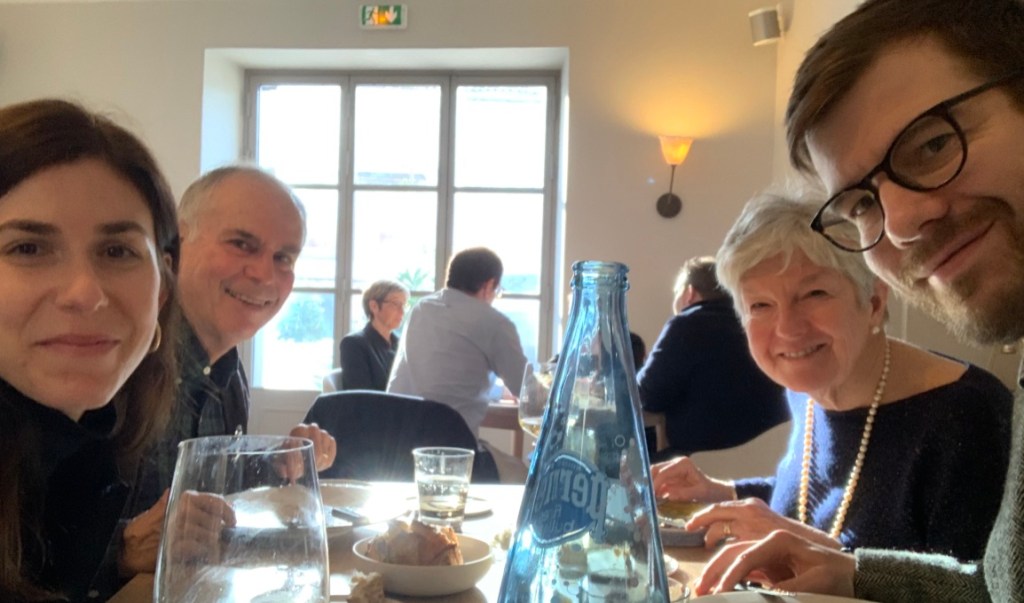
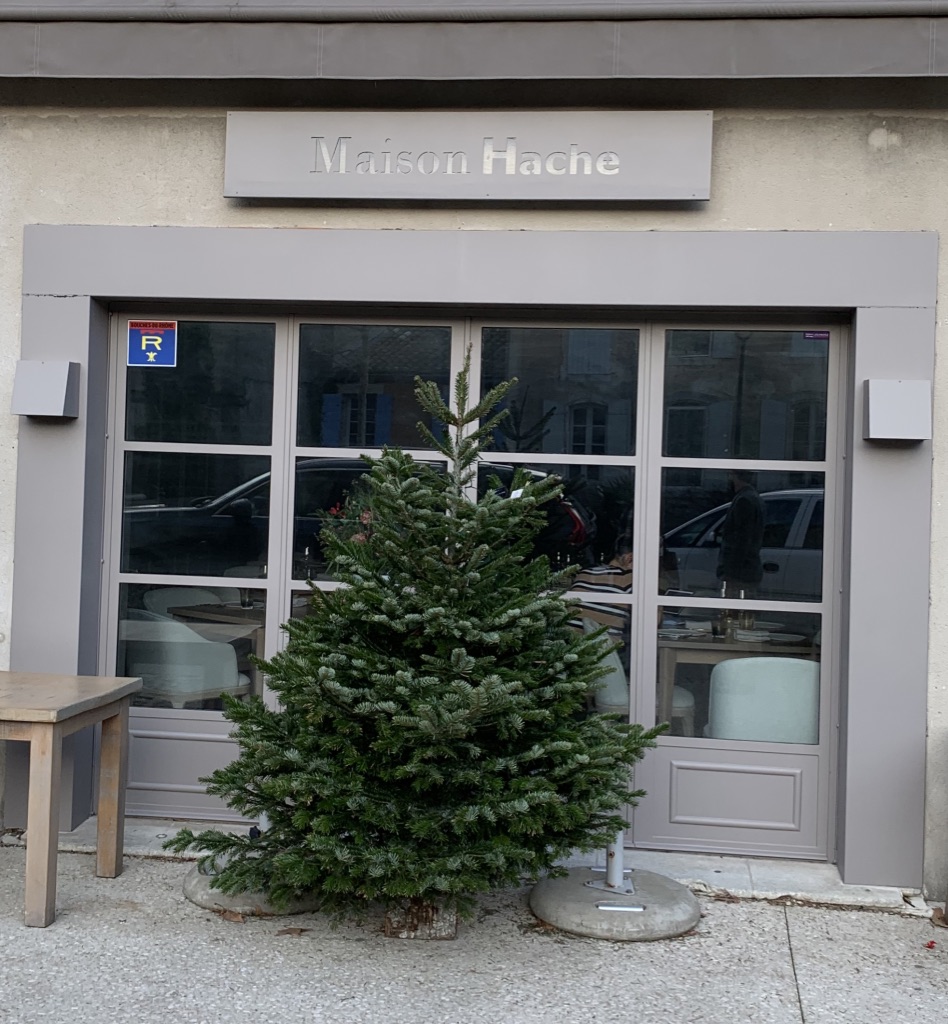
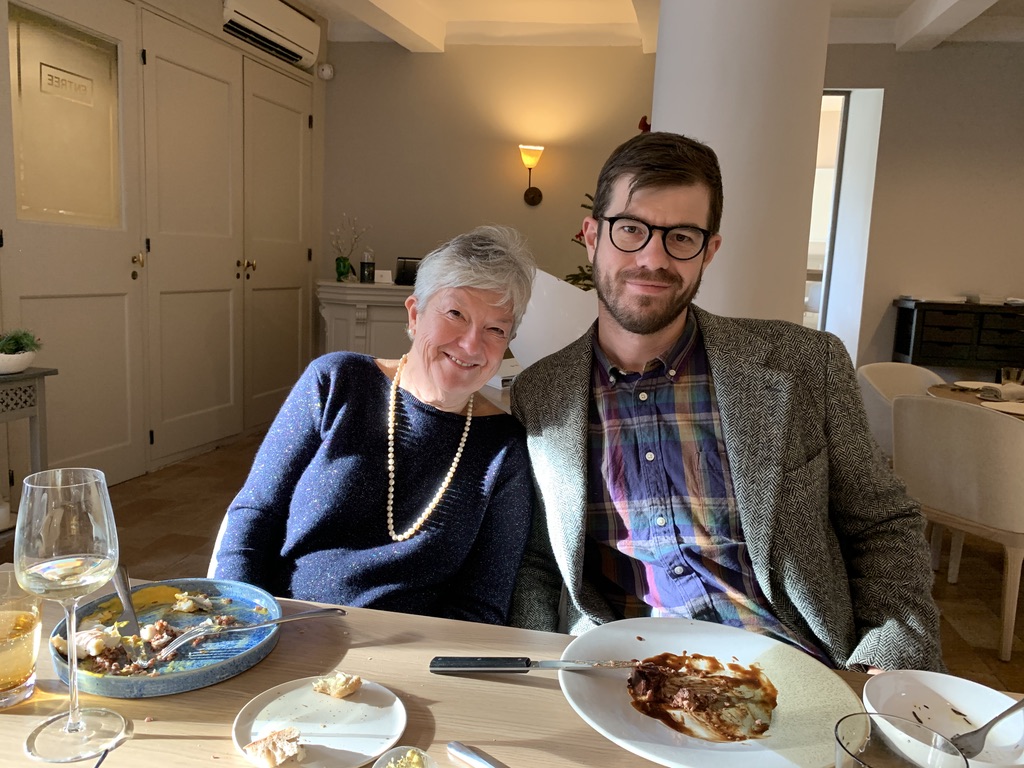
Next on to Maison Hache in Eygalières. This is a restaurant run by Christopher Hache, a chef who earned his first Michelin star at Hotel de Crillon in Paris, obviously no slouch! He decided to move to Provence with his family in order to spotlight and celebrate the agricultural products of the region. And really, who wouldn’t rather be in Provence full-time? The SIL of our landlady is a server there and the word was that it should not be missed. So we were happy to share it with Ben and Rachel. Everything we were served was fabulous, from sea bass filet to venison to the rabbit. All prepared with finesse and beautifully plated. The pièce de résistance for Donna was the chocolate soufflé. Really just over the top! We are awaiting the Michelin stars to be awarded on January 27th and look forward to seeing M. Hache’s name on the list!

Lunch at Maison Hache. Will Chef Hache get his star? We vote YES!

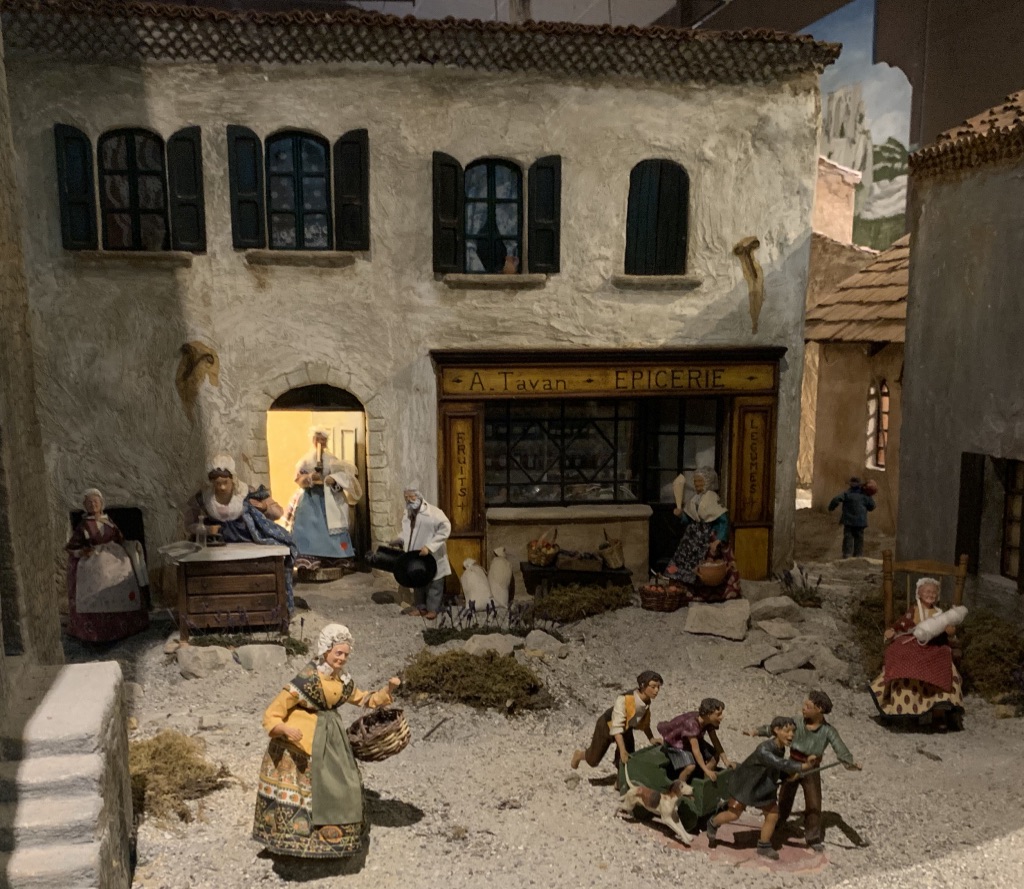
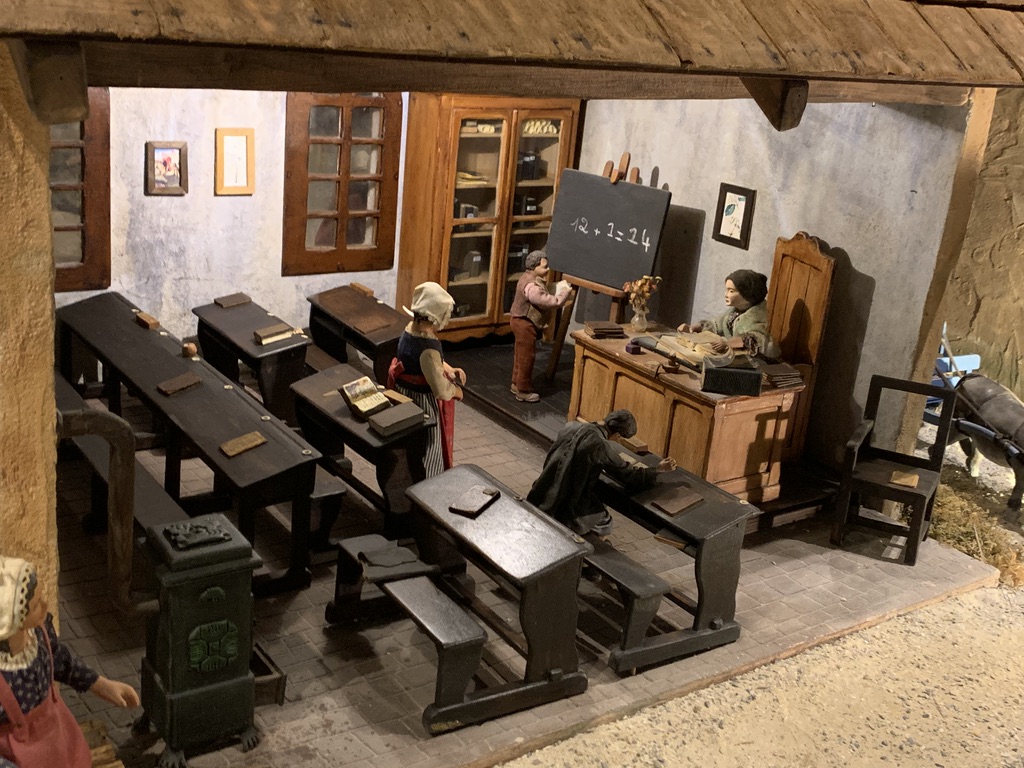
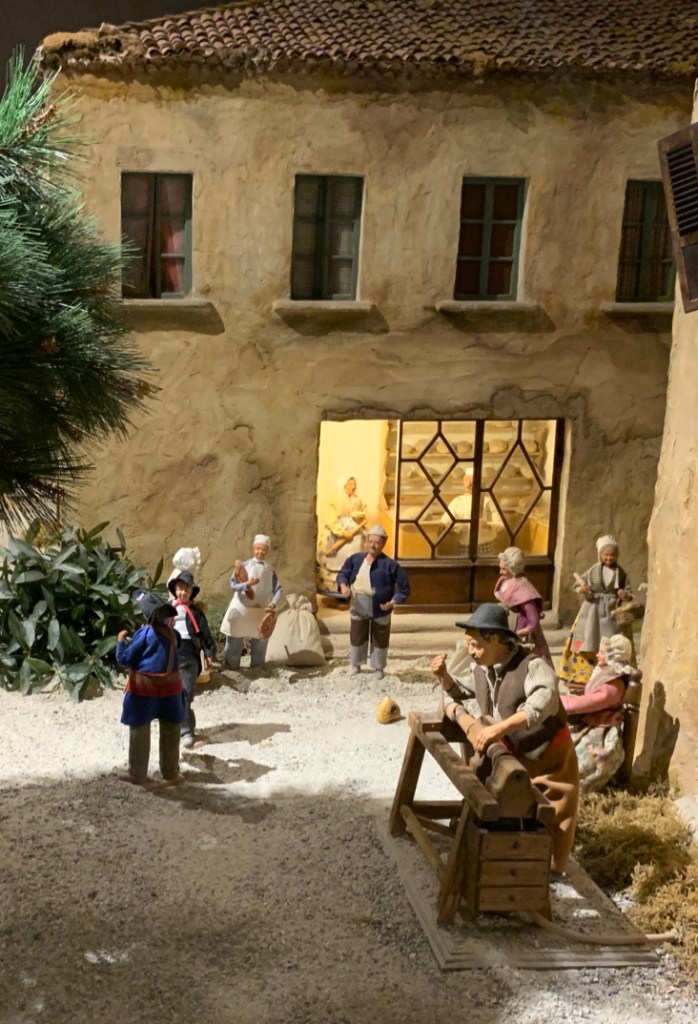
After lunch we moseyed over to Le Paradou, another tiny Provencal village, known for its Musée des Santons. As mentioned in the previous post, when Christianity was banned after the French Revolution and the Reign of Terror in 1794, the faithful needed to find ways to practice their religion without getting caught. And Christmas being the important celebration that it is, they searched for a solution that would allow them to acknowledge the birth of Christ without seeming to do so. Santons had been a part of the Provençal culture for hundreds of years. These were clay figures, usually modeled on folks in the village – the baker, the butcher, the farmer, the printer, housewives at a market, etc. So folks  used their clay figurines to create village scenes – along with a little Nativity scene in one corner.  The most amazing santons are handmade and really look like people you might expect to meet in the village. They come in varying sizes from about 2 1/2  to 12 inches tall – some are taller – and dressed in typical Provençal clothing, carrying the tools of their trades. There are shops and houses and barns and bakeries that make up the villages along with children and animals. Nowadays, most santons are machine made, but there are still some artisan santon makers around. Vintage santons are really quite glorious!

Les Santons à la Musée des Santons au Paradou.

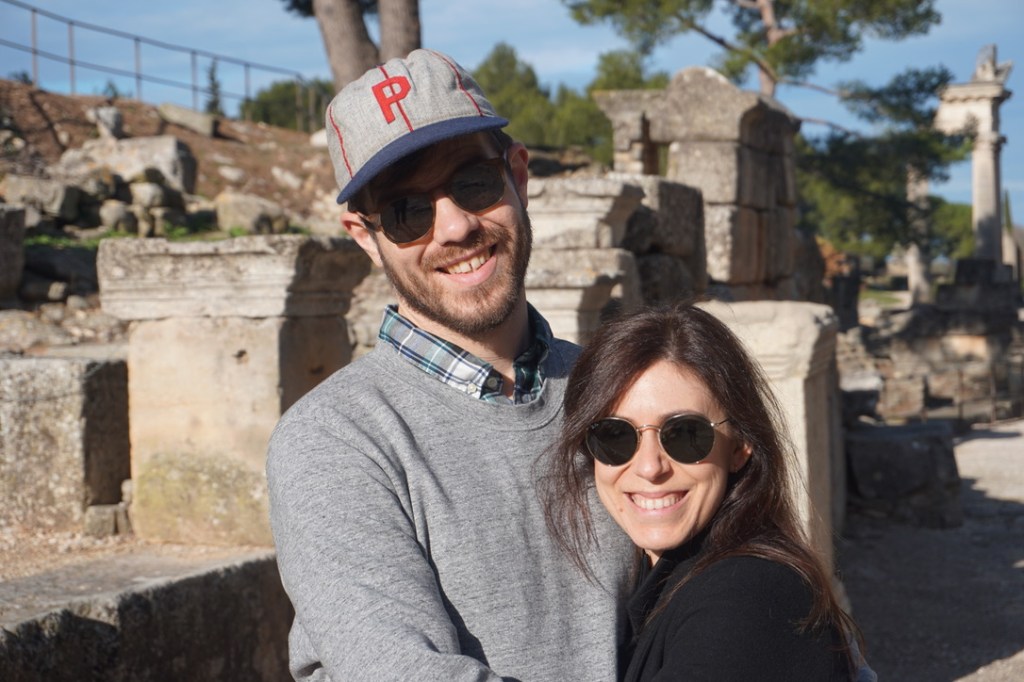
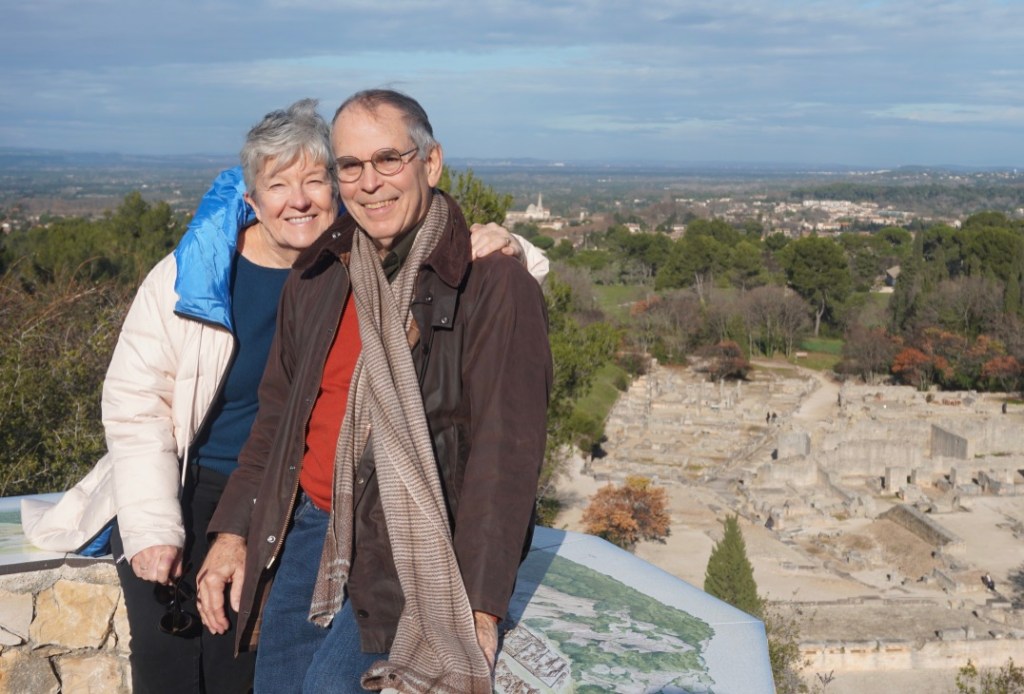
On the 27th, we decided to start with Glanum, the Roman ruins outside of town. It was fun to share with Ben and Rachel. We had a glorious, cold, sunny day to wander around this glorious pile of stones!

Next – a bucket list item for Rachel and Donna – a visit to Gordes, a Ville Perchée! The view of this beautiful little village, teetering on the top of a hill, overlooking a beautiful valley, is stunning. After so many years of looking at pictures and yearning to visit, Rachel and Donna were both elated to be there!

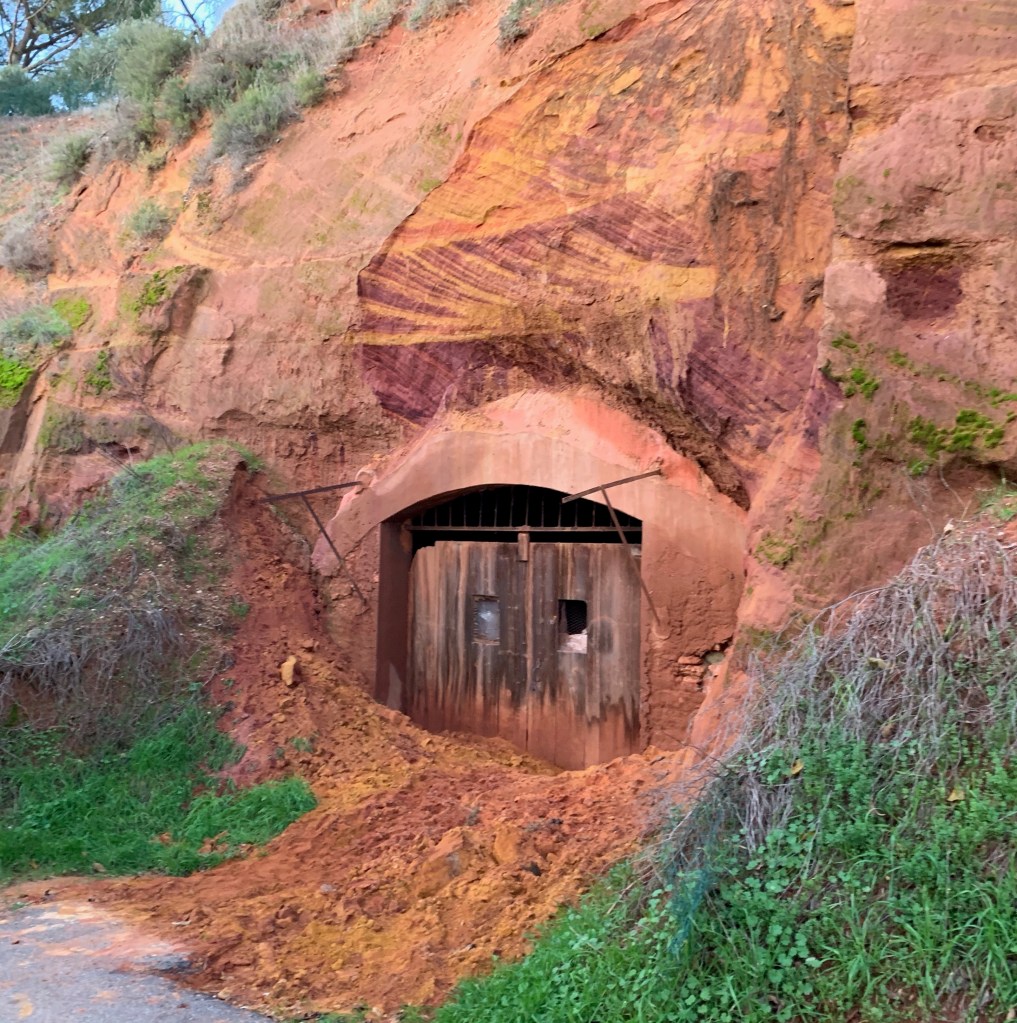
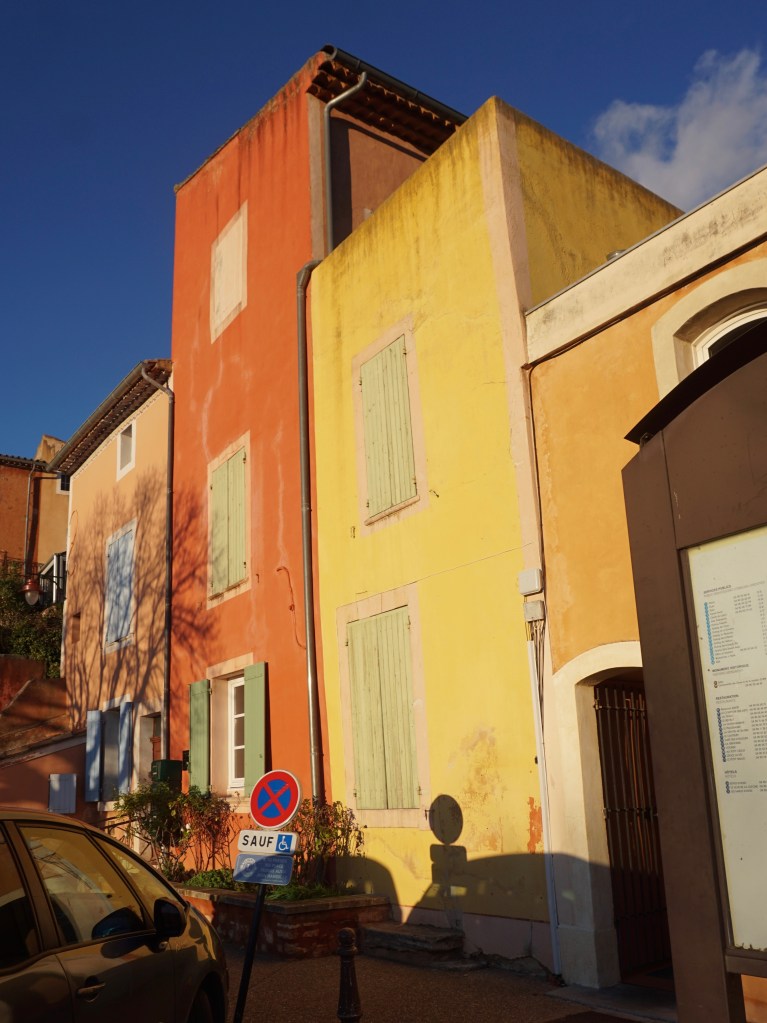
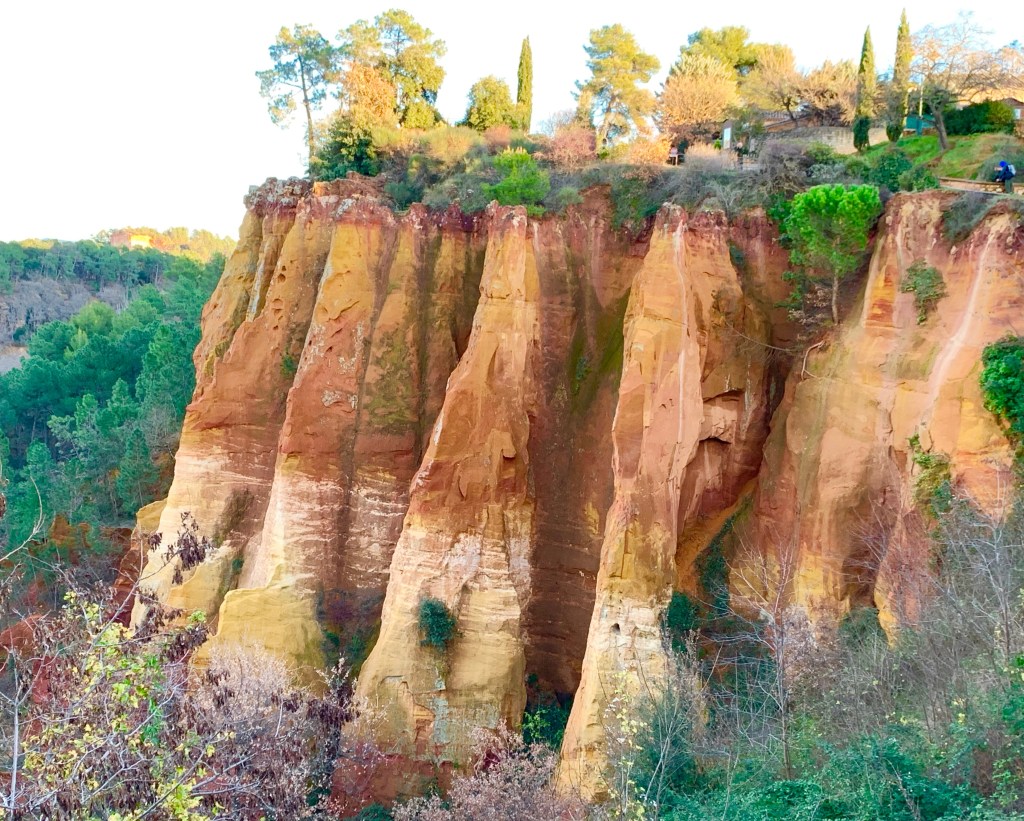
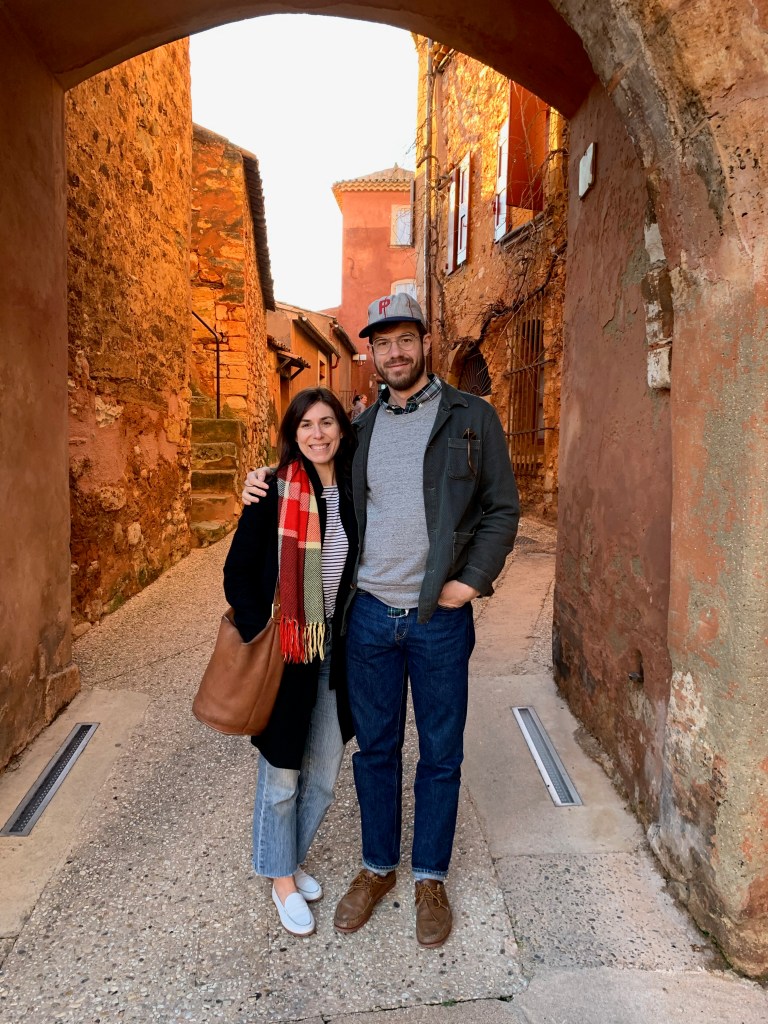
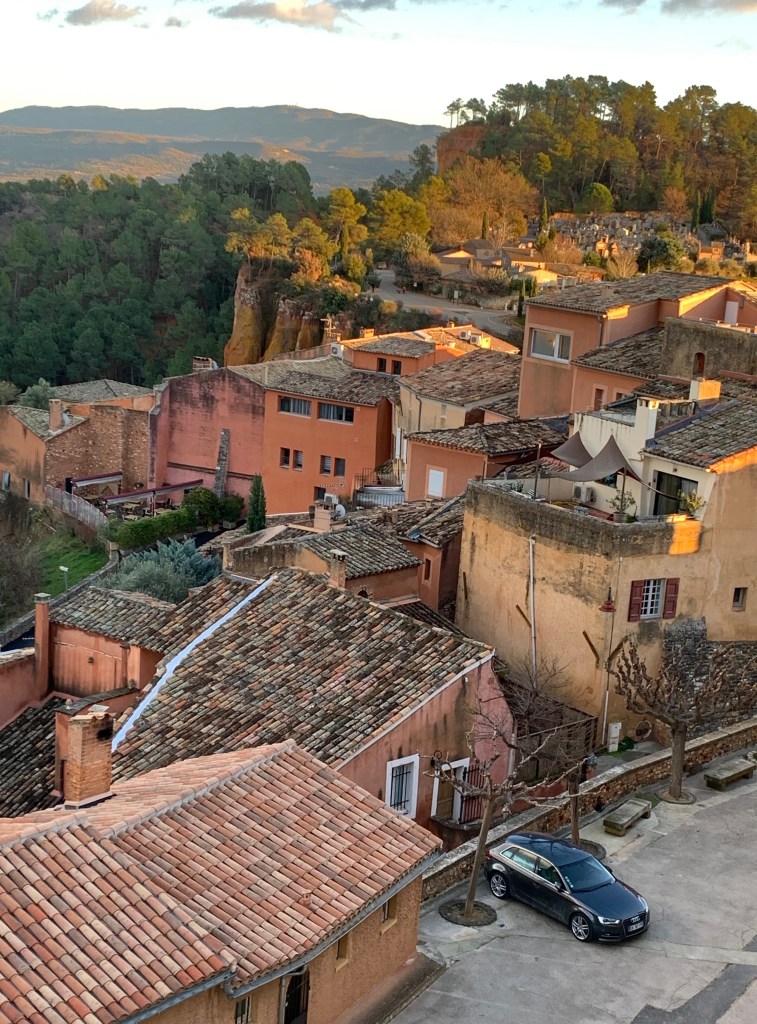
From Gordes, we decided to head to Roussillon, about a 30 minute drive through the countryside. Often called “The Colorado of France”, Roussillon is famous for its red cliffs and ochre quarries. Coming upon the village, with the brilliantly colored houses and the striking red and yellow cliffs contrasted against a vivid Provençal blue sky, was almost breathtaking! We strolled around the picturesque maze of narrow streets and squares. The ochre facades of the houses varied from deep red to orange to bright yellow created a cheerful ambiance. We were all captivated.

After a bit of a wander about town, finding most shops and restaurants closed, we headed back to St.Rémy, stopping for apéros at Bar Tabac des Alpilles. Then home to cook the ENORMOUS cassoulet that had been aging gracefully in the frigo since yesterday. Donna had prepared all the components before Ben & Rachel’s arrival and then assembled it, allowing time for blending all the flavors of pork and duck and beans and sausage. It took a committee to get it into and out of the oven – the 8 quart Le Creuset dutch oven was full to the top! But it was worth the physical labor, because the cassoulet was delicious! Of course, there was TOO MUCH! We had enough for a meal for 4 and then several meals in the freezer for us to enjoy later!

Bright and early the next morning, Ben & Rachel got in the car to head back to Paris. Thanks to the grève, with many families on the road following la fête, a drive that should have taken seven hours, took eleven hours! Tant pis! It should be said that despite only having Benjamin & Rachel here for four days instead of seven, and despite Ben being under the weather for one of those days, we had a glorious visit. And we are missing them like crazy now!

And, we are missing you all like crazy, too! The only really hard part of this trip is missing our friends and family. We feel so enormously fortunate to be able to have the opportunity we have. So we are sharing it with you on this blog, but it would be so much better in person!

By the way, Sam would like you to know his Twitter handle is @SamuelAhr.

Love to you all,

Sam, Donna & LuLu

December 2019

Christmas in Provence

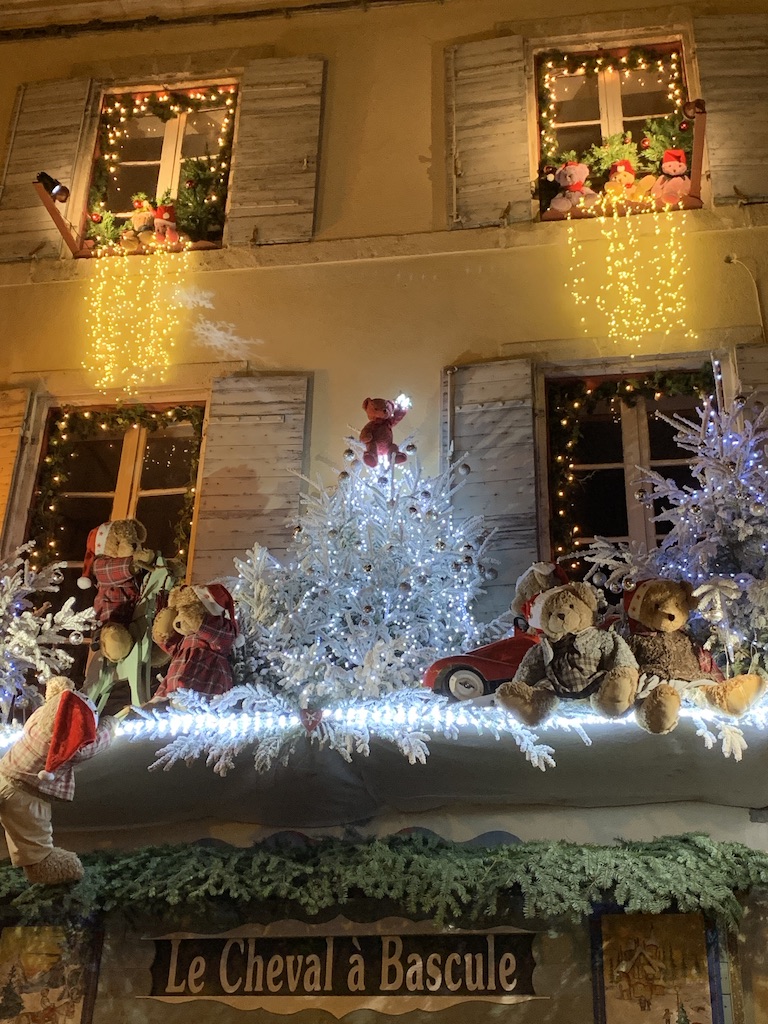
Much to our chagrin, the commercial onslaught of Christmas felt eerily similar to the US. About the beginning of November, trees and tinsel and lights started appearing in the super market and the drugstore. So, we weren’t sure if we would experience a real Provençal Christmas or a bastardized French version of an American commercial celebration. 

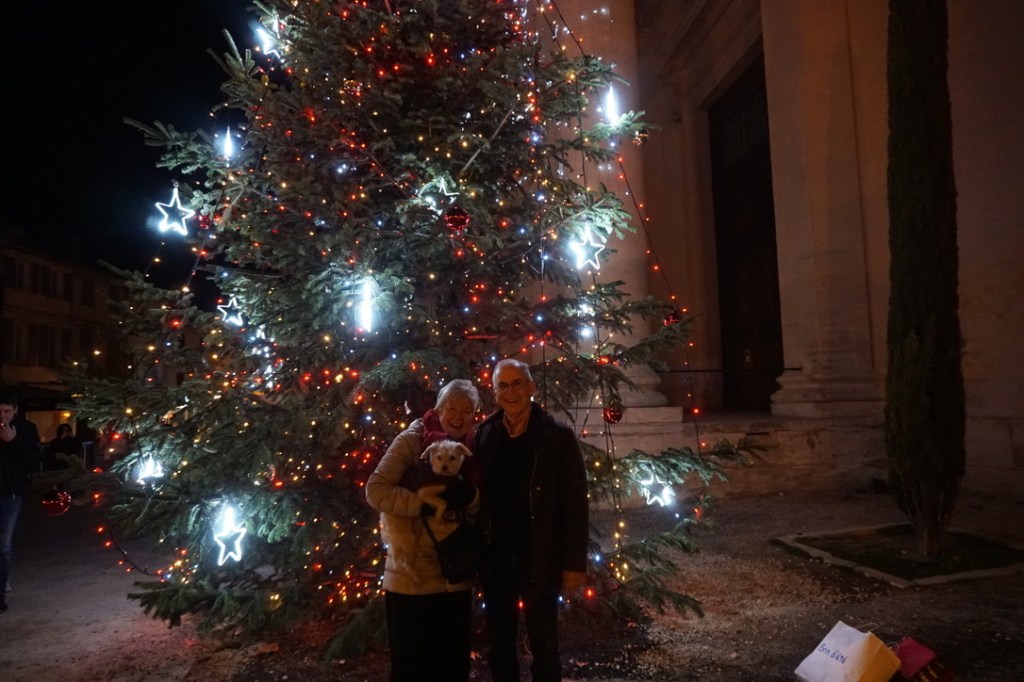
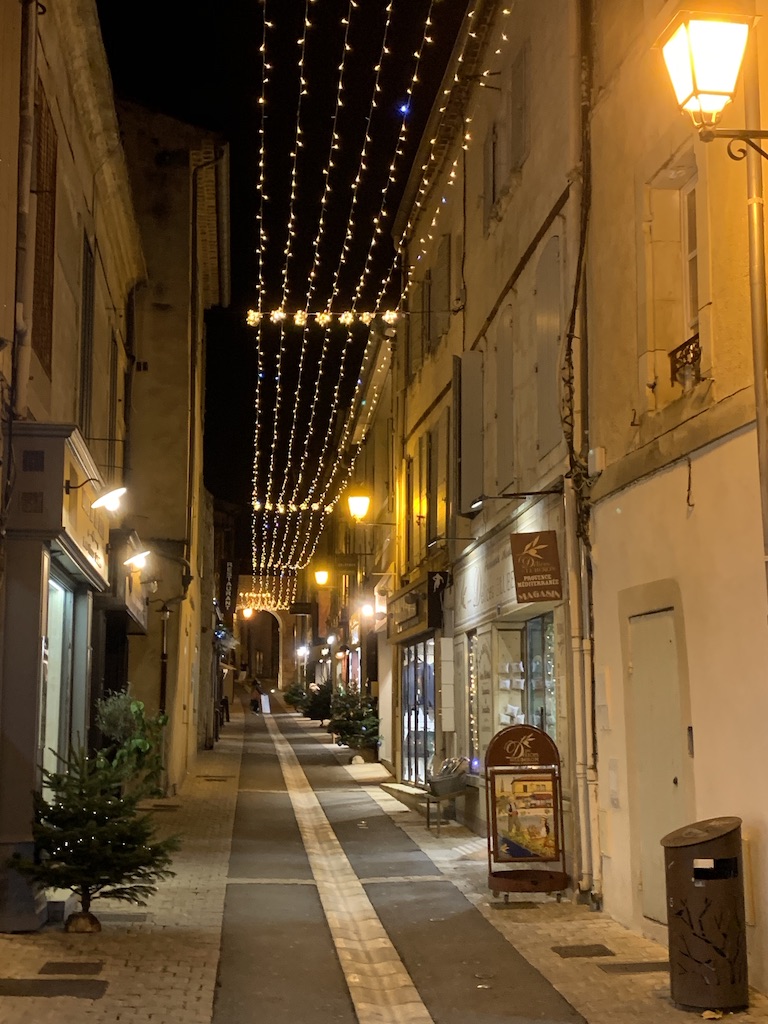
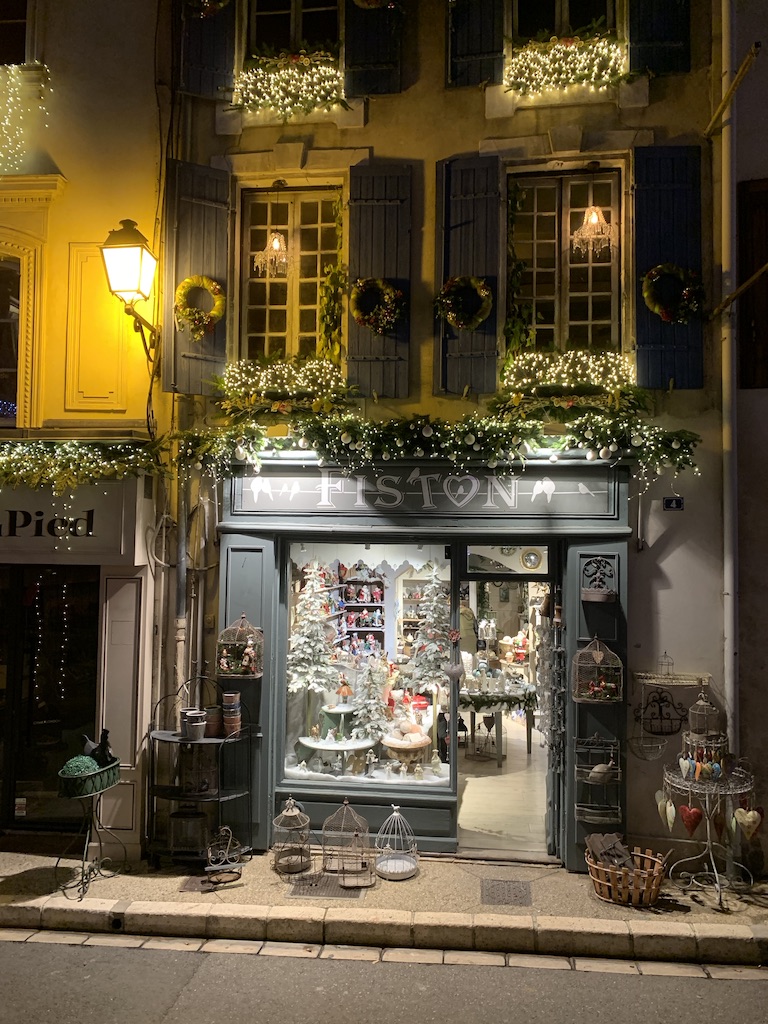
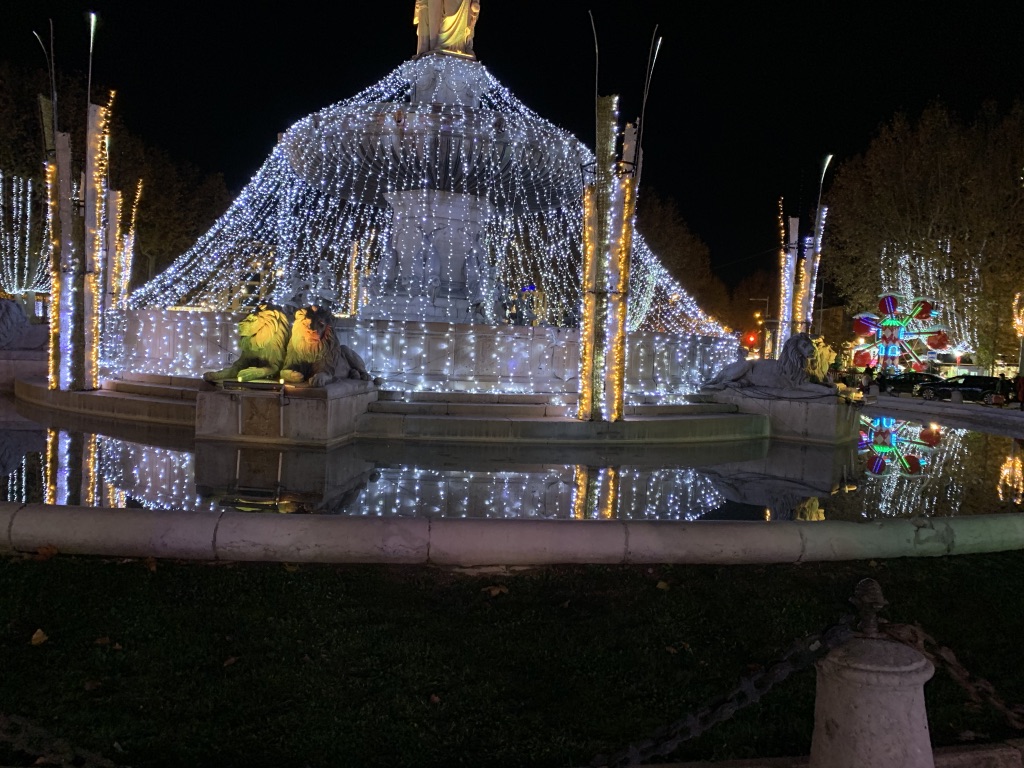
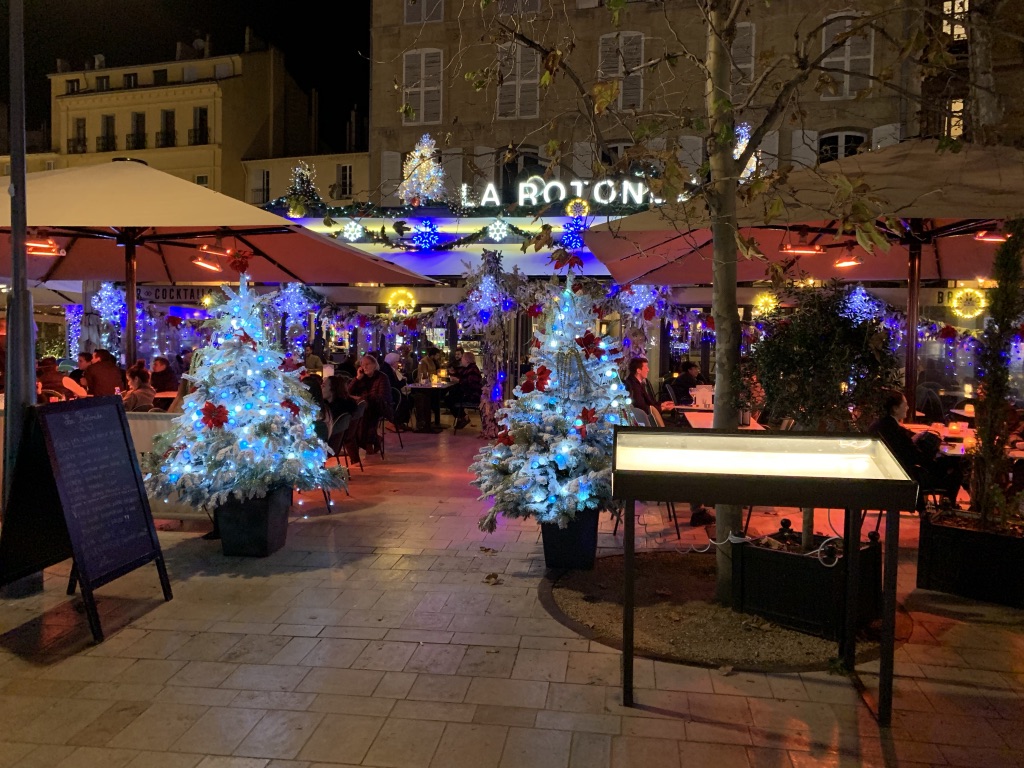
Then, about the middle of November, we noticed municipal employees in cherry pickers hanging copious strands of lights along the narrow, curvy pedestrian streets in the historic center of St Rémy. A huge Christmas tree went up in front of the church. The plane trees along the rocade  that circles the historic center were given their own gown of lights. Shops all over town began hanging greens over the doorways. And it began to feel very French, very Provençal.

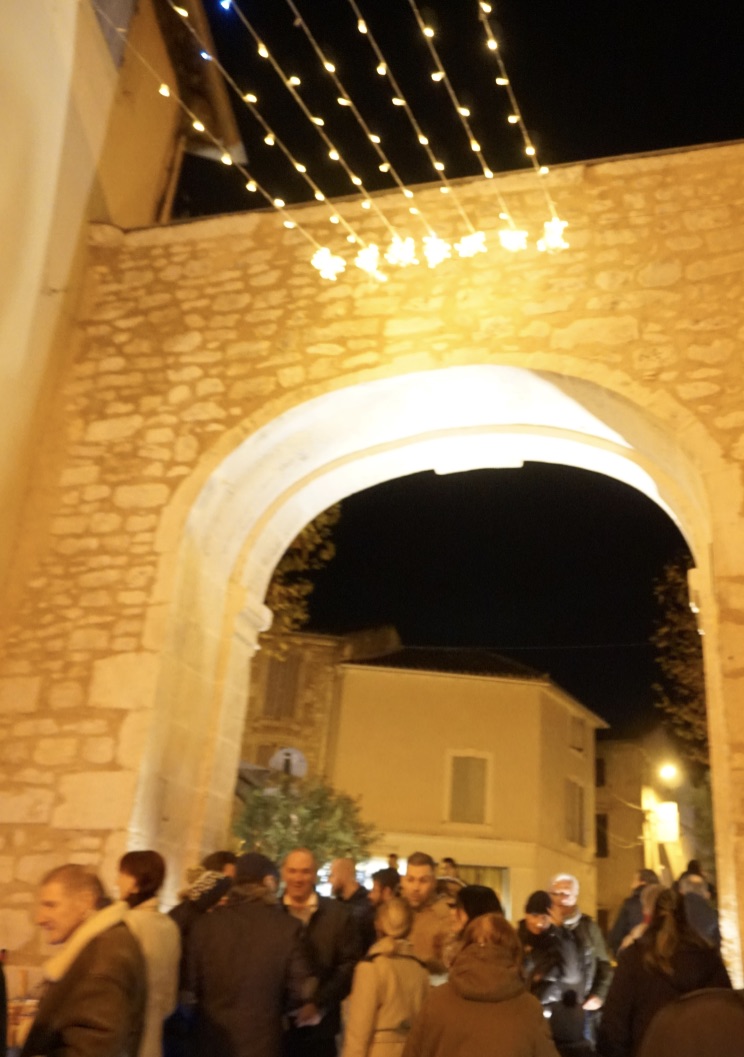
The weekend of December 7th and 8th was the official kick-off of the Saison de Noël. Saturday evening was the Fête des Lumières.  All the lights we had observed being strung were glowing and all of the shops were open late into the evening serving Apèros – mulled wine, hot chocolate, champagne, crackers and nuts and nibbles, soup, crèpes, candy, treats of every description. Folks wandered in and out of the shops, chatting with neighbors and shop keepers, getting ideas for cadeaux. And we delightedly joined in!

On Sunday, we went to afternoon tea at the Hotel Gounod. Seated in the warm and cozy lounge we enjoyed tea and cocoa, pain d’épice, chocolate covered candied orange peel, sablés and gingerbread men. All sweet, no savory, much to Donna’s dismay!

La Fête des Lumières in St. Rémy

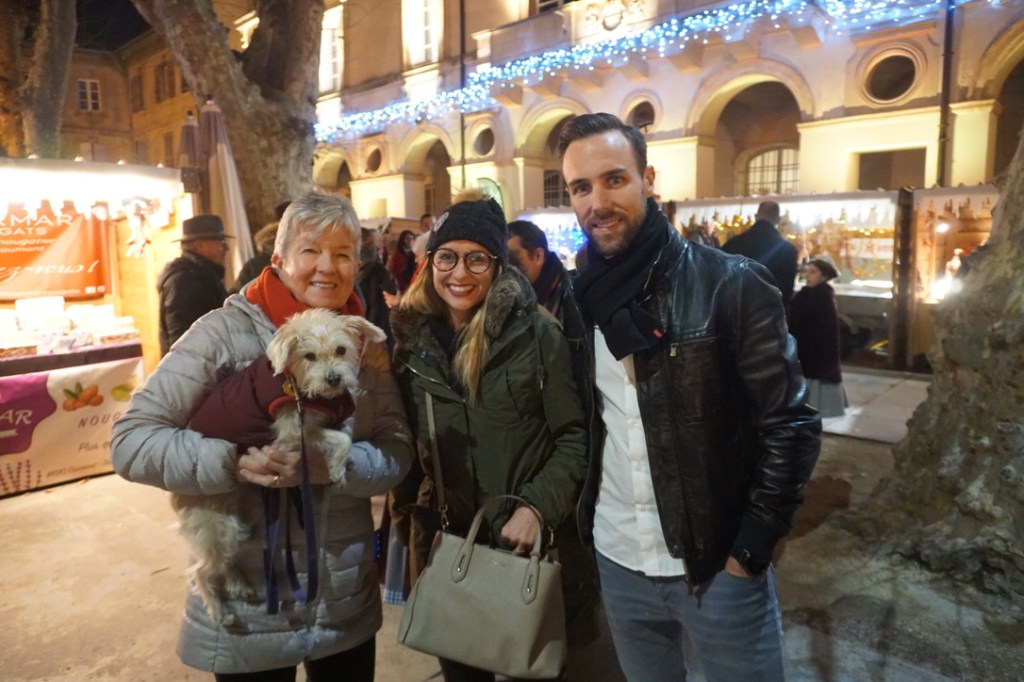
The next week, we drove to Aix-en-Provence to experience their world famous Marché de Noël.  The broad pedestrian thoroughfare, Cours Mirabeau, had been transformed into a village of vendors in tiny cabins. From the majestic fountain on Place Cézanne all the way to the Chapelle des Oblates, Cours Mirabeau was awash in lights and commerce. All the local products were showcased – cheese, wine & Champagne, foodstuffs, olive oil soap, lavender sachets, candy, handmade toys, silk scarves and clothing, jewelry, art work of all sorts. There was also a Foire des Santons with several vendors. Santons are the clay figurines molded after local villagers that were used to portray the Nativity scene during the period when religion was banished during the French Reign of Terror in 1793. (More on santons later.) The lights and ambient music of this vibrant Marché put us in a festive mood! We purchased four cuisses de canard confit (duck thighs preserved in their own fat) for a planned cassoulet.

But there was more to come! December 21st and 22nd was the Marché de Noël in St. Rèmy. And it was as small and intimate as the Aix-en-Provence Marché was large and spectacular. A small village of vendor’s cabins had been erected in the Place Jules Pellissier in front of the Hôtel de Ville. Again, food and wine and cocoa, sweets, olive wood products, soap and lavender products and throngs of St. Remois socializing, eating and drinking. 

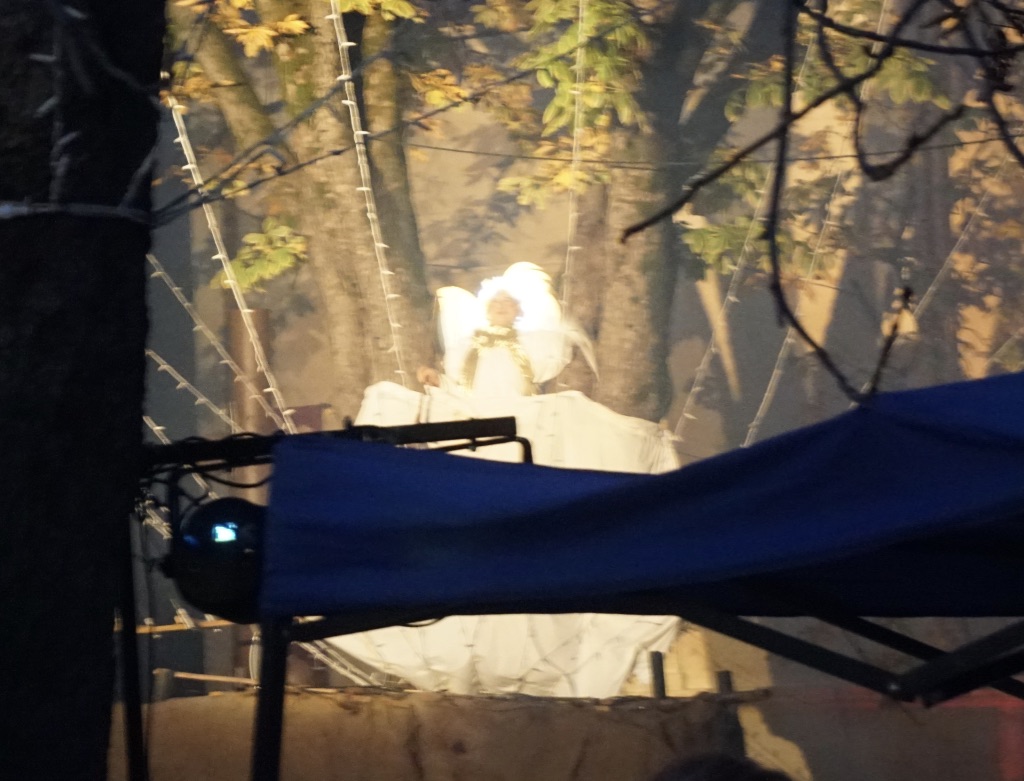
Saturday evening there was a Pastorale presented – the Nativity story told by local actors and musicians, but set in Provence! There were gendarmes, bar keepers, the local mail carrier, angels and Joseph leading Mary to the inn on a live donkey. Unhappily, we arrived late and could only really see Gabriel, perched in a tree, narrating the scene. Next time we’ll get there earlier!

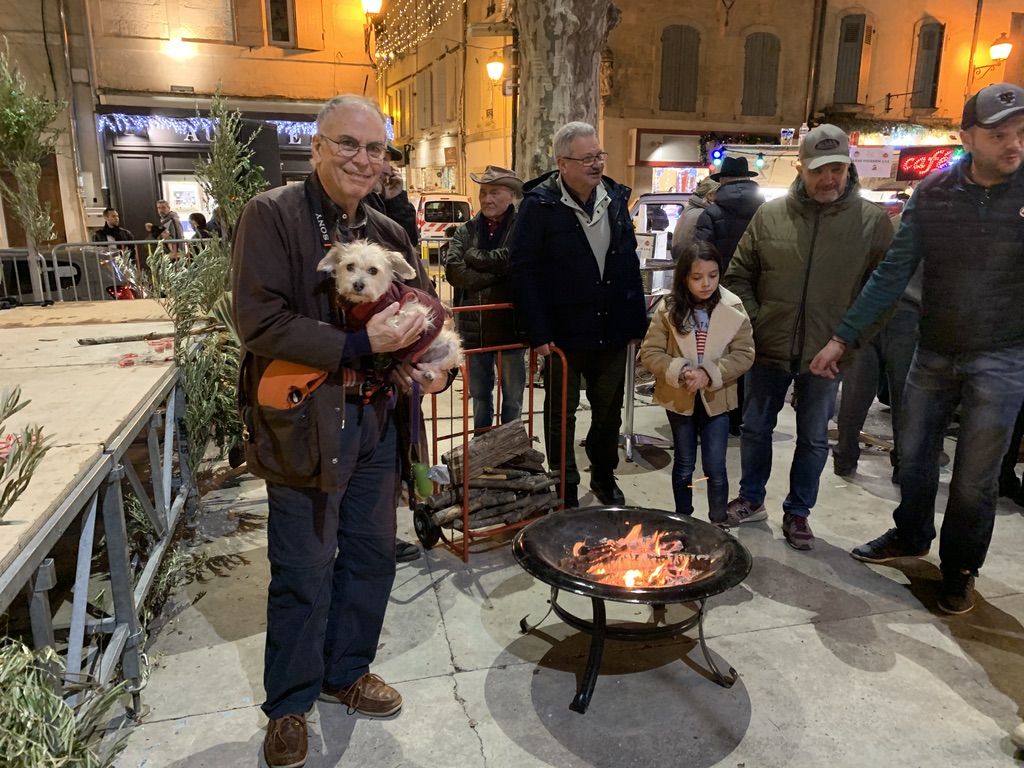
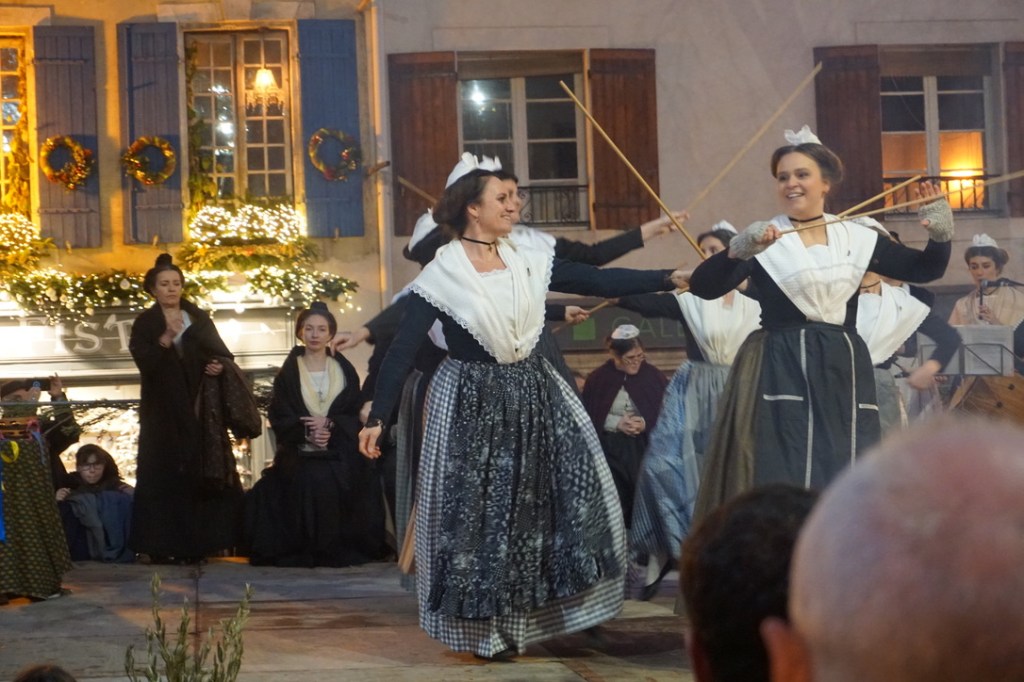
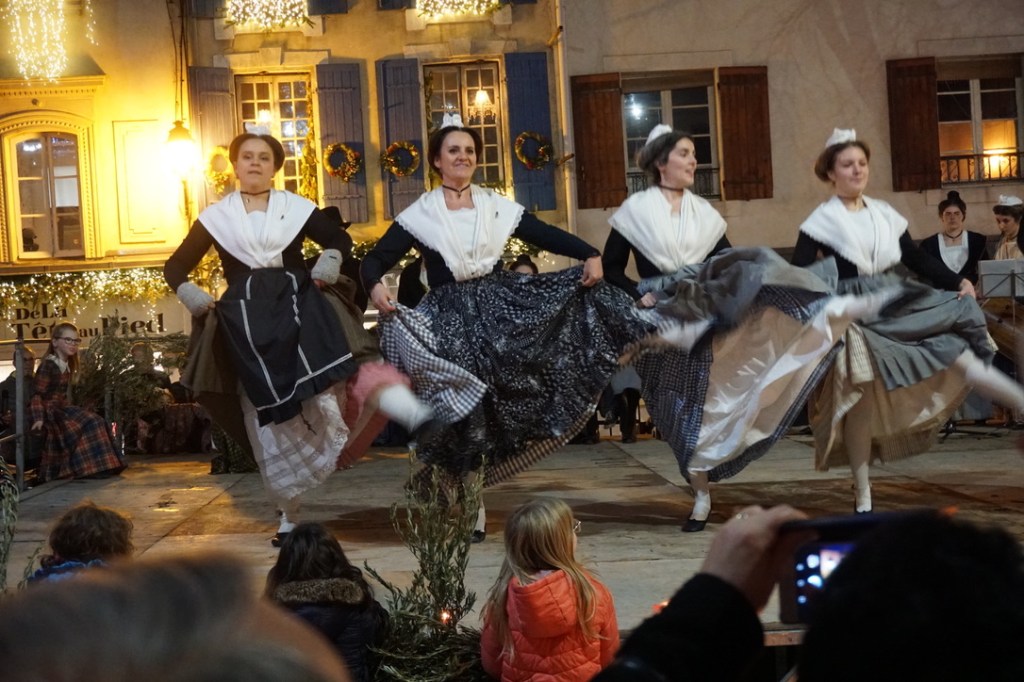
Then Sunday evening was Le Feu de Saint Jean d’Hiver. Dancers in Provençal costumes performed several typical folk dances, accompanied by pipe and drums. The dancers were aged about 6 years old into their 20’s. It was very crowded, but we were able to see the entire program, especially enjoying the utter joy expressed by the younger dancers. It was contagious!

Then, onto vin chaud and more socializing! We were delighted to bump into people we knew and wish everyone Joyeuses Fêtes!

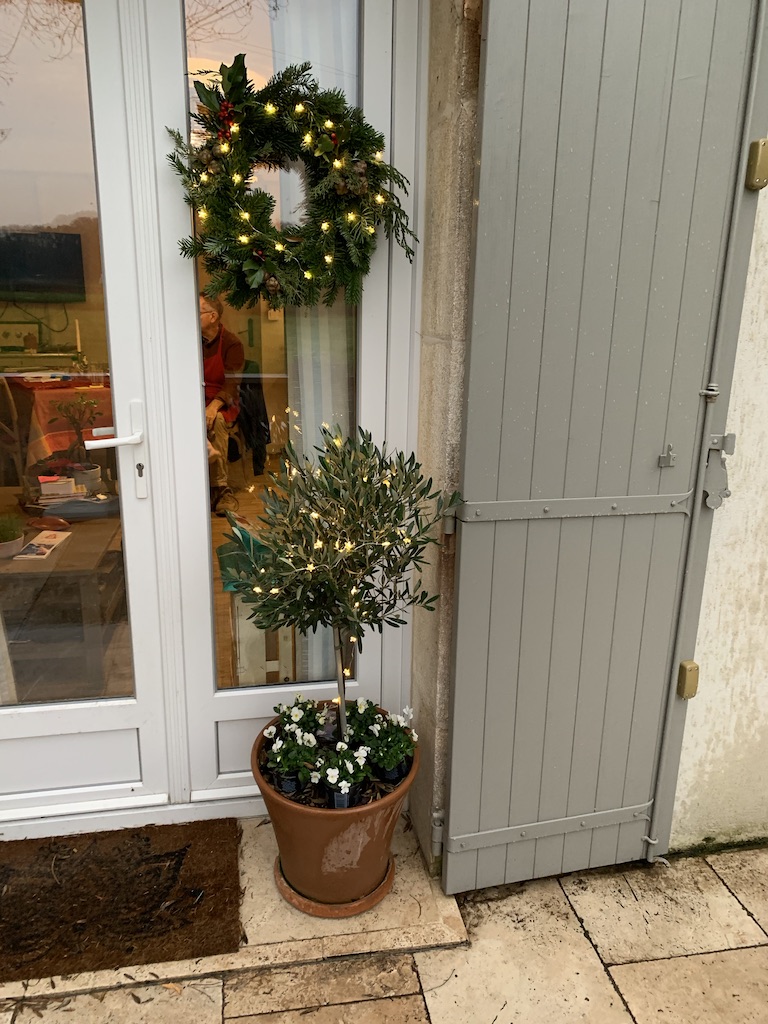
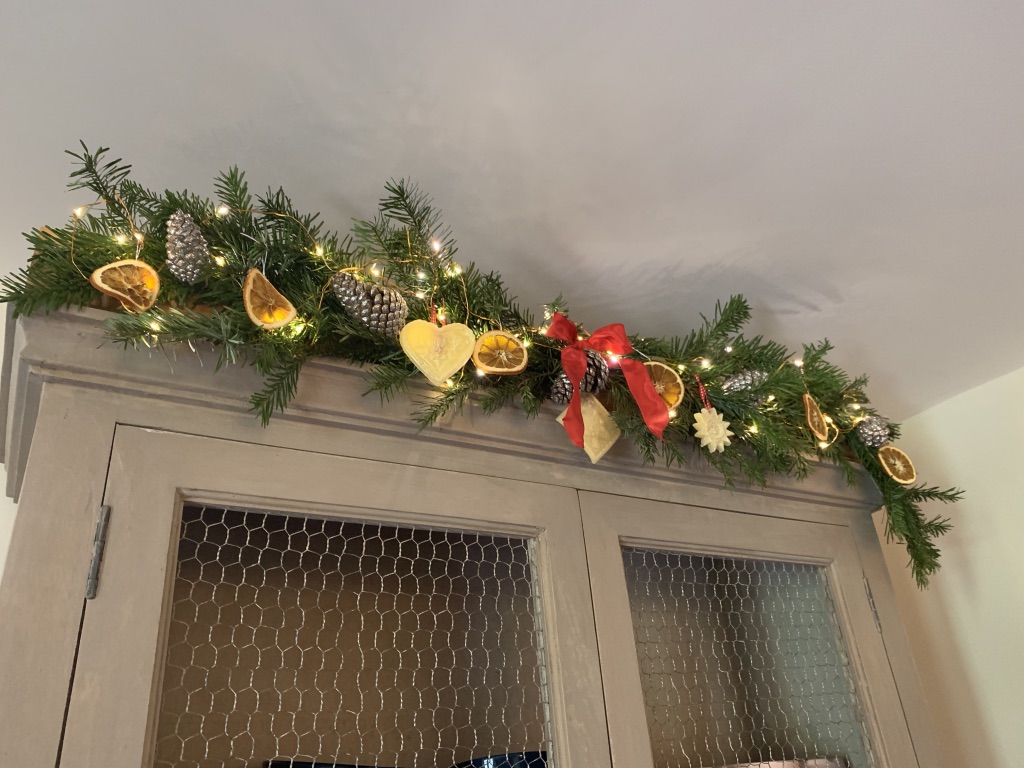
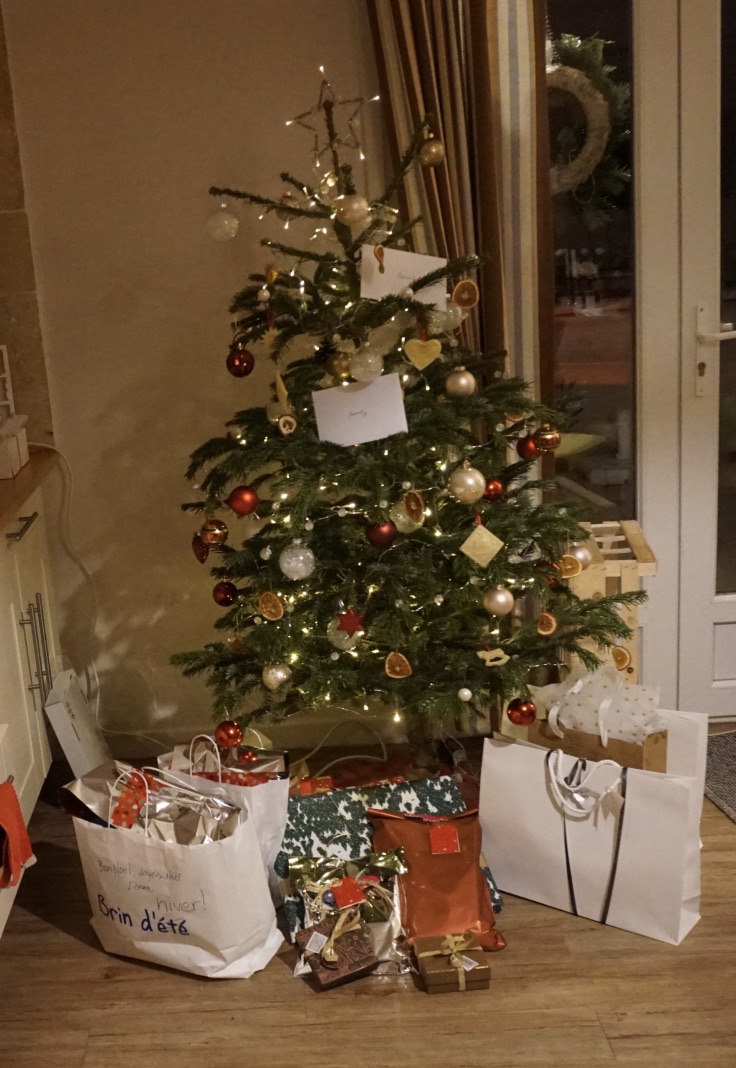
Meanwhile at our apartment, we had been busily preparing for the arrival of Benjamin and Rachel! Stollen had been baked, gifts had been purchased, lights had been strung and a sapin de Noël had been decorated – thanks to Rainey who sent a dozen handmade wax ornaments! 

Christmas in Provence Part Deux, coming soon!

A Day in the Life…

Another little note: As we prepare to post this, it is December 3. The “expert” from the French telecom company changed something out and we had wi-fi for about an hour – a couple of weeks ago! He is supposedly coming back tomorrow, but today we awoke to find wi-fi! It won’t let us open some things, so we’re not sure what’s going on… The hardest part of this trip has been dealing with the internet, pretty much wherever we’ve been. In any case, that’s not much to complain about! Hopefully things will get better! More posts coming as soon as we can get a solid connection!

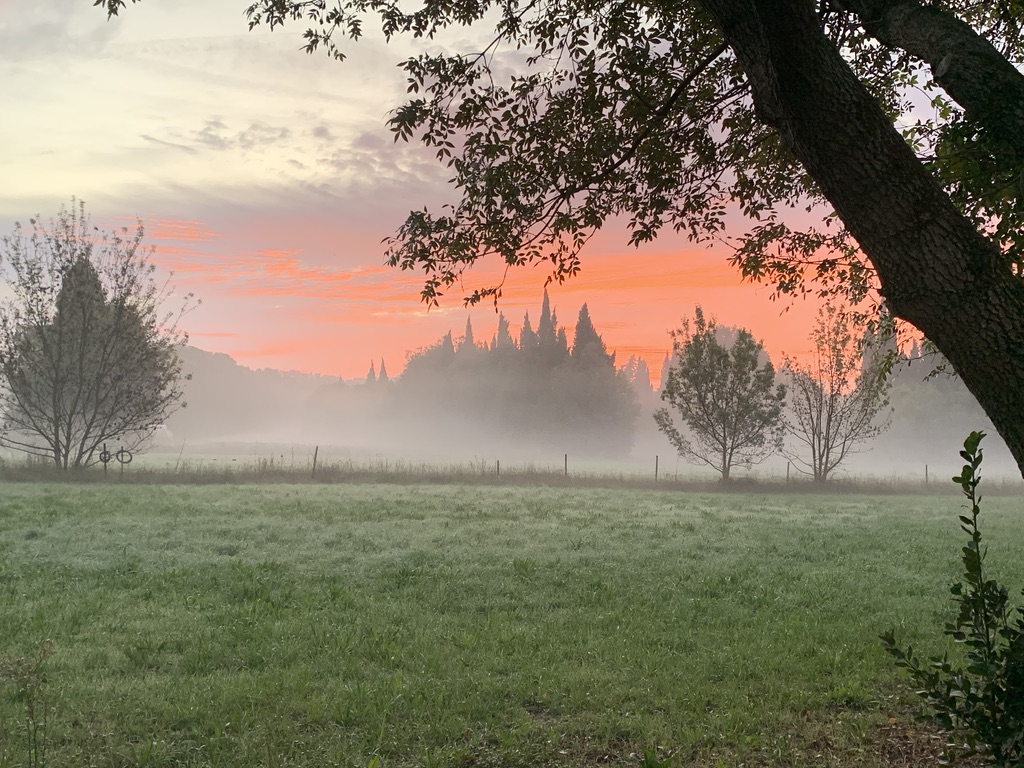
This is the first sunrise the morning after we went back to Standard Time – about a week before the US change.

Our life here in St. Rémy is very different than our life in Oakland – for many different reasons, mostly good.

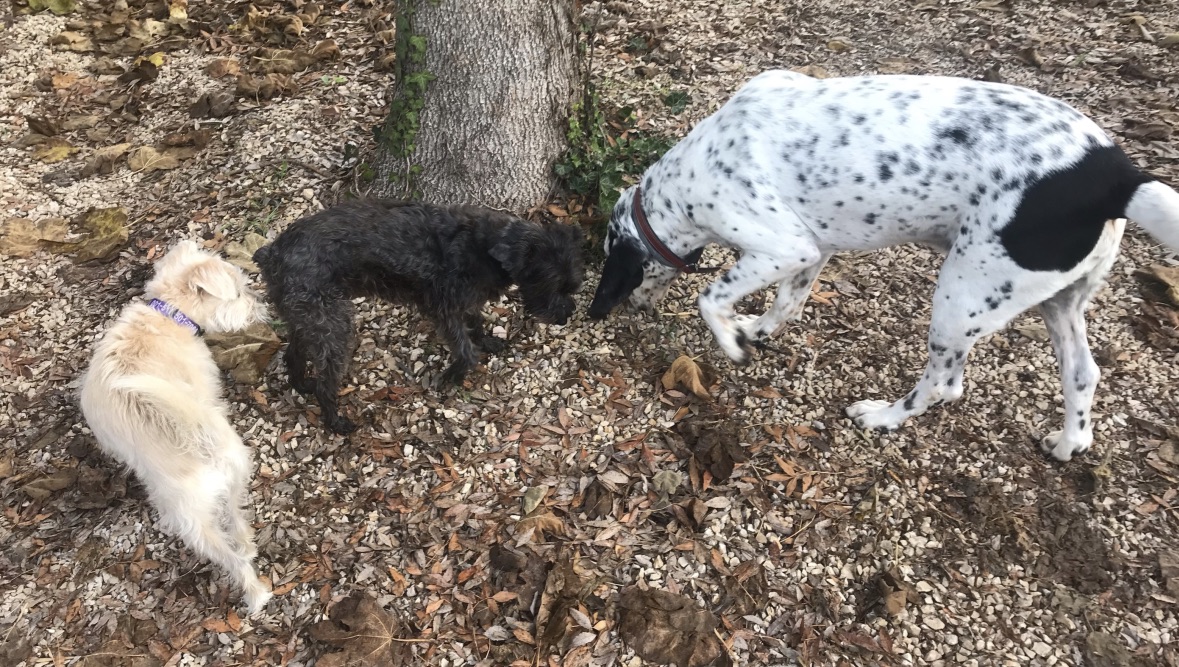
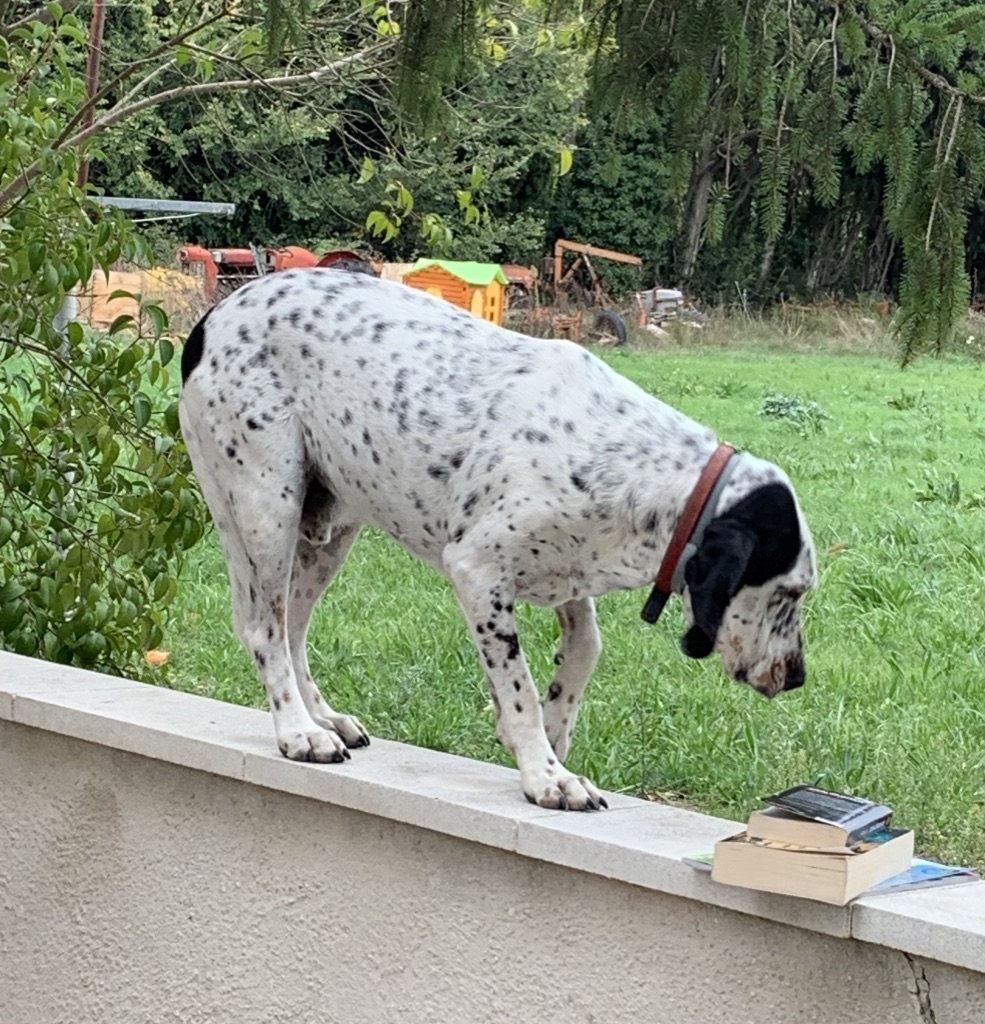
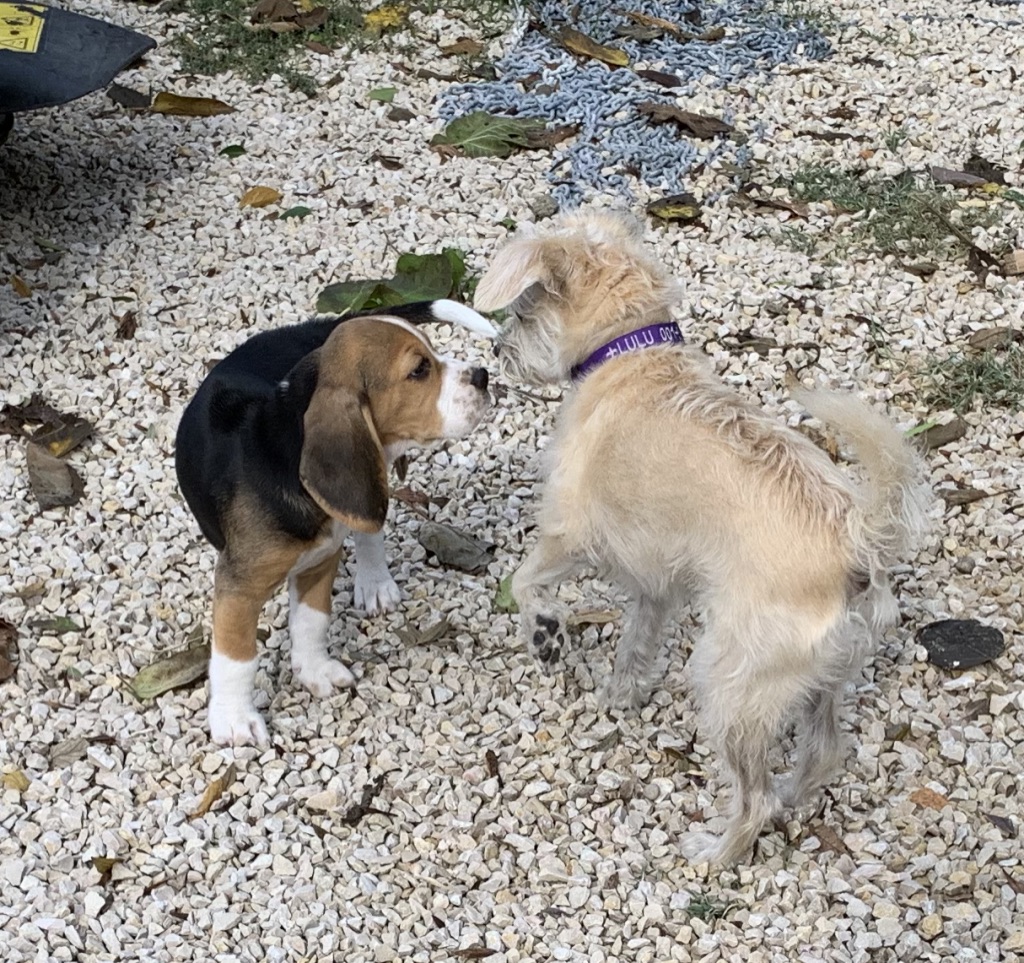
The first thing to say is that LuLu is très contente here!  Because we are way off the road and there is a lot of property around our apartment, she is able to spend time outside unsupervised. There are an infinite amount of sniffies here and she takes her work seriously. So usually, once or twice a day, she spends 15-30 minutes outdoors on her own, exploring. There are two dogs that live here – Prospère, a handsome hound and Coquillette, a little terrier mix exactly LuLu’s size. Prospère is a rescue who’s is pretty much scared of everything, including LuLu! At first she was afraid of him, but now she wants to engage with him and he runs away from her! She and Coquillette basically ignore each other. They greet each other, take a minute to sniff and then go on their way.There’s no hostility, but they’re not bosom buddies (bottom buddies?) either. Also, Delphine’s sister-in-law, Morgane, and her partner Charles recently adopted Pongo, a purebred Beagle puppy and LuLu is intent on socializing him whenever he comes over!

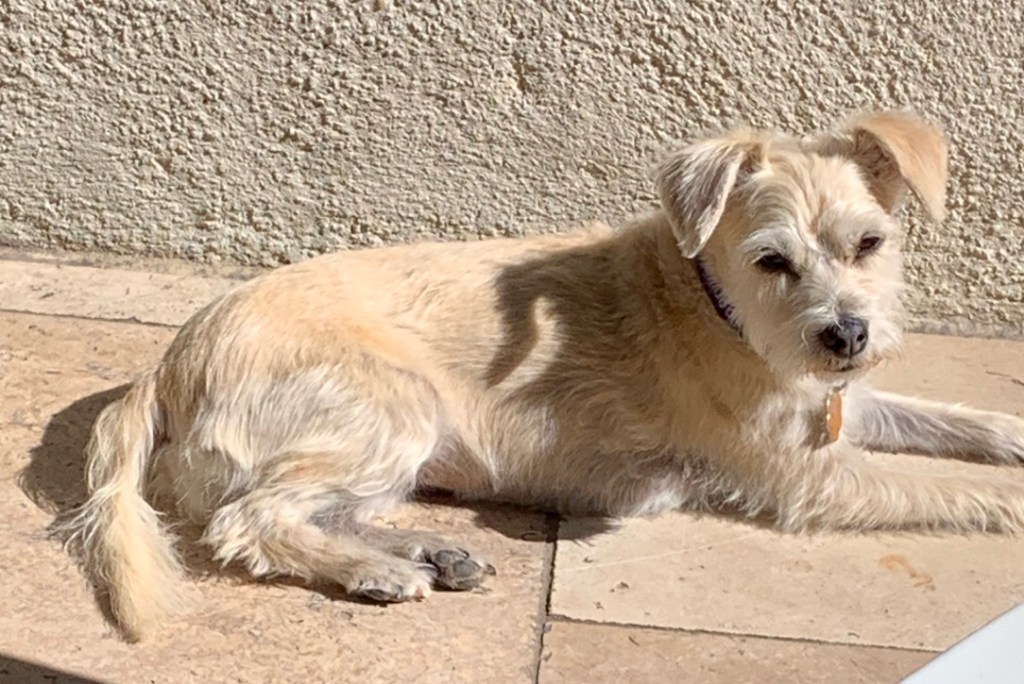
Taking a sunbath! We were previously unaware that there are canine chameleons!

Clockwise from top left: 1. Les Trois MousquetairesLuLu, Coquillette et Prospère. 2. LuLu and Pongo meeting for the first time. 3. Père coming over the fence for a visit.

The first couple of weeks that we were here was all about getting oriented and nesting in our apartment. Unpacking and feeling like we were HOME was a treat! We went to Ikea the first week. (Yes, we know. But it’s close and has much of what we need and is inexpensive.) Being cognizant that everything we buy will probably stay here, we kept the shopping to a dull roar. We purchased a few items that we felt we couldn’t live without – pot holders, rubber bowl scrapers, a laundry basket, a bonsai ficus (20€!), some tall glasses. And a throw pillow for the couch. All of this will stay here in the apartment, or go up to Théo and Delphine’s house. 

We also spent some time exploring the grocery shopping possibilities in our town. The best are the open air marchés on Wednesdays and Saturdays which you have seen in the previous post. So that’s the best place to start – with the local producers who bring products that were picked yesterday! It should be noted that our enthusiasm for the marchés often exceeds the capacity of our frigo. At one point, while cleaning the refrigerator, Donna discovered 5 cartons of various types of olives from different marchés!

But close to us is a little commercial area which has the Intermarché supermarket, a BIO organic grocer and Cerise et Abricot produce market. 

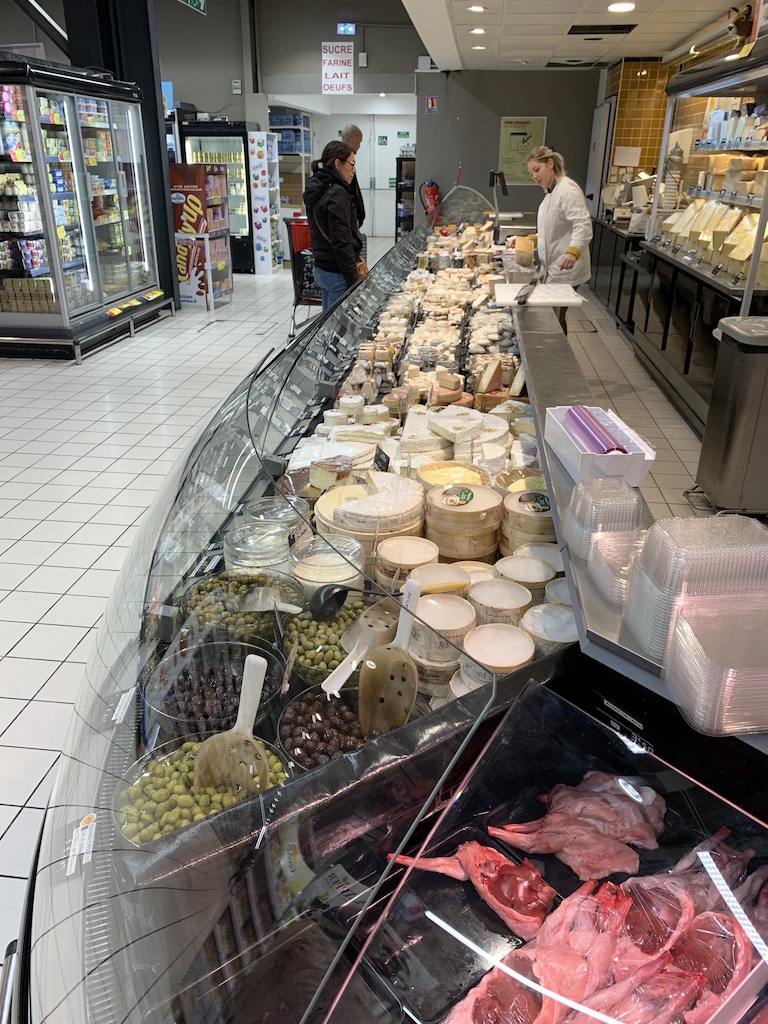
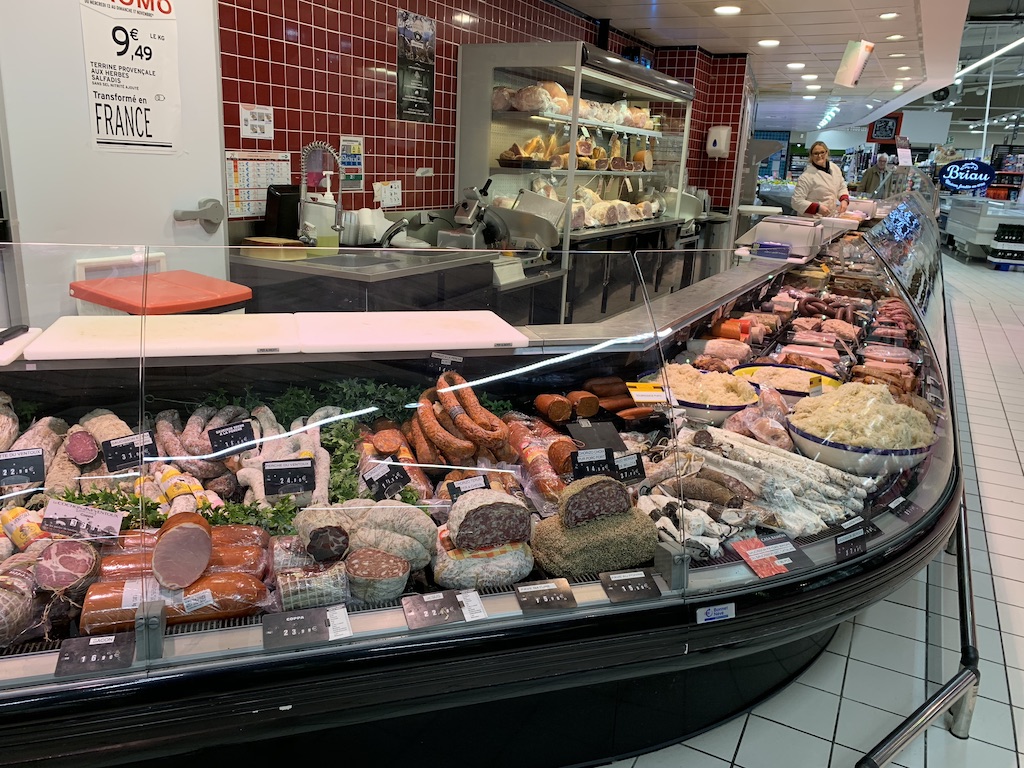
Intermarché is like Whole Foods on steroids! It has regular and organic produce, an entire aisle of organic flours, pastas, crackers, cookies, cereals, etc. Plus, a patisserie, a cheese counter about 15 feet [5 meters] long, a butcher, a charcuterie et traiteur with prepared foods such as smoked meats and sausages and about 49 different types of ham (including the best bacon we’ve ever had!), patés, salads, dips and spreads, cooked meats, quiches and poultry, and a huge seafood counter that will prepare a shellfish tasting platter for you to take home (Haven’t tried it yet). Intermarché also has cleaning items, pots & pans, shampoos and bath soaps – everything that you might find at a grocery store at home. So – it’s convenient no matter what  you’re looking for. And it’s open for longer hours. Bio and Cerise et Abricot close at lunch time – very standard in France. Of course boulangeries (bakeries), patisseries (pastry shops), fromageries (cheese shops), boucheries (butcher shops)  and poisonniers (fish mongers) are abundant. 

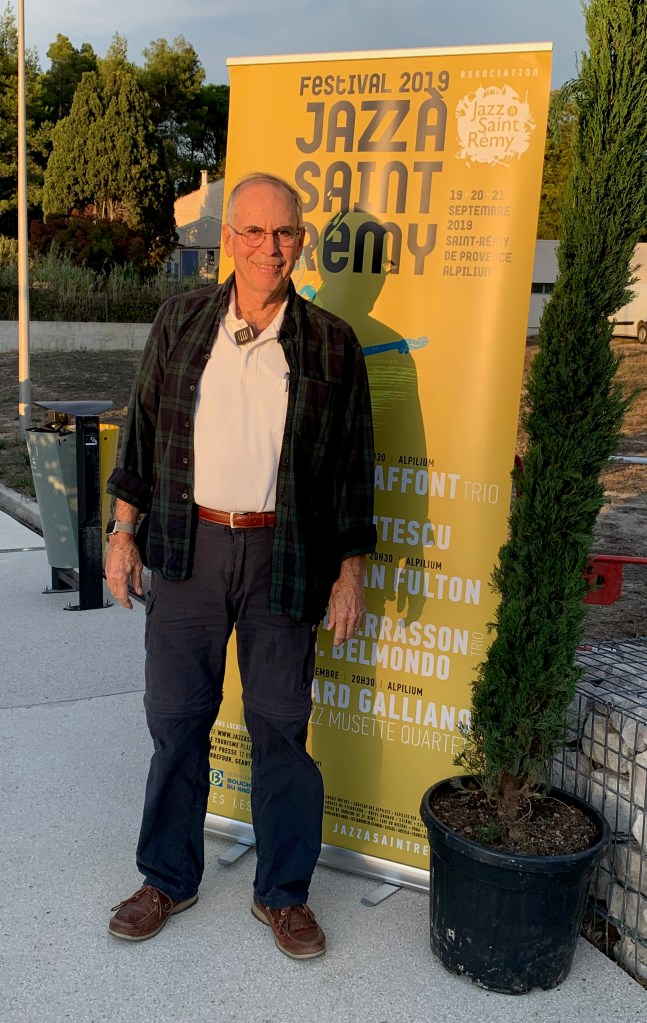
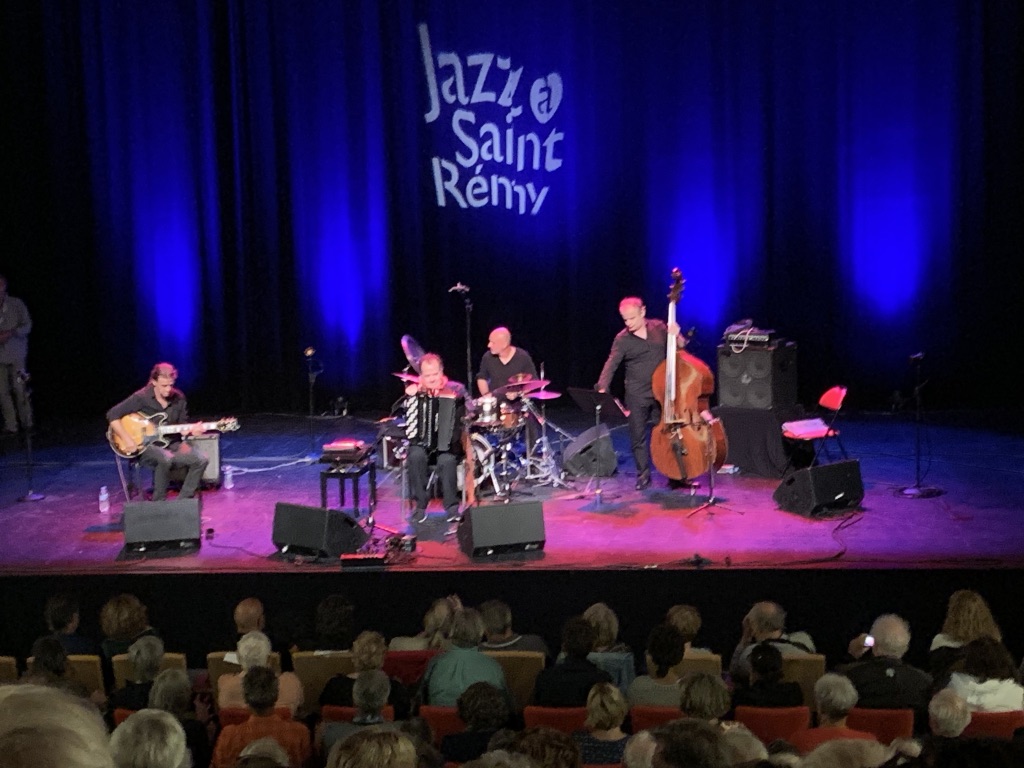
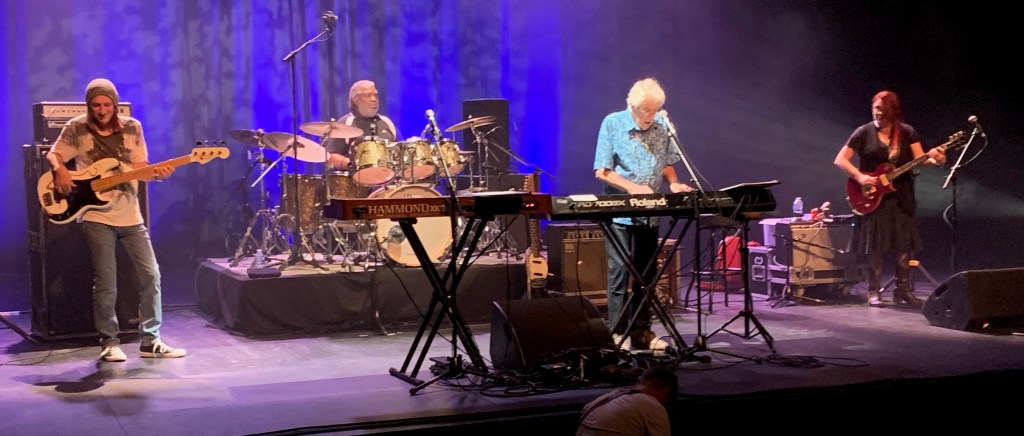
In terms of entertainment, there is quite a lot to do here. There is an event venue called The Alpillium which offers theater, music of all genres, dance recitals, etc. At the end of September there was the St. Rémy Jazz Festival and we attended two of the three concerts. The first night we saw the Steeve Lafont Trio with Costel Nitescu on violin. This was Gypsy jazz and it was FABULOUS! The second concert we attended was on the recommendation of the Monsieur at Cerise et Abricot – the Richard Galliano 4tet. Also wonderful. Galliano is apparently is very famous in Europe. His son is the drummer for the group and he was, to Donna’s mind, the main attraction. Just wonderful! We also managed to score tickets to see John Mayall – aged, but still pretty wonderful with a terrific young female guitarist. We also saw Raul Mindón, an amazing guitarist and a two man “circus”, Inbox. These two young jugglers and acrobats tossed around about 20 large moving cartons for about an hour! They will be joining Cirque de Soleil on its upcoming US tour!

 We are looking forward to some other events coming up in the next few weeks at the Alpillium. There is one movie theater in St. Rémy. It shows mostly French movies, but there will be the occasional English or American movie and that will usually be shown in the VO – Version Originale – for about half of the showings, and then dubbed in half of the showings. We managed to see the Downton Abbey movie, The Adults in the Room and Le Mans in VO.  The movies are only here for a week at a time, so you have to stay alert if there’s something you want to see.

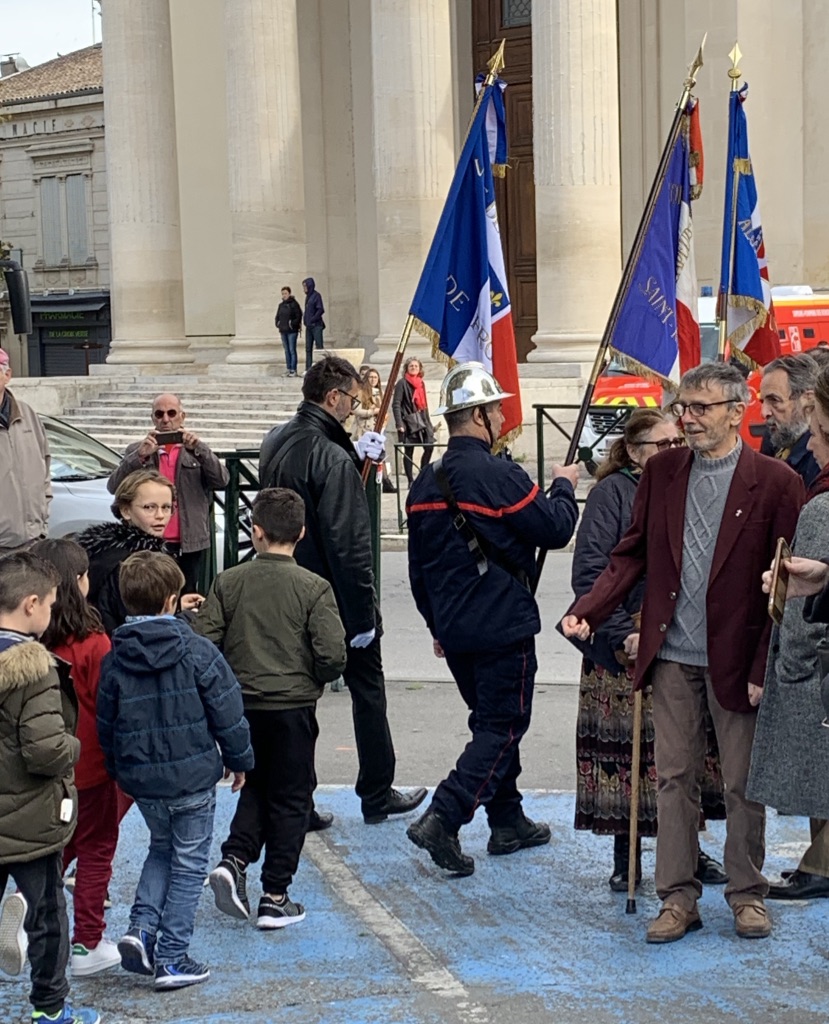
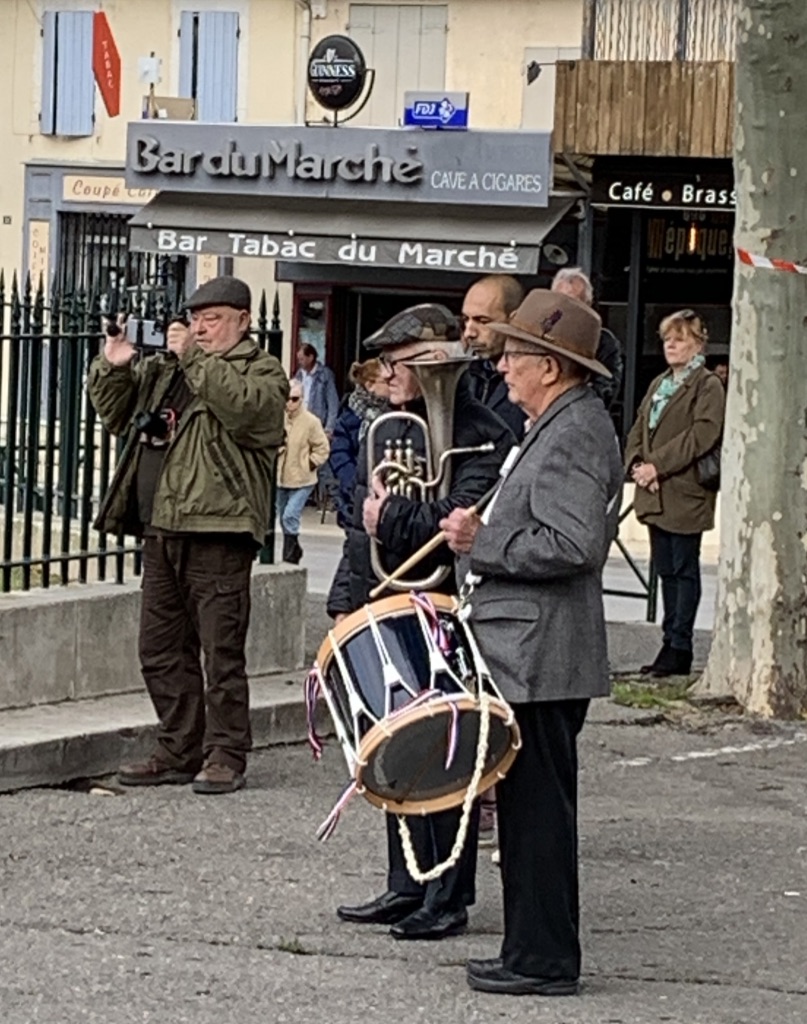
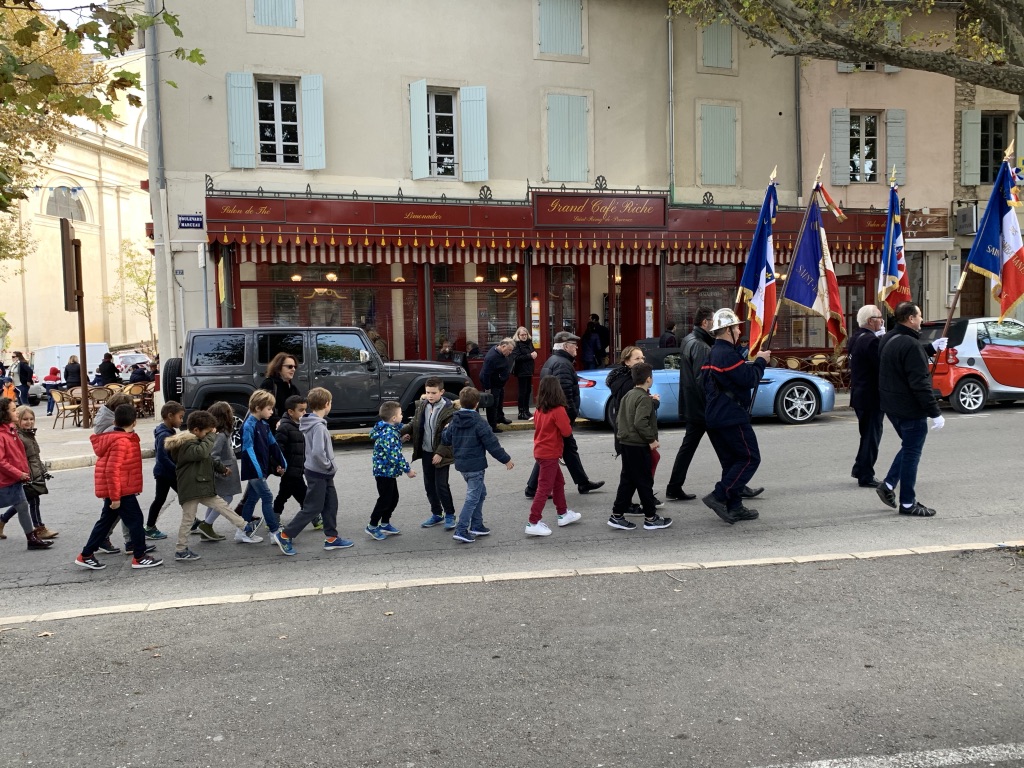
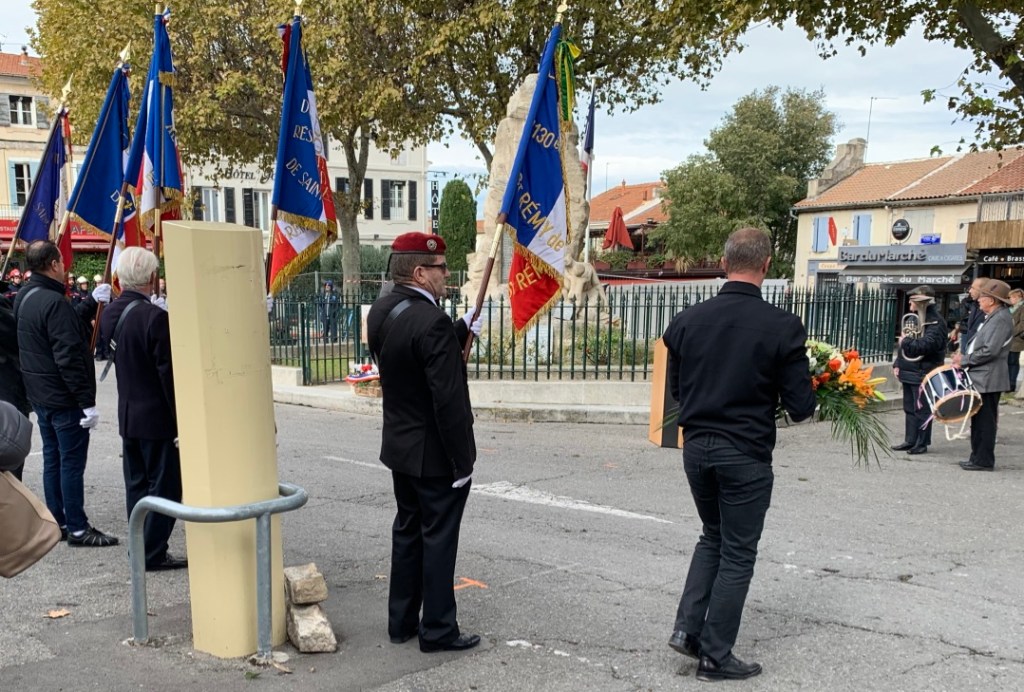
We have a little booklet that is an annual calendar of events in St. Rémy and we check it out to see what’s to do every week. November 11th we attended a ceremony in remembrance of the Armistice of 1918. The war memorial is in what is now a municipal parking lot next to the church. There were military veterans of various French campaigns, police, sapeurs pompiers (firefighters) and a class of either second or third graders with their teacher. Plus, about 100 other citizens. Wreaths were laid, the French version of taps was played by two lovely old gentlemen and the Marseillaise was  sung.  We then marched together to two cemeteries and did the same thing again at memorials in those cemeteries. It was quite moving and made Donna think of Daddy Jess, her maternal grandpère who fought in France during that war.  Afterwards we went to Hotel de Ville for apéros and the presentation of a medal to an elderly gentleman for heroism in Algeria.

As far as television goes, we don’t have a schedule, so when we turn it on, it’s kind of a crap shoot as to what we will find. So we don’t often turn it on. One day we watched “Bones” in French. It was one we had seen previously, being a fan of the show and Steve Beers, its producer (husband of Donna’s good friend Rainey). So that was kind of amusing and fun. We have more often found “reality” TV – with shows similar to The Bachelor or Love Island. Young, attractive, overly dramatic people  having conflicts – not our genre at all! We can watch Apple TV and (when we have internet) we can watch Netflix and Amazon. But most evenings, we read. Sam is reading Sapiens by Yuval Noah Harari and enjoying it tremendously. Donna is concentrating on reading in French. And mostly books she has read in English previously. It has made a big difference in vocabulary acquisition! A lot of words can be deduced from the context and occasionally she has to look up a word or two or three or four per page. 

And speaking of the acquisition of French language skills… We have both been taking French lessons from a terrific teacher and Provençal native, Magali Viven. Sam has taken several weeks of lessons and is making progress. Donna took one week, concentrating on pronoun placement and more complex sentences. She is coming along. Every new adventure adds a new vocabulary word (or two or three or four!). Talking on the phone is still a challenge, but even that has improved! 

Magali, Julie and Donna having apéros in Magali’s garden. Sam is in the foreground (not shown).

One thing we have enjoyed is the French custom of Apéro – a little break between the end of the work day and dinner. Most bars will serve chips or nuts or  tiny crackers when you have a drink at this time of day. So every so often, before dinner, we will go to a cafe or a bar for a drink and a chat. [Sam has never been roughed up for his sans alcool requests.]We love the custom and wish it would spread to the US!  We go out to lunch or dinner a couple of times a week, but Donna is enjoying shopping for ingredients and cooking at home, so mostly we eat in. 

At the butcher, the cuts are very different than what we find in US butcher shops, so that has been a challenge to try to figure out. To get a pork chop, Donna asked for a part of a pork roast to be cut off. Then she cut that in two to make two 1 1/4” chops. But it was boneless, so we missed the additional flavor that a bone-in chop has.  The chickens come with their heads and feet still attached, so of course, Donna learned how to say “Please remove the head and the feet.” “Enlevez la tete et les pieds, s’il vous plaÎt.” [“SVP in this case means “dammit!”]

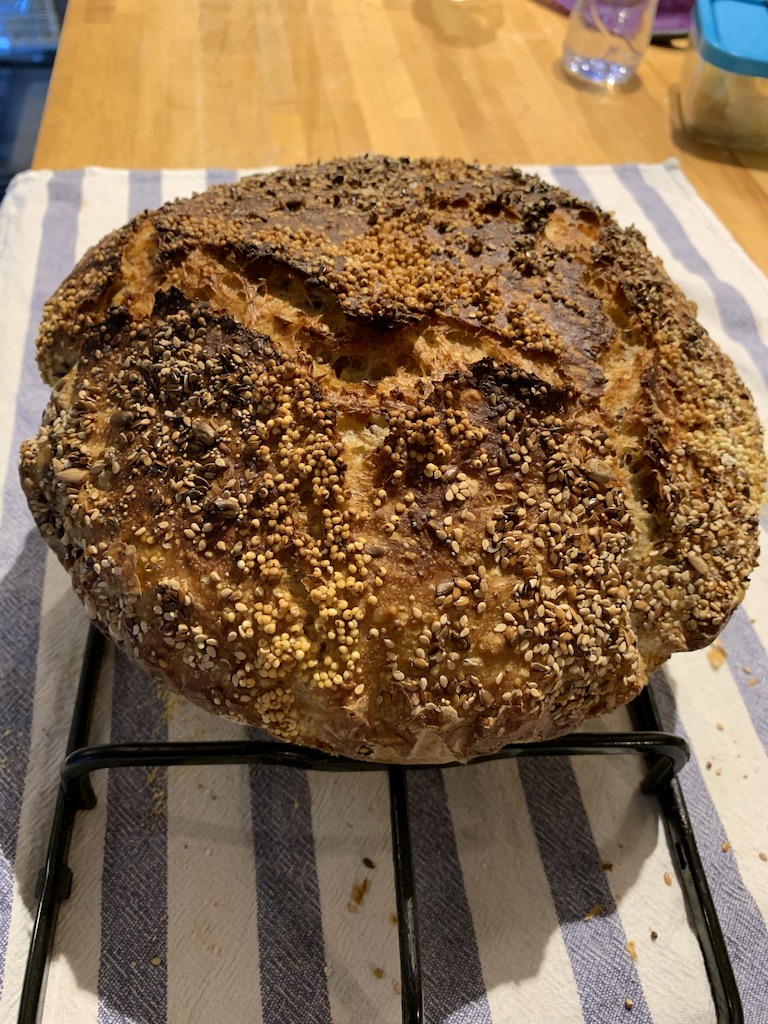
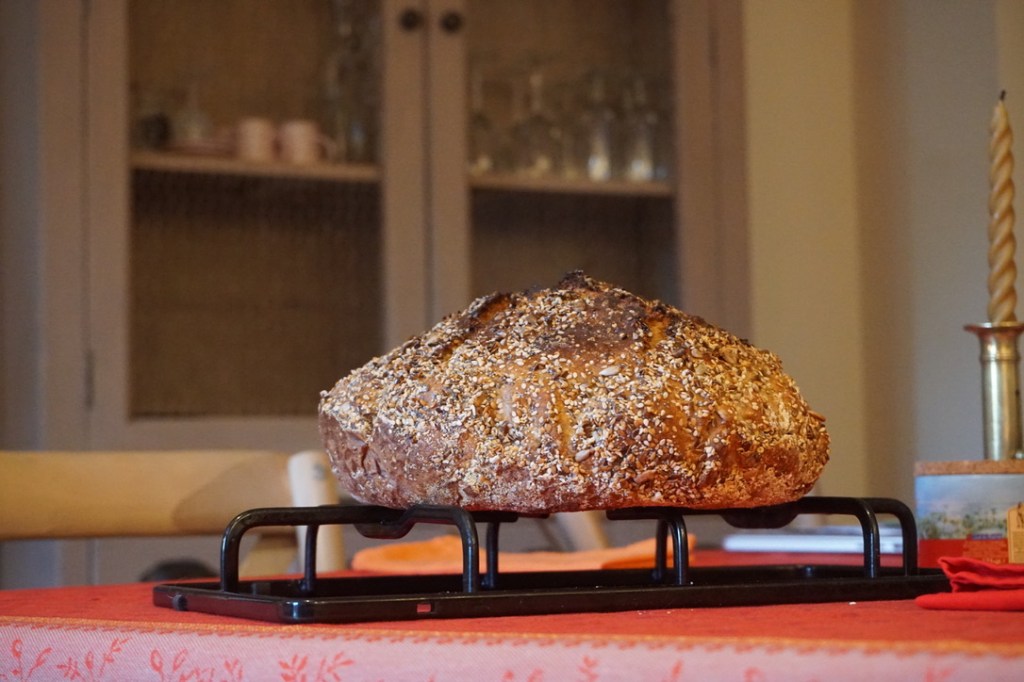
While Donna has enjoyed cooking, Sam has been an amazing boulanger! At least twice a week he has been putting out some of the best bread ever! And as mentioned previously, we share the loaves with our hosts, Delphine and Théo, who LOVE it! He has used the wood oven once, but since most of his loaves are no-knead, the bread needs to be cooked in a Dutch oven to begin and then taken out to be cooked on the floor of the wood oven. You get a little hit of wood smoke! 

Note from Sam: A remarkable thing happened upon making the first loaf, in September. I bought a 1 kg bag of flour, Pain Bio aux 5 céréales! It’s white flour (US equivalent, high gluten flour) with rye flour, oat flakes, millet, rice, lin brun, and sunflower seeds. It made me look good from the start. But I’m a little afraid to take credit. (Donna says he shouldn’t be – it’s all been delicious!)

More recently, sourdough tugged at us and I’ve given it a try. Results have been tasty but somewhat uneven in the crumb. The recent NY Times recipe is long and time-consuming, but seems to be profoundly on point. I wish I was retired so I could have the time…. I found another, softer, easier way and it makes very good sourdough but it ain’t as tangy. All told, making bread here has been fun.

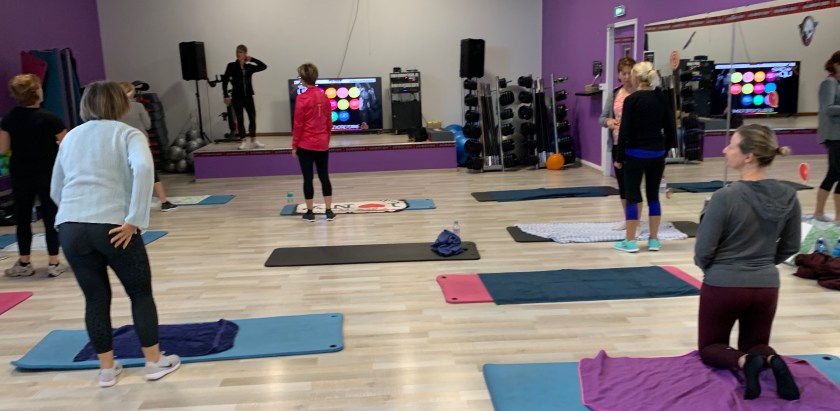
We have joined a fitness club, Wake Up Form, which is part of a chain in France. We go to stretching and Pilates three times a week. The club trainer came up with work-out regimes for each of us  on the machines, so we can do on the days we don’t have class. The stretching and Pilates teacher talks about 300 miles a minute and is a bit difficult to understand, but Donna has learned a TON of new body part words! The instructor knows a very few words in English – like “straight leg” and “shoulder down” which she uses when Sam needs a reminder. But everyone is friendly and helpful. Sam is the only man in any of the classes and he suspects that the other men in the club (not Woke Up in this regard) do not approve of his attending the classes. Sam is finding that at this stage of life, his body rebelled after a spell of inactivity. Three months’ touring Europe was a lot of walking, but lifting was incidental and not enough! Range of motion thus curtailed is improving with strength and flexibility activity. He has just started physical therapy for carpal tunnel syndrome (R) and osteoarthritis in his shoulders (R & L) and can use the equipment and mats at the gym for these exercises.

Virginie, on the stage, preparing to lead a Pilates class.

We have also dipped a toe into the medical care in France. We both got flu shots – you get the prescription from the doctor, go to the pharmacy to buy the vaccine and then go back to the doctor for the injection. It cost less than 30€ each for us to get flu shots – which we imagine is a good deal less than what an uninsured person would have to spend in the US. Sam had an x-ray on his shoulder for 58.35€. Donna has been getting physical therapy for her knee at about 16€ per session (less than her co-pay in Oakland!). St-Rémy only has general practice docs, so if one needs a specialist, one needs to head to Aix-en-Provence, Montpellier, Marseille, Arles or Avignon, all within an hour or so of St. Rémy.We do have health insurance coverage on this trip, but it doesn’t cover pre-existing conditions. And as a wise friend of ours said – At our age, what ISN’T pre-existing?

Going into the GP’s office here is a very different experience and took some intuiting to figure out the way it works. At the clinic we have been going to there are no appointments. You walk in, say “Bonjour” to everyone in the waiting room and find a seat. Then you need to count how many people are in the room and make a kind of mental note of who was here before you. If there are five people in the waiting room, you are sixth in line. After the number five person exits the doctor’s office and he asks who’s next, you get up and enter. When you leave the office, you say “Au revoir” to the folks who are still waiting. Très aimable!

Once or twice a week Sam goes to Aix-en-Provence, about an hour away, where he has friends. Occasionally, Donna accompanies him and spends her time wandering around the Vieille Ville while he is with them. We may have dinner with them, or come home for something simple. Aix is a lovely old town with an amazing old historical center. And it has a mall with some interesting shops kind of on the order of Fourth Street in Berkeley. We have not yet spent any time being tourists there. We have big plans to get to the Cezanne Museum, however.

And, of course, we try to do some sightseeing here in Provence. The next few posts we will share some of the places we’ve seen in this beautiful part of the world. 

Our Town

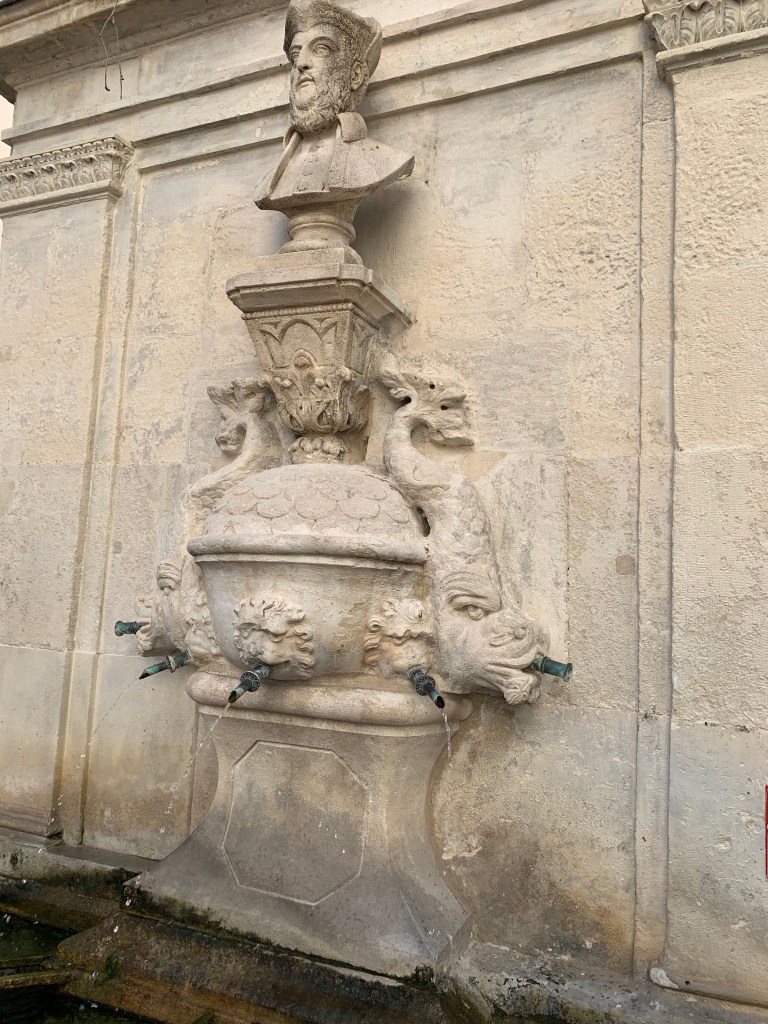
La Fontane des Quatre Dauphins in the Place Jules Pellissier – in front of Hotel de Ville (City Hall) in St. Rémy de Provence. These dolphins represent the sons of Louis XIV, only one of whom – i.e. one of fourwas able to reign as king for more than a few months. The Rémois call this the Fountain of Three Dolphins, as no matter where you stand, you can only see three of them-i.e., three of four!

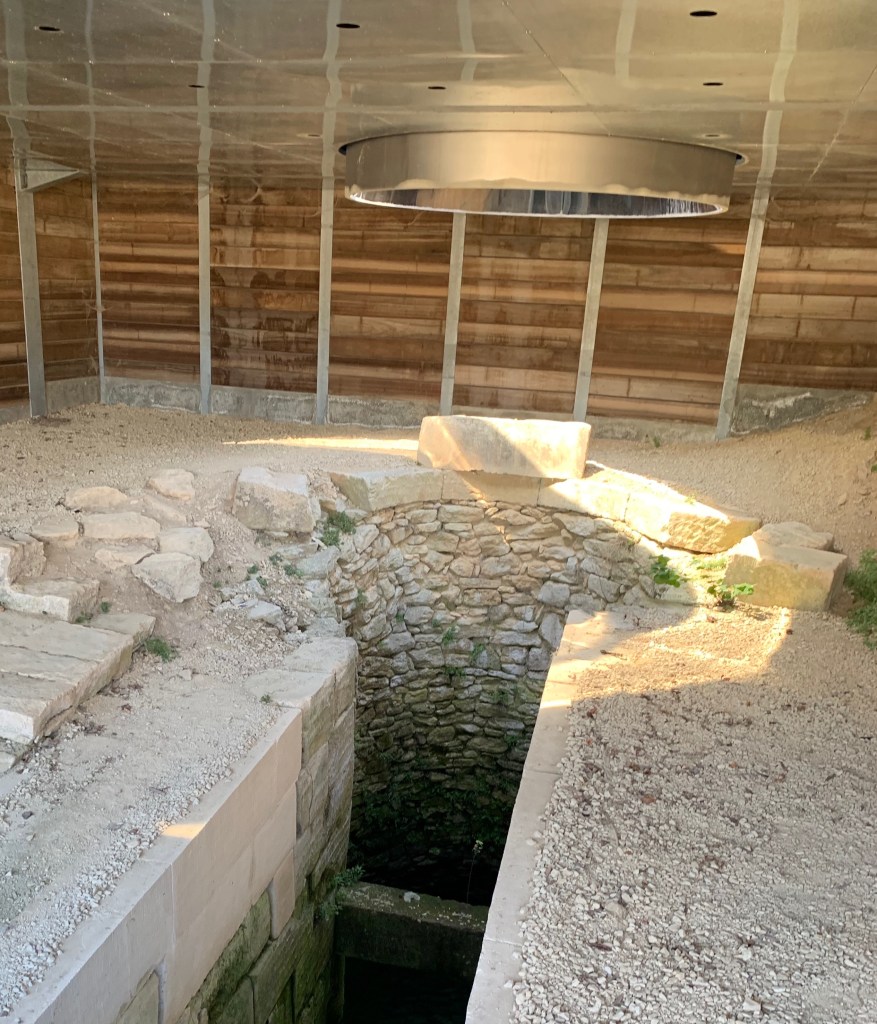
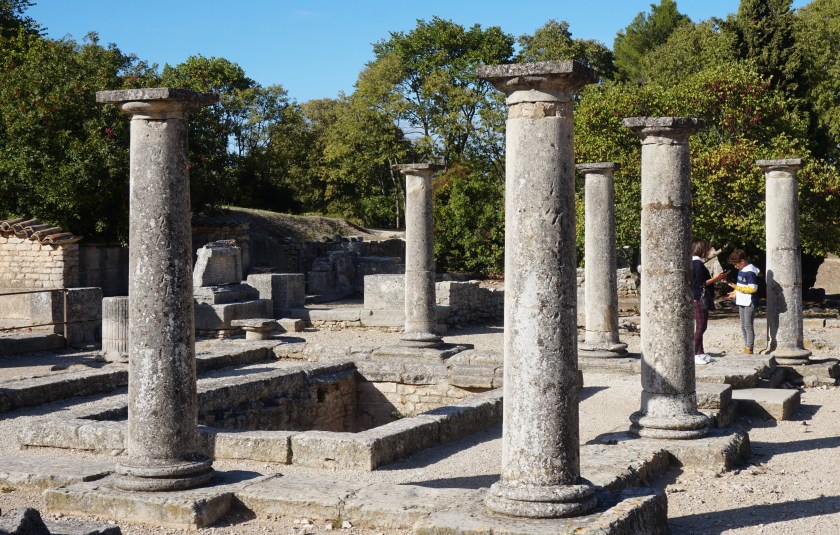
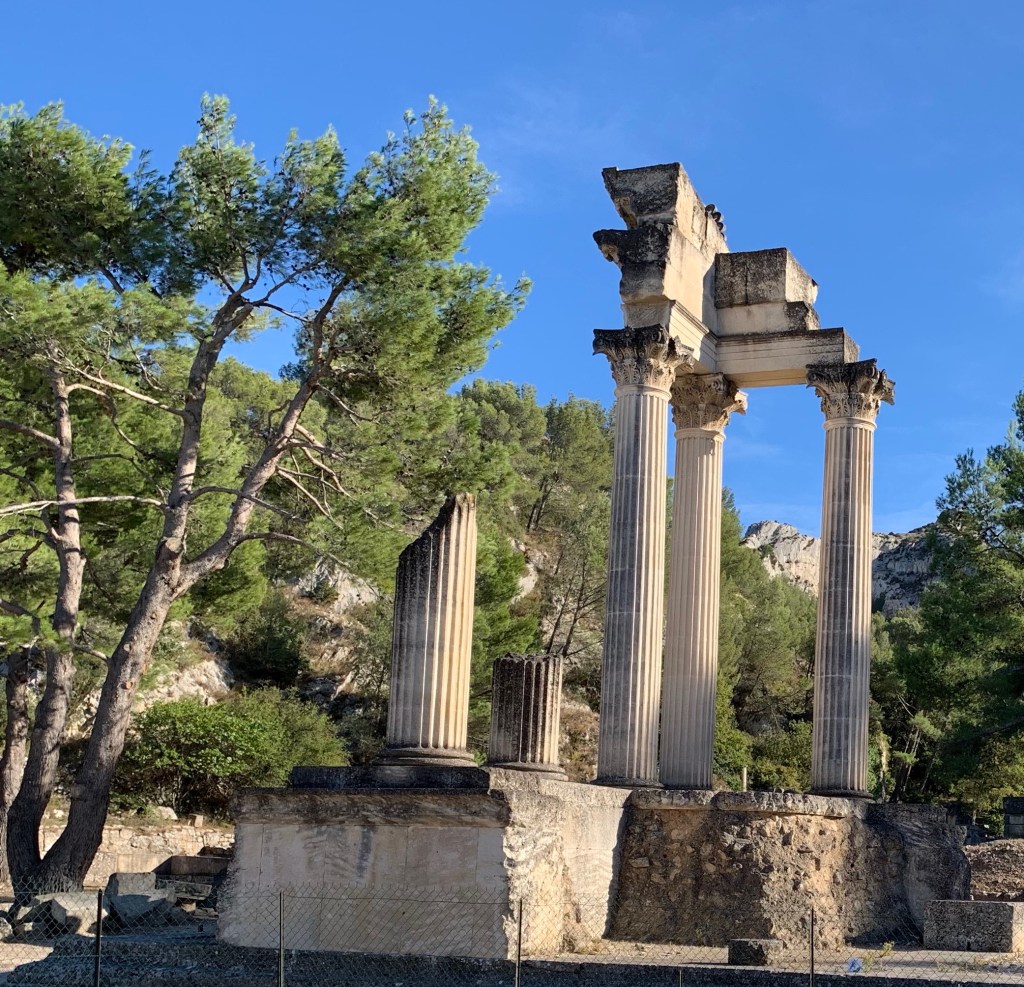
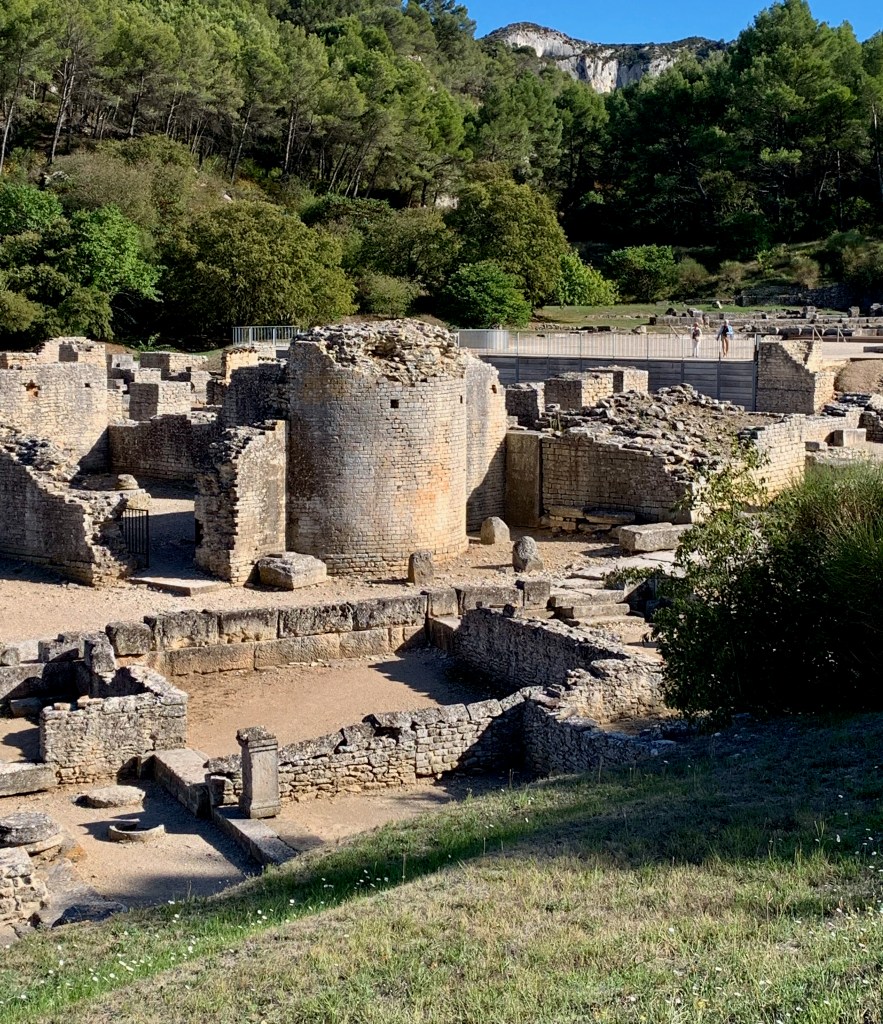
The first indigenous inhabitants of this area in Provence settled here in the 6th and 7th centuries BCE. Protected by the mighty Alpilles range of limestone cliffs and believing that the springs in the area had healing properties, it was a salubrious location. Named Glanum  after the Celtic-Ligurian god Glan, the first settlement was small, however subsequent relations with the Greeks from Marseille brought wealth to the inhabitants of Glanum, more sophisticated building techniques and an extension of the inhabited zone in the Hellenistic style. Then, in the early years of Augustus’s reign (63 BCE to 14 CE), Glanum became a Roman colony, after Rome moved in to ward off Hannibal. This brought another  transformation to the town’s architecture, covering over the Greek construction with Roman works. 
Glanum is one of the oldest, largest and best preserved archeological sites in Europe. It had everything needed for a civilized Roman city – a sacred spring, housing, shops, a forum, temples, baths, cafes, and a basilica, no less, for administrative purposes. Defensive walls and ramparts from earlier periods became surrounded by the larger town and were subsumed in the Roman plan. The siting of the main town provided for natural drainage to handle both runoff and waste.

At the entrance to the town stood two amazing monuments that remain nearly completely intact to this day – the Mausoleum and the Triumphal Arch. These monuments stood for centuries without any indication that there were more ruins to be discovered!

However, in 260 CE, the Alammannic (aka Barbarian) invasion nearly destroyed the town, and the survivors abandoned Glanum and moved to an inhabited area about 2 km north that later came into the possession of the Abbey of Saint-Remi in Reims.

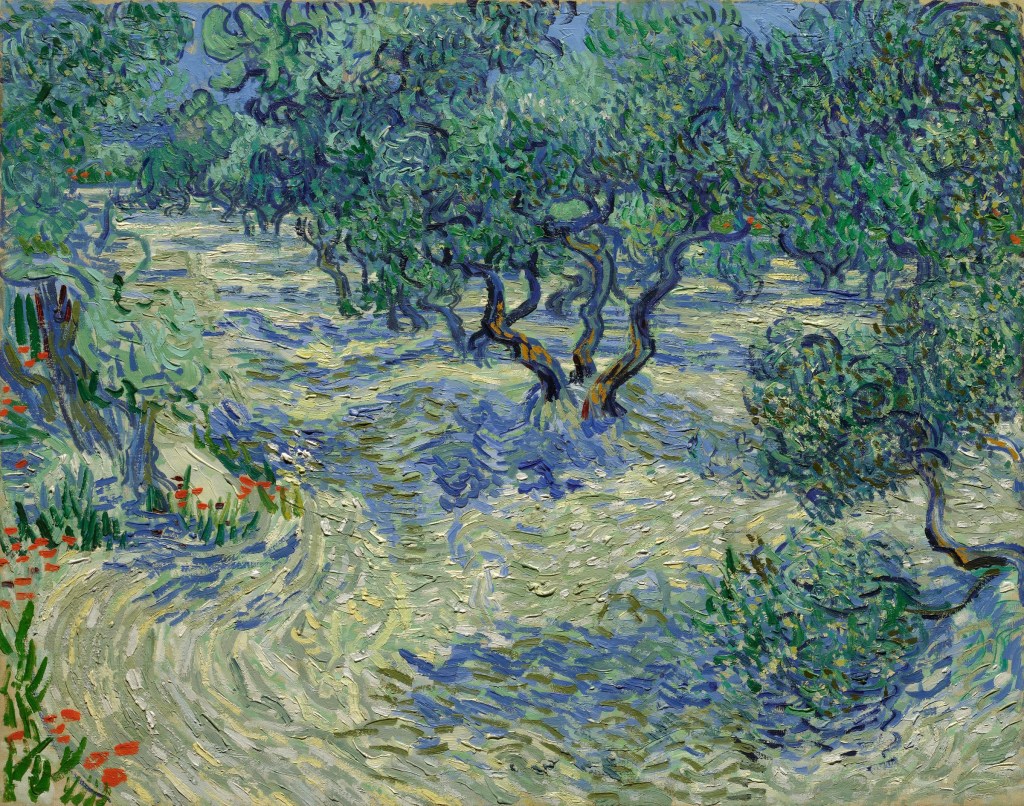
Following this destruction, Glanum was left to fall out of memory. Eventually, rain, silt and rocks from the Alpilles poured down the mountain sides and covered up the remains of what was once a vibrant town. The Mausoleum and the Triumphal Arch, on high ground, were the only remaining visible vestiges of the city. And it was not until 1921 that the ruins of Glanum were discovered under an olive grove immortalized by Vincent van Gogh during his stay in St. Rémy in 1889, and a vast archeological endeavor was undertaken. 

The Olive Orchard by Vincent van Gogh

Present day St. Rémy is a composite of old and new. Built using rocks scavenged from the remains of Glanum, the historical Vielle Ville is a web of narrow streets that weave around like a plate of spaghetti. Surrounded on four sides by a ring road consisting of Av. Victor Hugo, Bd. Mirabeau, Bd. Gambetta and Bd. Marceau, there are no parallel streets, no grid and not a full complement of actual street name signs. A street sign is a tile or enameled plaque set at a corner building at the level of the premier étage, or, to us, second floor. These lovely limestone paved streets are lined with medieval restored houses and lead to quiet little squares shaded by plane and chestnut trees. Cafes and bars invite you to sit, have a drink and people watch.

By the 1400’s St. Rémy was a walled town with only one entrance, the Porte St. Paul. Later other gates were added, however today there remain only two, the original St. Paul Gate and the Porte de Trou, or Hole Gate. What remains of the walls has been transformed into homes, hotels and shops.

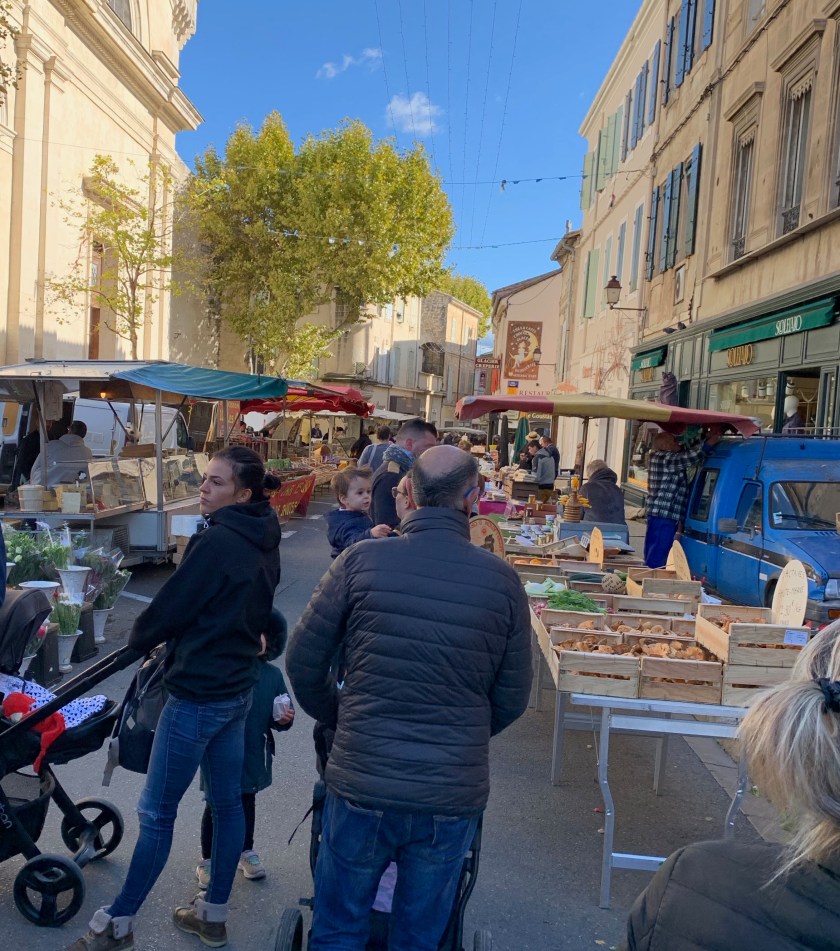
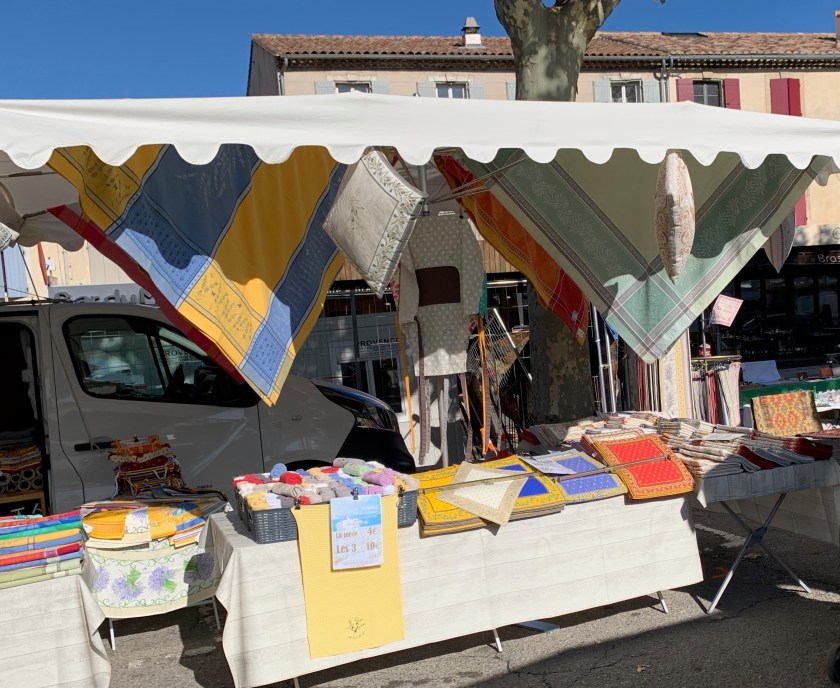
Much of the historic center is populated by more tourist-oriented shops. Lots of trinkets and souvenirs, lavender and soap purveyors, Provençal pottery and linens. There are many art galleries, a few small antique shops and some boutiques ranging from high end to bargain level. There are also caves à vin, fromageries, a terrific spice shop, and some wonderful restaurants. Spring and summer bring onslaughts of tourists. Many stay in St. Rémy itself or in hotels, gites and Airbnb’s in the nearby countryside. But also, tourists from cruise ships in Marseille show up often, especially on Wednesday, which is the Grand Marché Provençal. The Grand Marché has food purveyors as well as a wide variety of clothing, hats, shoes, housewares, table and bed linens, ceramics and pottery, soaps, art prints, and jewelry. On Saturday there is a Petit Marché Alimentaire in the Vielle Ville which is almost exclusively food-oriented and consists of local vendors of produce, meat and poultry, cheese, honey, wine, lavender, sausages and olives and olive oil.


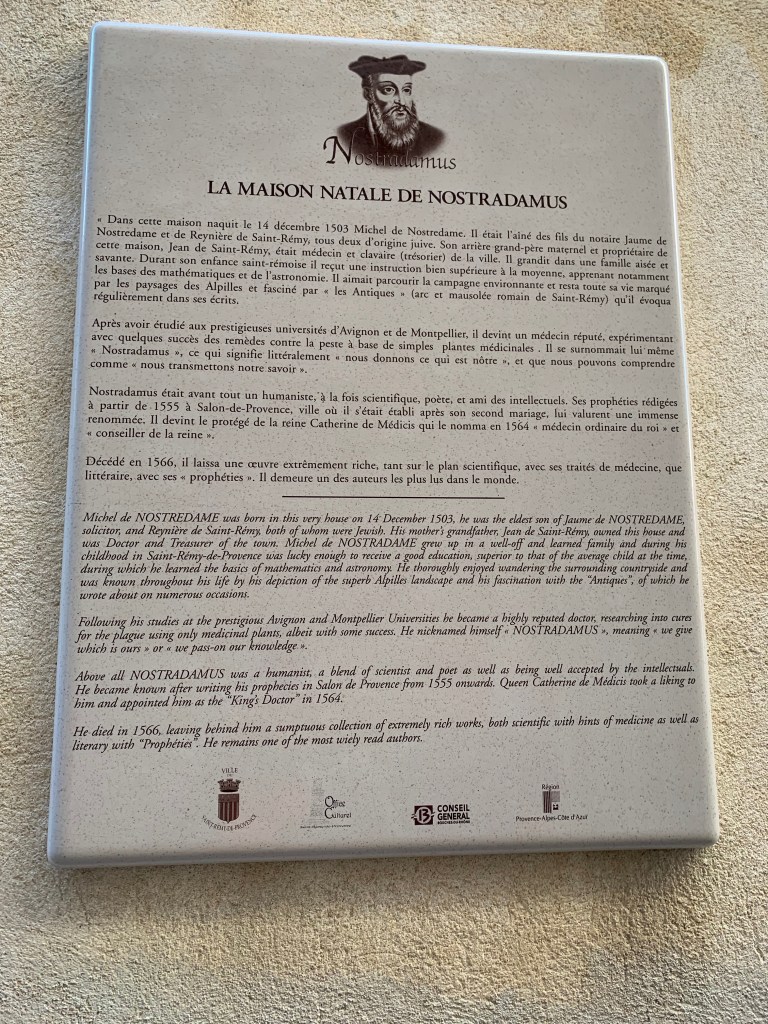
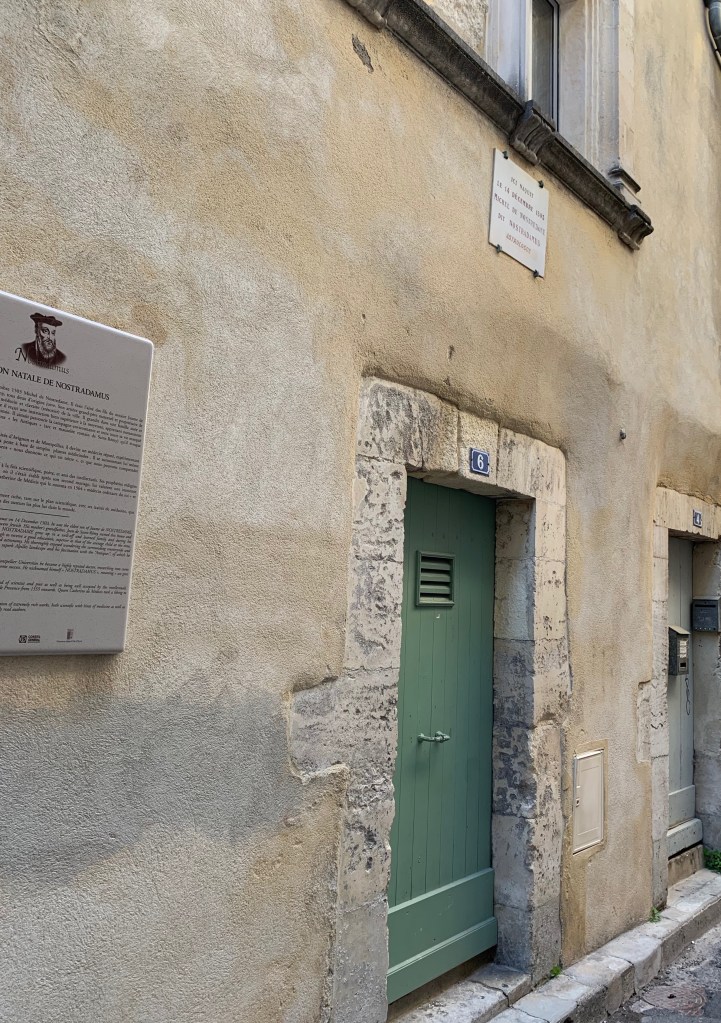
St. Rémy prides itself as being the birthplace in 1503 of Michel de Nostredame, aka Nostradamus, a French astrologer, physician and reputed seer, who is best known for his book Les Prophéties, published in 1555. Other famous residents include Fréderic Mistral, the poet; Charles Gounoud, the composer, who wrote the opera Mireille during his brief sojourn here; and Marie Gasquet, Provençale novelist and queen of the Felibrige, a literary and cultural association created to promote the Provencal/Occitane language and literature, F. Mistral having been one of the founders.

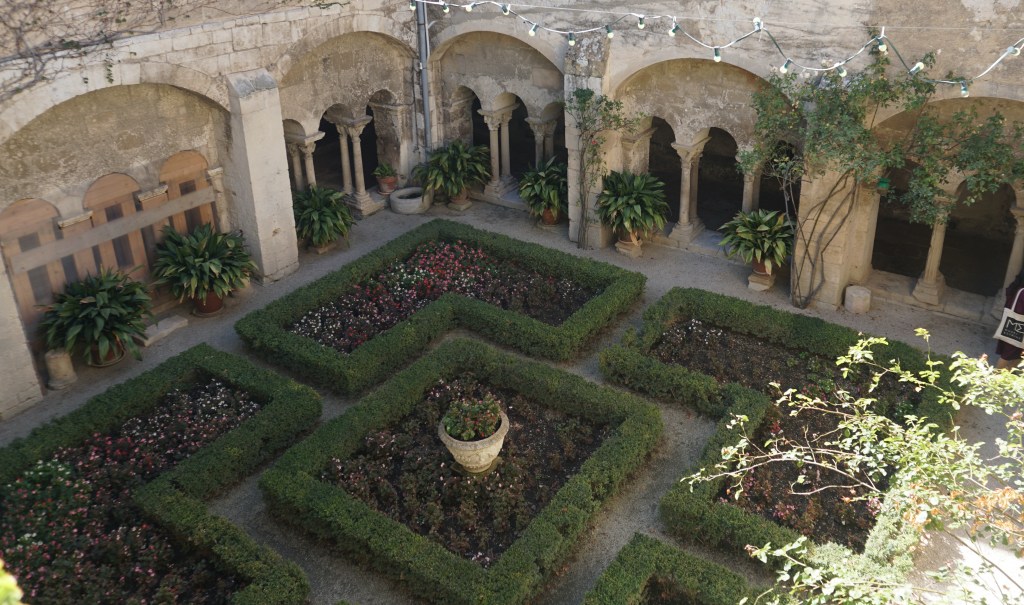
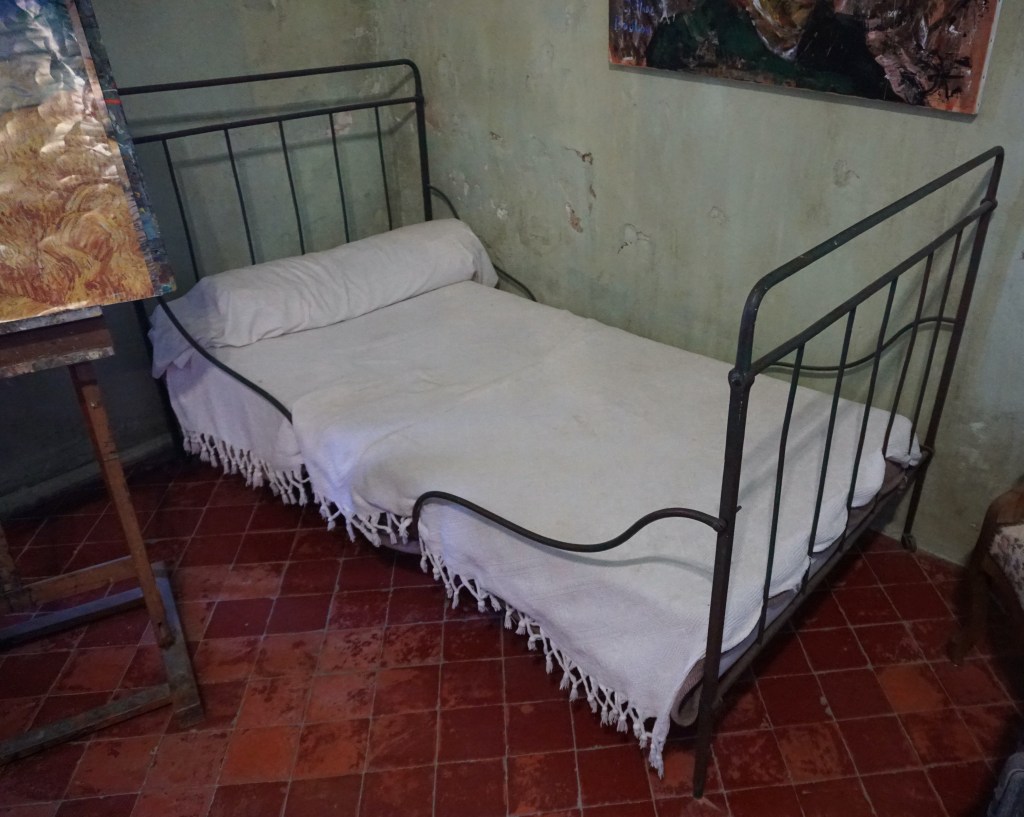
Out of many other famous persons who are associated with St. Rémy, Vincent van Gogh is probably the most celebrated. He first arrived on May 8th, 1889, to be “interned” at his own request, in the Asylum of Saint Paul Mausole. 
Fascinated by the quality of light and the beauty of the landscapes that he discovered in Saint Remy, he was very inspired during his 53 week stay. He was relieved to find a very understanding reception among the religious and staff who welcomed him and allowed him a great deal of freedom to leave the asylum to paint (accompanied, bien sûr). Despite periods of serious mental disturbance, he completed nearly 150 paintings and 100 drawings within one year, including Starry Night and Self Portrait. He left Saint Rémy on May 16th, 1890 to go to Auvers sur Oise, where he committed suicide two weeks later. (We understand there is some controversy over whether his death was a suicide.)

A poster advertising the asylum. Les aliénés refers to the “the insane”.

Interestingly, Albert Schweitzer was also a patient at the St. Paul Mausole asylum. Doctor Schweitzer was “hospitalized” here in 1917-18, for the remainder of WWI. He wasn’t so much ill as German. He took advantage of his “hospitalization” to write The Decay and the Restoration of Civilization and Civilization and Ethics, part of his philosophical study of civilization.

This is a bit of the history of this lovely little town where we have settled-for five months, that is. In the next post we look forward to sharing how much we enjoy living here and some of our daily activities.

Settling in In St Rémy

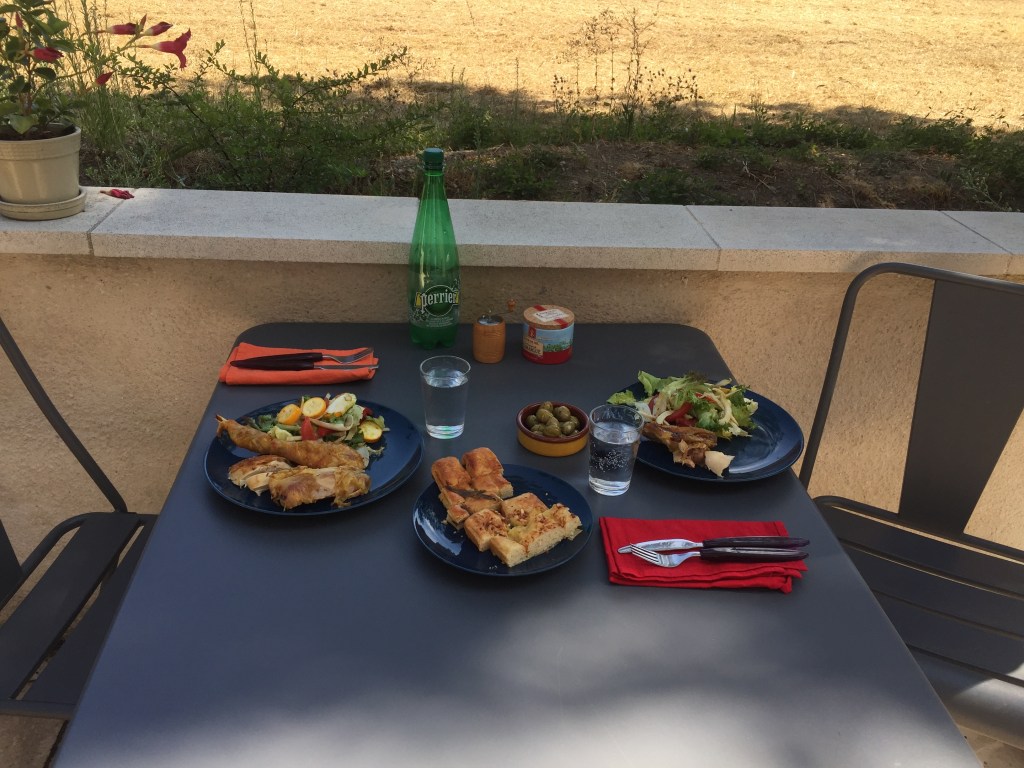
Le déjeuner à coté de l’herbe! This is part of our dream of living in France!

We arrived at our new home at 7:03 PM on the 1st of September. Delphine and Théo met us and escorted us into the apartment, where they had loaded the table with gifts from local producers – wine, olive oil, a huge bar of olive oil soap, mineral water, cookies (Théo’s favorites),and fleur de sel. Such a sweet and generous gesture! Within a few minutes, their two children arrived – Gianni, nearly 6, and Gloria, 2. Curious, but shy, they orbited their parents and gave us skeptical looks. LuLu was taking the whole thing in stride, but was little hesitant herself!

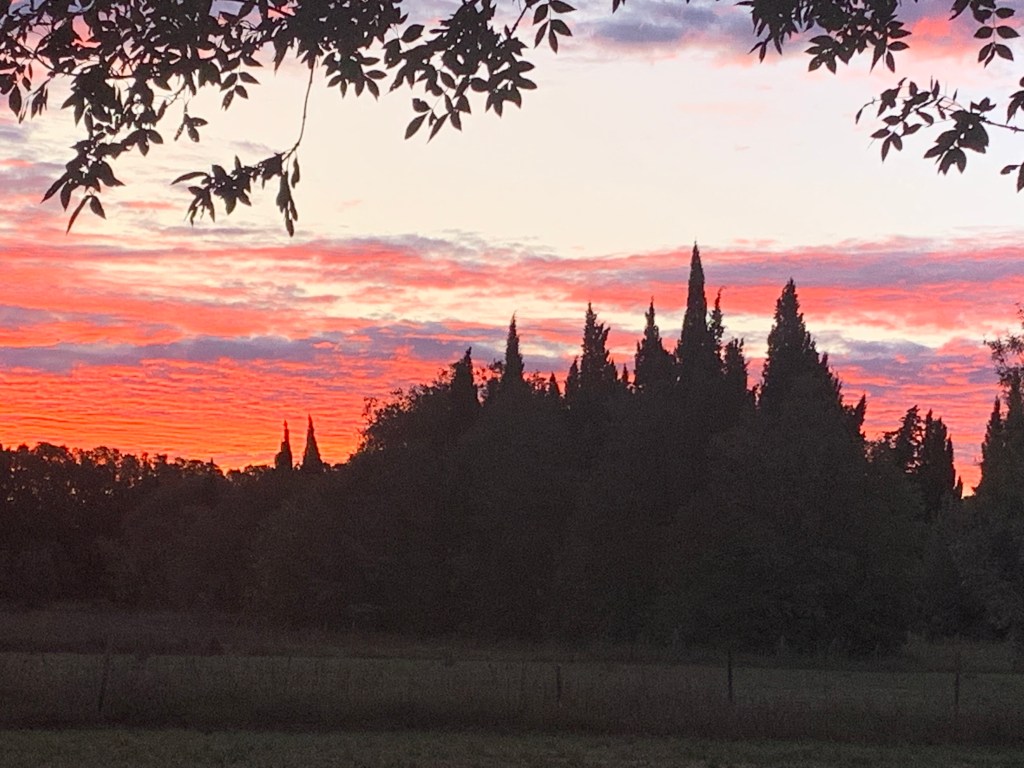
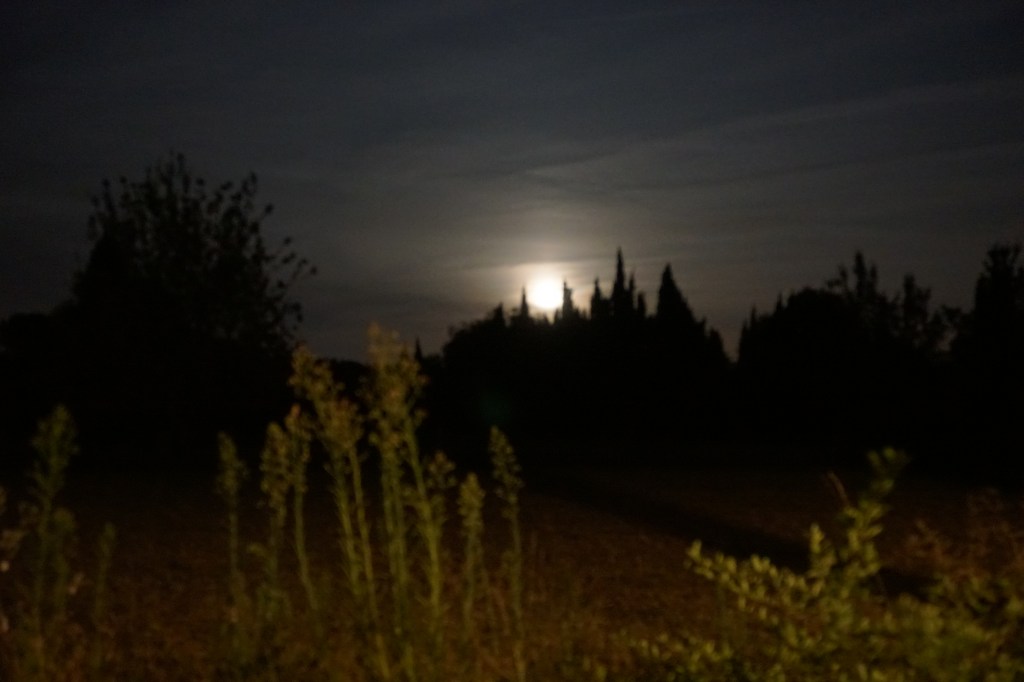
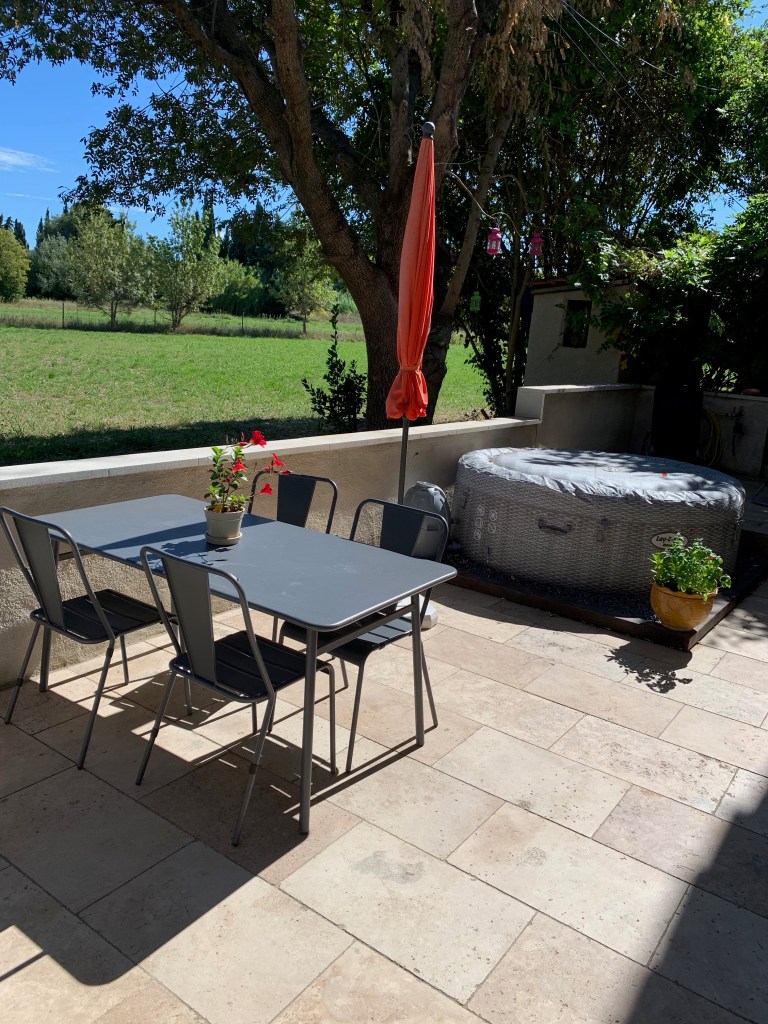
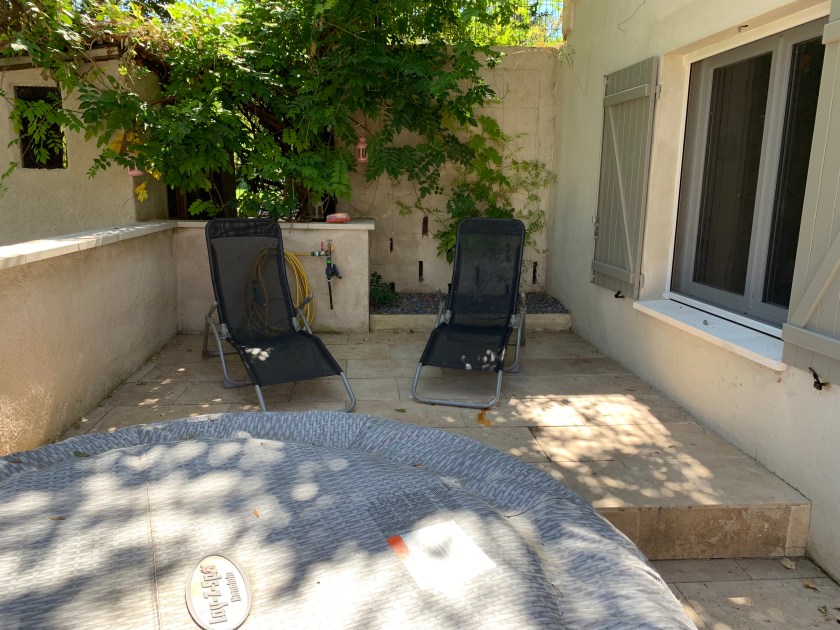
Our little abode is one of two rental units in the main house. Our apartment is on the ground floor (rez de chausée) at the back of Théo and Delphine’s house. And there is a smaller unit on the other end of the house. The house itself sits on a rather large property which includes a smaller house where Delphine’s parents live – with a glorious garden and piscine (swimming pool–it’s the Number 1 French word subject to joking by international punsters), and a large barn which houses Théo’s plumbing business and Delphine’s father’s mechanics shop. He is retired, but previously was a mechanic for farm vehicles. He continues to putter! We enter through a gate from the large parking area to a lovely, tranquil patio with a table and chairs, a spa and 2 lounge chairs. At one end of the patio is a huge wisteria with a trunk about 15 inches in diameter! We are already sad that we won’t be here to see it bloom next spring! The other thing we have on the patio is a wood fired oven (four à bois). We haven’t tried that out as yet. But watch this space, as plans are afoot for the Bernardonis and the Harrisons to have a pizza bake off! Théo apparently is quite the master pizzaiolo! Our patio overlooks an empty field, which I erroneously thought was a lavender field. Tant pis! The field is surrounded by mostly evergreen trees and we can watch the sun rise, or more commonly the moon rise, over them.

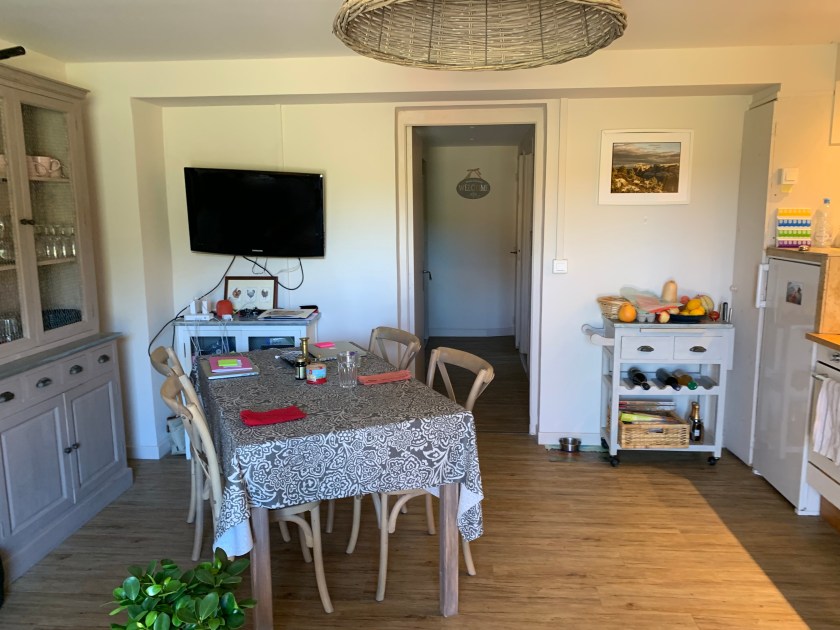
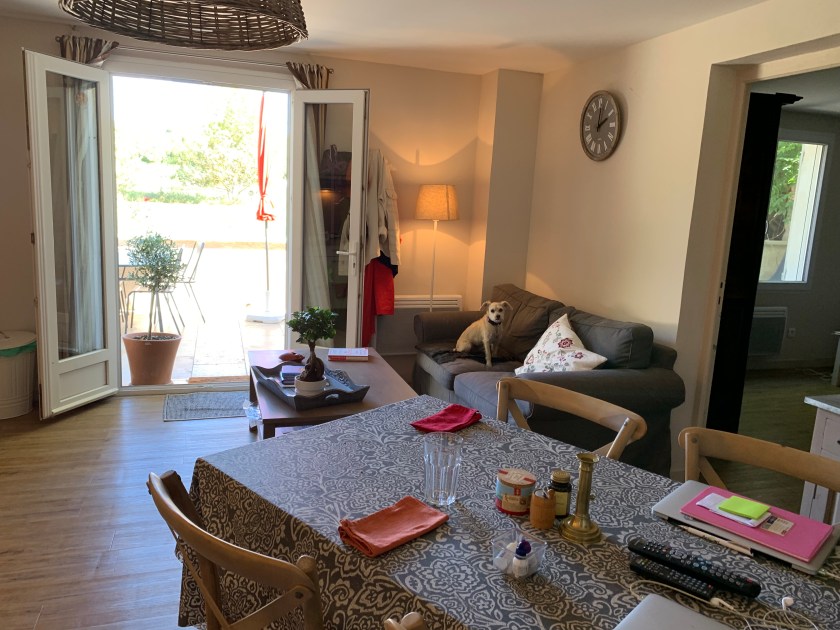
We have a kitchen/living/dining room combo. An open floor plan, as they say! There is a bathroom with a shower and a washing machine and a separate WC. There are two generous sized bedrooms. Ours is in the front of the apartment, just off the living room. The other one, at the back of the house has no window. Kinda weird, but very cosy and sleeping late is no problem! Everything is quite modern, new appliances, fresh stone tile, new beds. Delphine and Théo installed an oven after I expressed that I really liked to cook and bake. They also changed the windows in our bedroom from two small ones to one larger one. The kitchen is pretty well equipped, except there’s no cast iron skillet! I have my eye out for one of those. Delphine has loaned Sam a Le Creuset casserole for his bread – thereby earning herself half a loaf of bread every time he bakes!

We are about 2 kilometers from centre ville and two kilometers from a little shopping area with an Intermarché supermarket with a gas station & car wash, Cerise & Abricot organic green grocer, Aldi’s, and Bio, which is apparently a French chain of organic grocers. It has EVERYTHING, take-out prepared food, a cheese counter, butcher, wine, bread counter, cleaning supplies, everything organic, humane and sustainable! Around the corner there’s an organic bakery with fabulous bread (not as good as Sam’s of course). There are a couple of patisseries in the neighborhood (which Donna has not explored. Her self control only works if she doesn’t go in at all! Once inside, all bets are off!). Also, we even have a Mr. Bricolage which is like a small Home Depot. So, really, whatever we need is easily accessible.

Delphine, Théo, Gianni and Gloria are delightful neighbors! Delphine has her own business grooming dogs. LuLu got to be a client a couple of weeks after we arrived and looks just gorgeous after Delphine’s ministrations! She also keeps chickens, so every day we take out our little pile of vegetables, from salad trimmings to leftovers, and give them to the girls. They oblige by providing eggs! Fresh and delicious! Her parents Jany and Joël are warm and friendly. We are really enjoying getting to know the family. We’ve also met Theo’s parents who drop by occasionally.

We are just loving St. Rémy! It is a gorgeous little town. Our next post will be all about our new neighborhood!

Love to you all,

Sam, Donna & LuLu

September 2019