
After struggling to get through a toll gate – 40 minutes of bumper cars – the road into Rome was blissfully open and free of jams. At a certain point, we crested a slight rise, and there, laid out in front of us, was the Metropolitan City of Rome. It’s stunningly low-rise. There isn’t a building over six storeys, as far as we could tell, although we later learned that the Colosseum was seven storeys. It was near sunset and the city seemed bathed in a golden light. It was probably the reflection of 98˚F heat radiating off the buildings! But it was still gorgeous and we were excited to be there.
Our Airbnb was a lovely apartment in a complex about 20 minutes by bus away from the center of action. We went through a locked gate into a calm, quiet, plant-filled courtyard. It was a cool and heavenly respite from the noise and heat of the city. Plus we were only two blocks from Carrefour, a supermarket open 24 hours a day, and there were some terrific restaurants right on our street. We were all set!
In the apartment, we found a book of guided walks around Rome. So, Monday morning, despite the heat, we set out to walk from the Pantheon to Piazza Navona. Rome is a sprawling, cosmopolitan city with nearly 3,000 years of globally influential art, architecture and culture on display. It would be nearly impossible to see everything, but we hoped to get to The Greatest Hits!
The Pantheon.
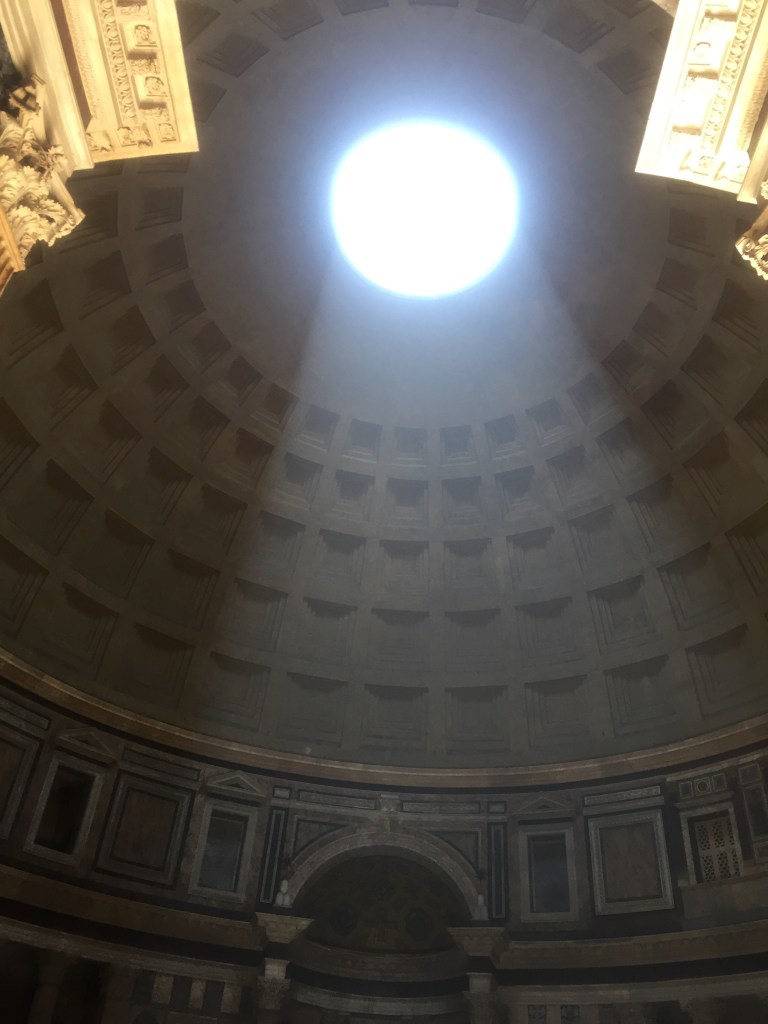
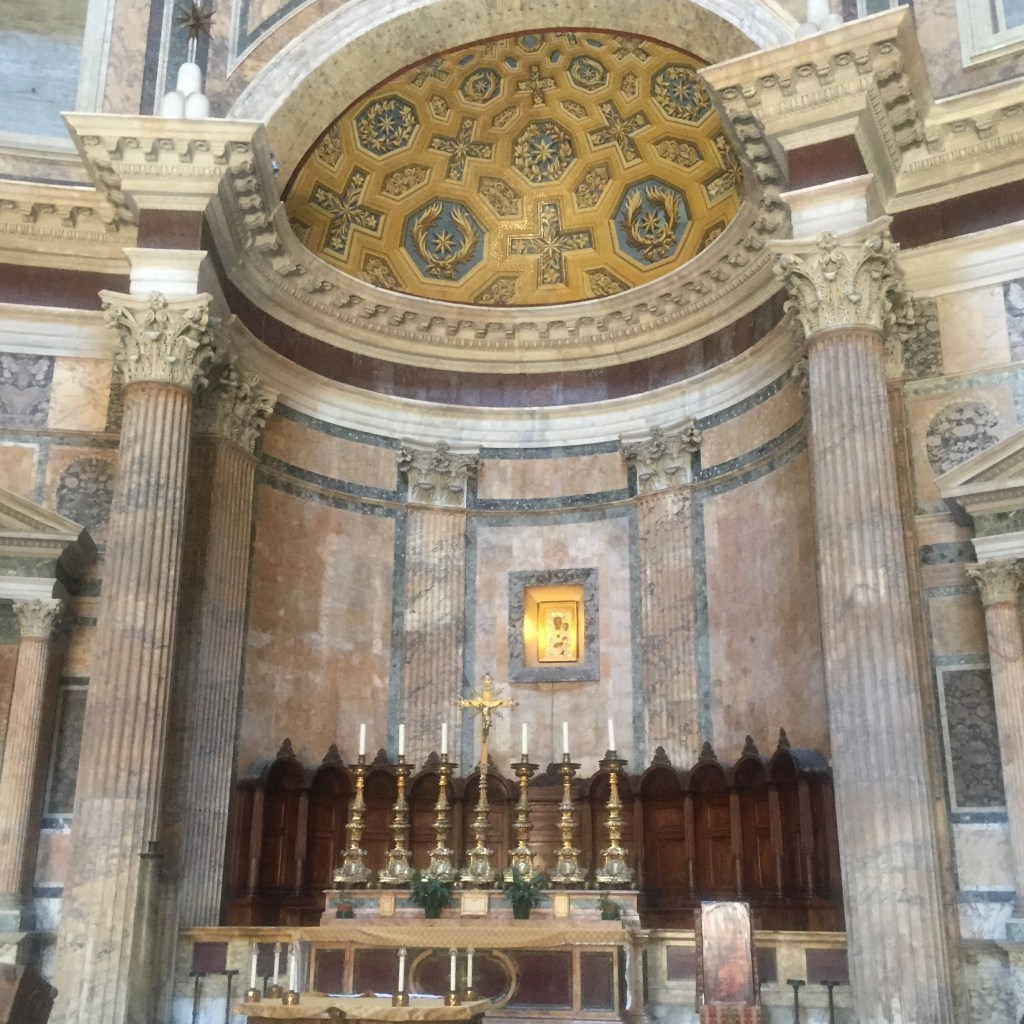
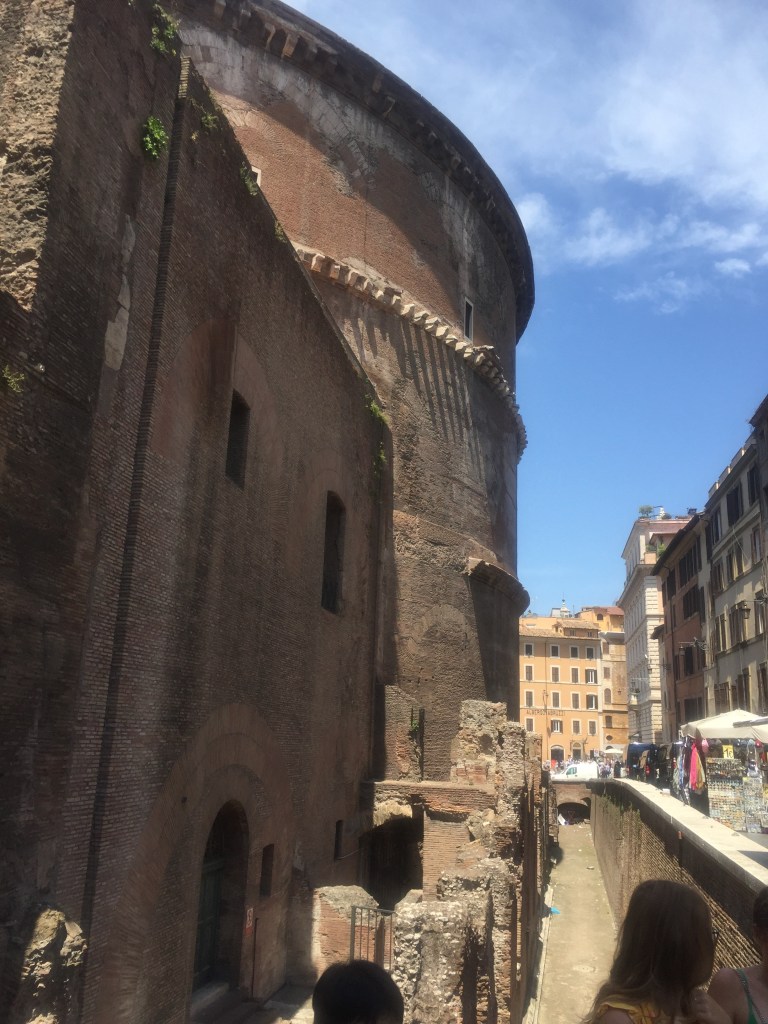
First stop, The Pantheon. It is one of the best-preserved of all of the ancient Roman buildings, in part because it has been in continual use throughout its history. Once a temple to all the Roman gods, since the 7th century the Pantheon has been a Catholic church dedicated to St. Mary and the Martyrs. As with many Roman antiquities, the Pantheon has been stripped of bronze and marble. Emperor Constans II of Turkey, stripped the bronze roof in 663 CE and sent it to Constantinople. Much of the exterior marble has been removed over the centuries. Columns and sculptures were lost. Pope Urban VIII stripped away the bronze ceiling of the portico. Happily, the marble interior has survived, albeit with a lot of restoration. Missing from the coffers in the dome is gold. It’s not clear how much coverage there was but we heard that the gold leaf in the coffers was expropriated for use somewhere else in Rome.
The Oculus is a stunning architectural achievement. The thickness of the dome varies – 21 feet at the base to about 4 feet at the Oculus. Directly below the Oculus holes in the marble floor that act as a drainage system in the rain -or the very occasional blush of melting snow. The dome is unreinforced concrete and its staying power has caused endless engineering debate. Is the concrete a lost recipe (mix design)? Was the freshly-poured concrete agitated (vibrated) to a fare-thee-well to eliminate air bubbles?
Another highlight of the walking tour included the monument to the unification of Italy in 1870. The Monumento Nazionale a Vittorio Emanuele was inaugurated in 1911 as a tribute to Victor Emmanuel II, the first king of Italy after the country’s unification. The Romans call it the Wedding Cake! It is so out of scale with the buildings in the entire rest of the city, it is hard to ignore!

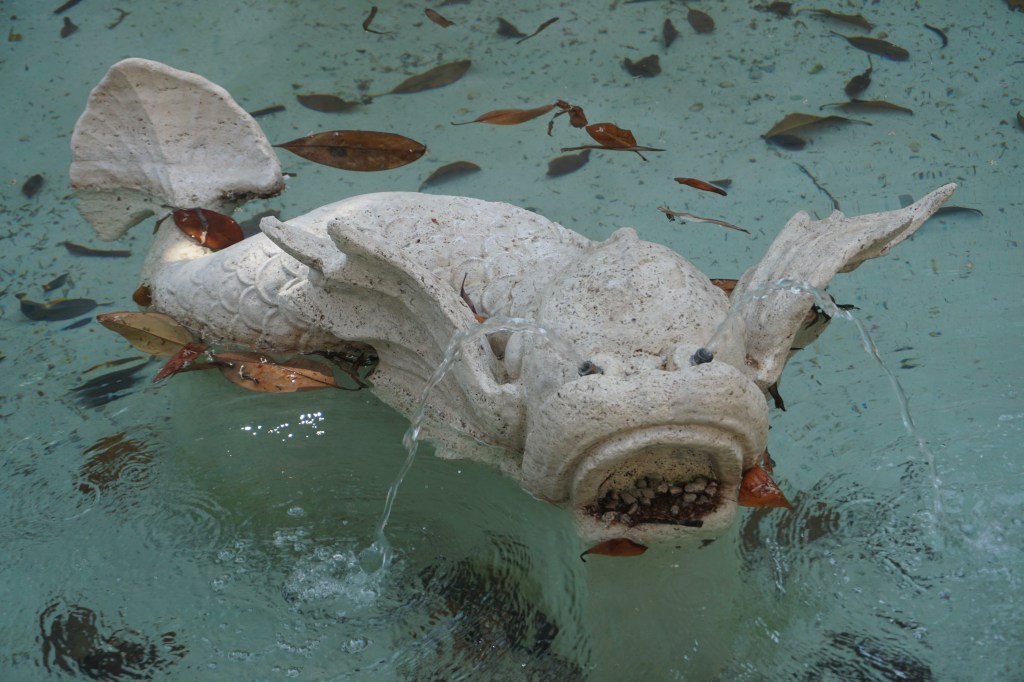
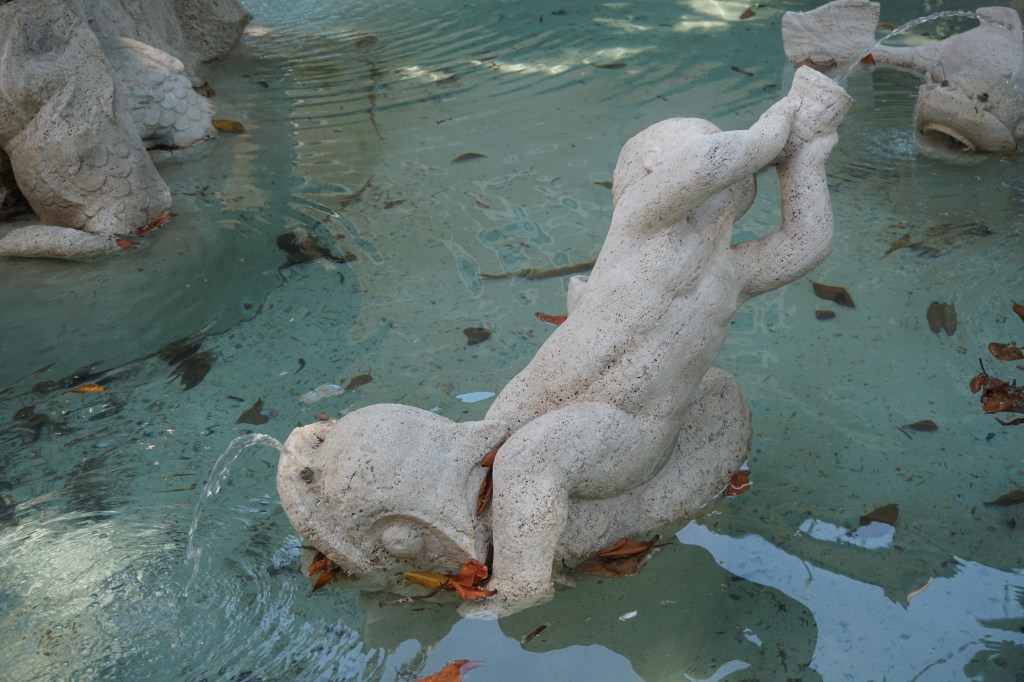
Next, the Piazza and Palazzo de Venezia. Built during the fifteenth century as a residence for Cardinal Pietro Barbo, the Renaissance building of Palazzo Venezia later became the papal residence (so much for that vow of poverty…) and the Embassy of the Republic of Venice. In 1916 it became property of the Italian state. It was converted into Mussolini’s headquarters during the Fascist era. The best part of this palazzo is the courtyard that is open to the public. On a 90˚+ day, a few minutes in a shady courtyard with a lovely fountain can be truly reviving!
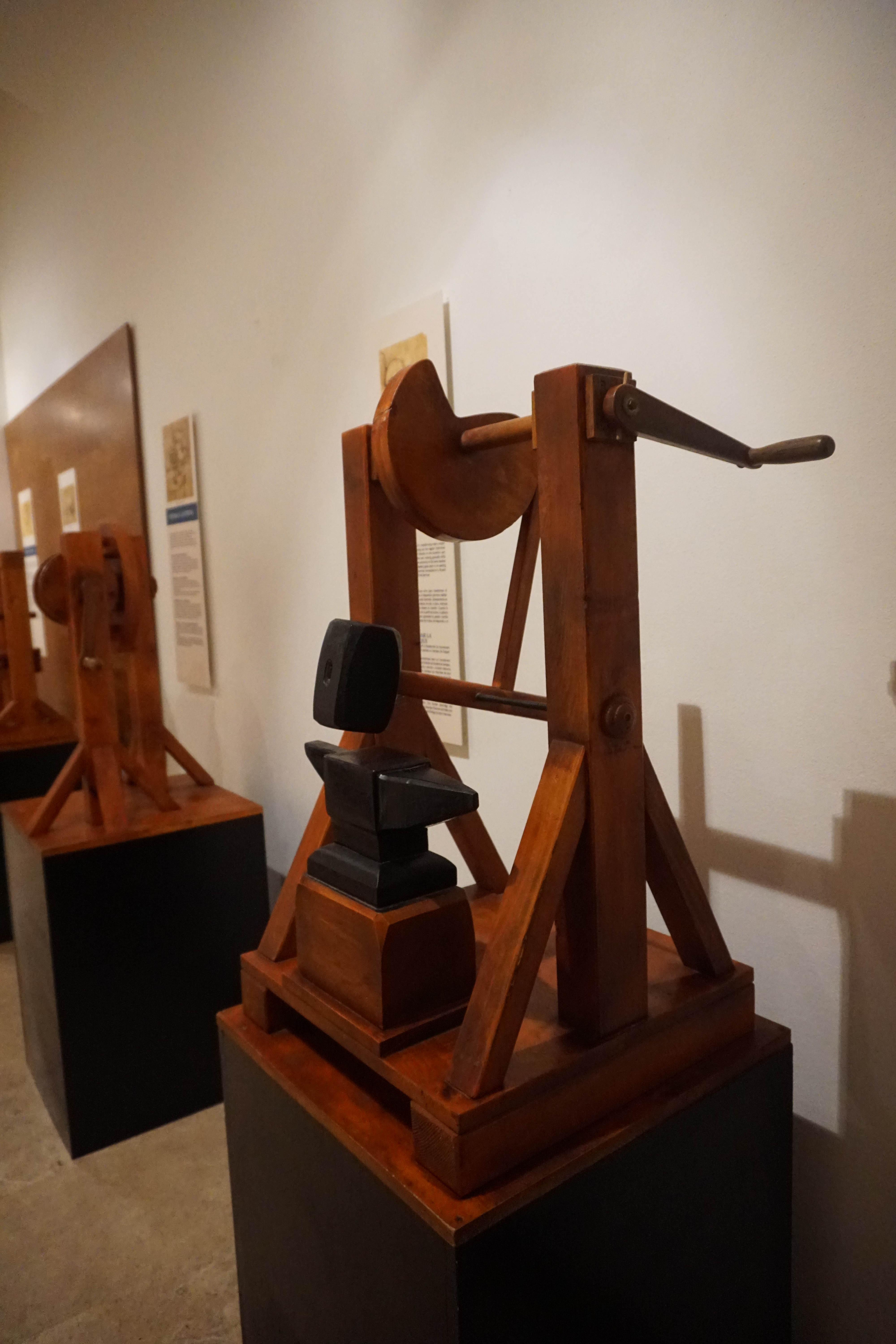
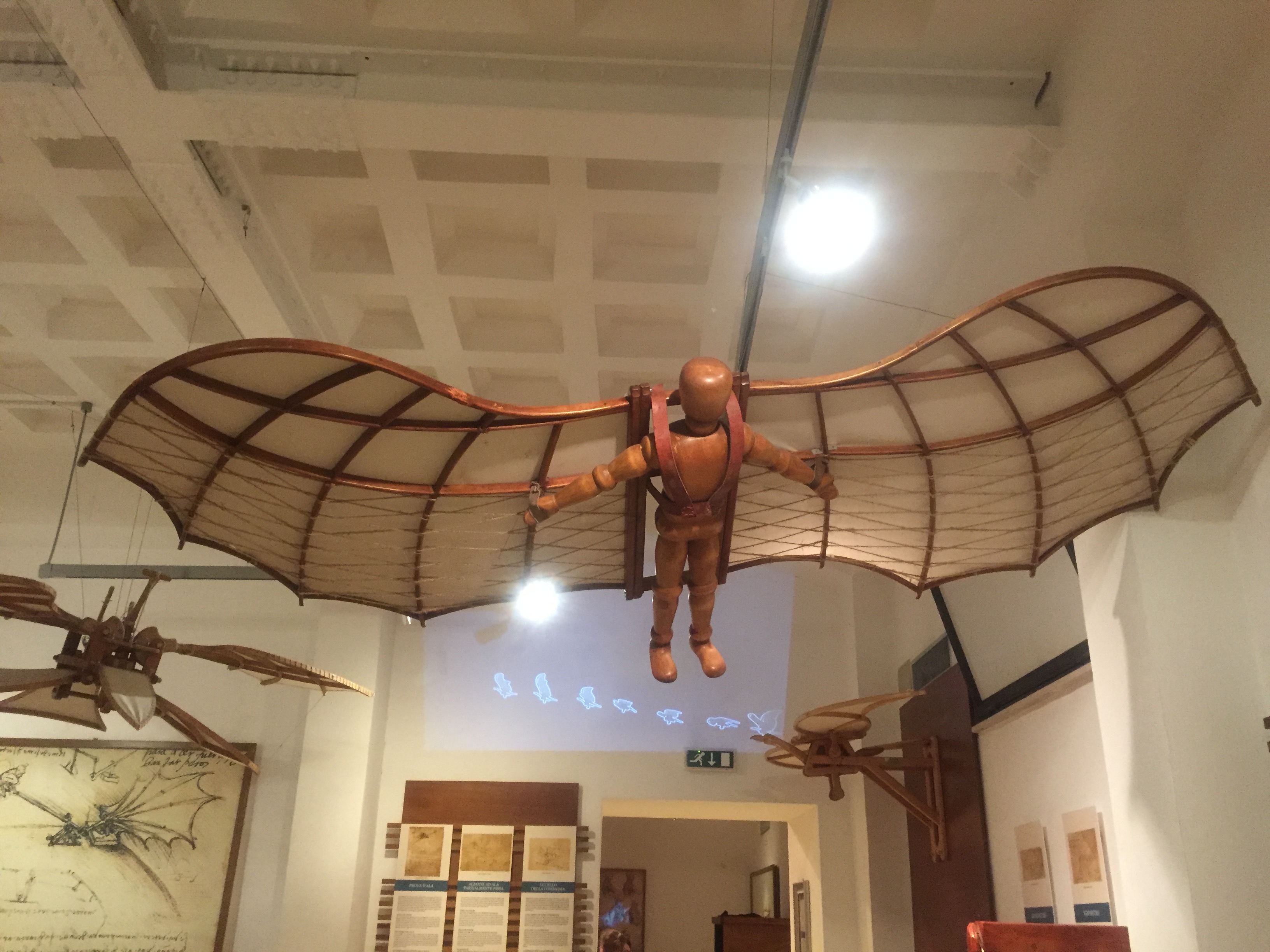
Somewhere in the middle of this ambitious trek, we bumped into an exhibition of the creations of Leonardo DaVinci. This exhibition had three things going for it: 1. It was air conditioned. 2. Because it is a private exhibition, LuLu was allowed in. 3. Leonardo da Vinci’s amazing mind! It included 200 wooden machines and 65 working models all constructed from da Vinci’s drawings – including flying machines, anatomical drawings, a machine gun, adaptable machines to do repetitive work such as the hand powered sledge hammer, below, and a bicycle. Just amazing! Da Vinci eventually gave up on the flying device because it would be too arduous to operate for more than a few minutes.
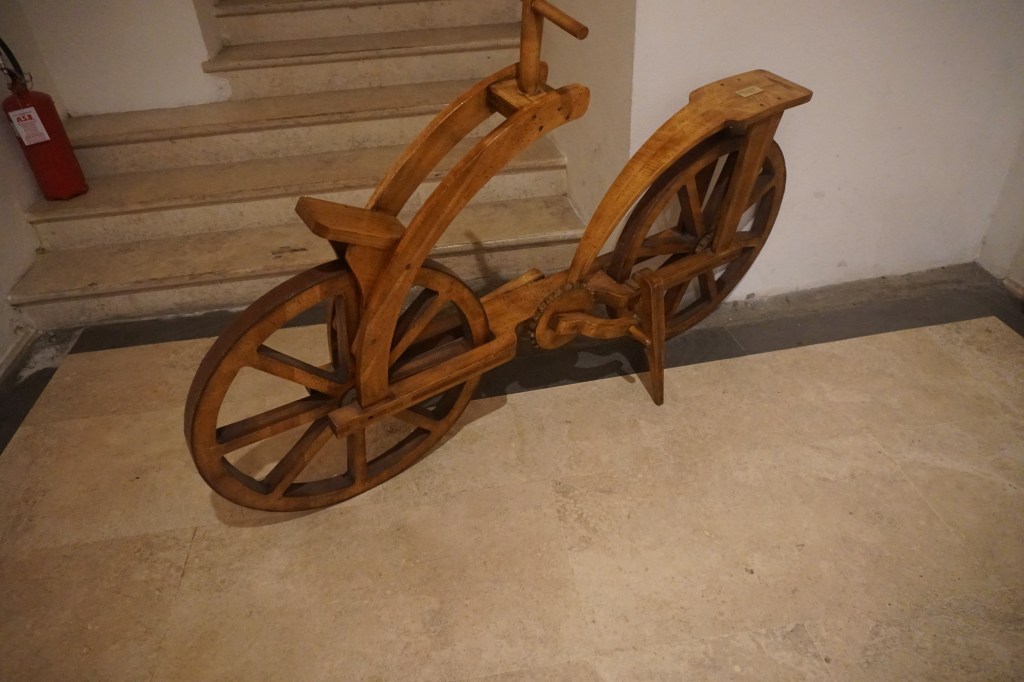
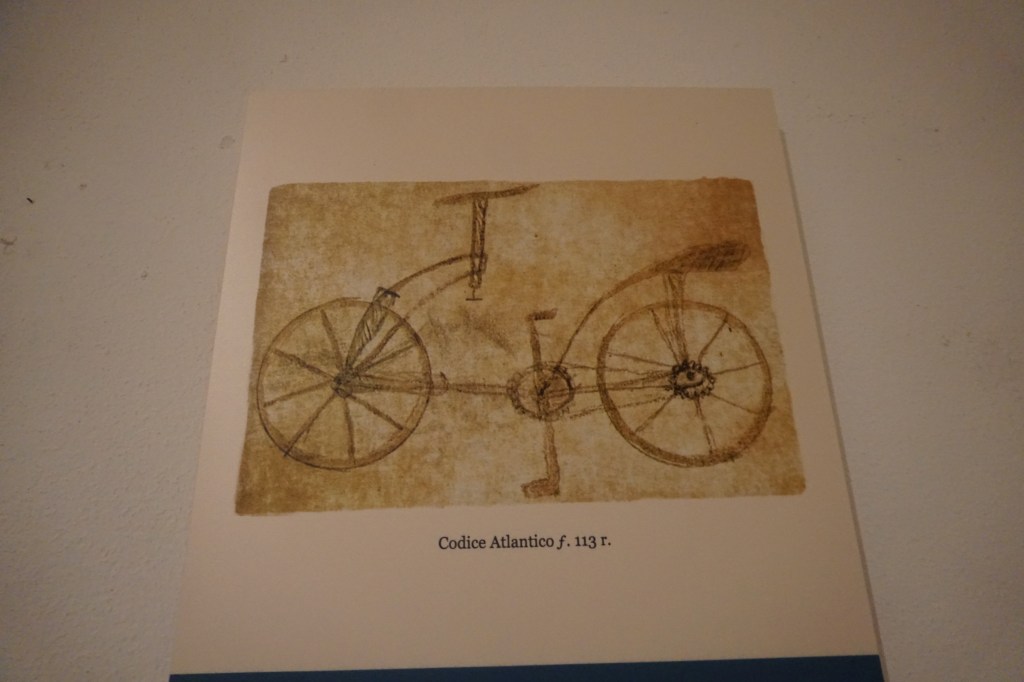
There is some controversy regarding the bicycle drawing. Experts feel it was drawn by one of da Vinci’s students. It was found on the back of a sexual anatomy drawing censored for 500 years.
Many more palazzos and piazzas later, we wound up the self-guided walking tour at Piazza Navona. The public square is built on the site where the Stadium of Domitian once stood. It could hold approximately 20,000 spectators, who came to see different athletic competitions. The most beautiful parts of Piazza Navona are its three fountains, designed during the papacy of Gregory XIII: the Fountain of the Four Rivers by Bernini in 1646-1648, the Fountain of the Moor by Giacomo della Porta in 1574 and renovateded by Bernini in 1653, and the Fountain of Neptune also created by Giacomo della Porta, also in 1574. There was a great deal of controversy and opposition to the construction of The Four Rivers, as Italy was in the grip of a famine and the citizens felt that extra taxes to build fountains took food away from their families.
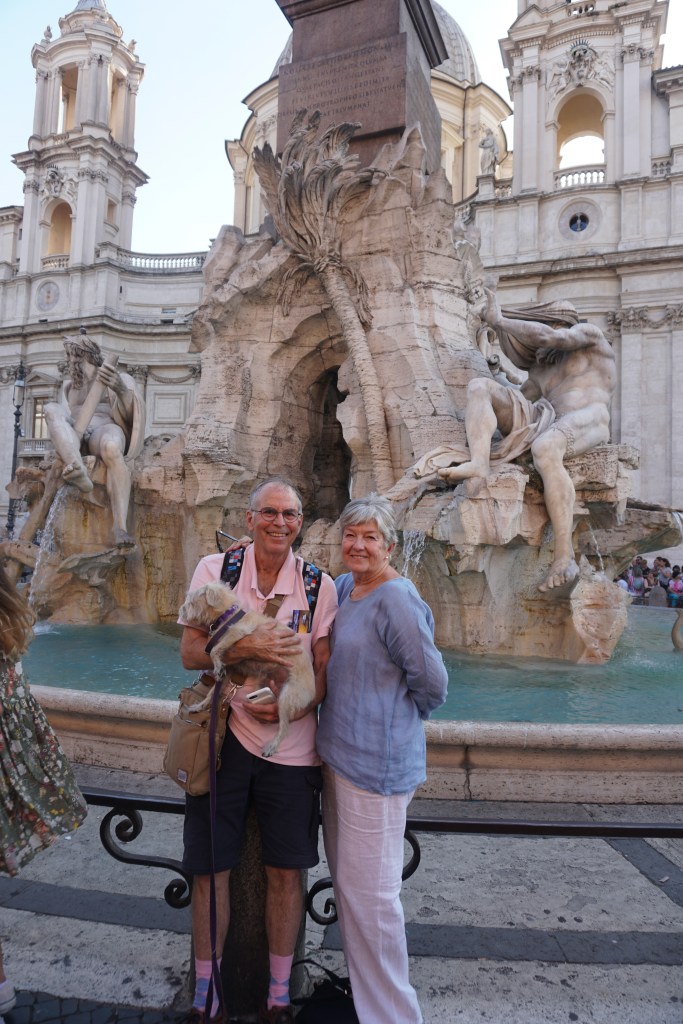
We spent 3 more days in Rome. Part II of this post will drop soon!
Love to you all,
Sam, Donna & LuLu
July 25, 2019

 LuLu's Outta Town
Wonderful to see Sam make an appearance! Looking every bit as exhilarated and rejuvenated by the travels as Donna!
Did “Four Seasons in Rome” provide any touring tips? He certainly made me want to see things for myself.
LikeLike
I keep enjoying your trip with you! Thanks Donna and Sam!
LikeLike
We’re still enjoying it too! More Rome, coming soon! Greetings to you and Alex from Norway!
xoxoxo-D
LikeLike