At the onset of planning this journey, we knew we wanted to stay in France for six months, including one month in Paris. When the idea of a five month stay in St Rémy de Provence was first floated, Sam was over the moon! Seems that St Rémy is a mere 90 minute drive from the ITER, an international project to create and harness fusion energy. His enthusiasm may have tipped the balance!
Fusion is a nuclear process. Local, independently-proven examples are Alpha Centauri, The North Star and, locally, our only energy source, the Sun. Do we need it, you ask? Here is a concise explanation, quoted from literature regarding a plant being built here in Provence, France.
Fusion is the process that occurs in the core of the Sun and stars. What we see and feel as warmth is the result of fusion reactions: Hydrogen nuclei collide, fuse into heavier helium atoms and release considerable amounts of energy in the process. Fusion is the source of life in the Universe.
http://www.iter.org
1. Current Project There are many machines around the world that are in the quest for creating and harnessing fusion. We happen to be one and a half hours from one existing one and one being built. They are the Cadarache and the ITER. “Iter” is a Latin word meaning, “the way,” and in this instance is also an acronym for International Thermonuclear Experimental Reactor. The machine within this facility where fusion will be studied and tested is a “tokamak.” In turn,“tokamak” is an acronym for “toroidal* chamber with magnetic coils” (originally in Russian). What will it do? The website (ITER.org) lists five principal goals. (NB, I do not know this material in any scientific sense, but paraphrasing helps me develop my understanding.)
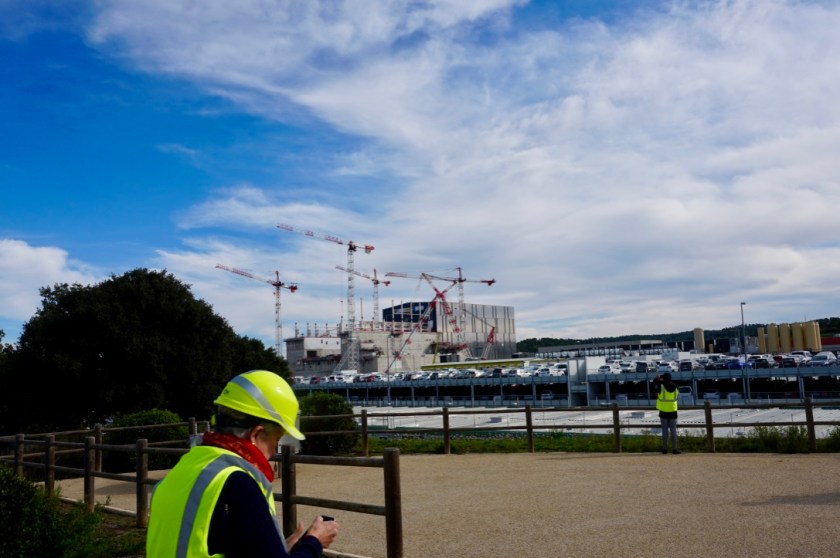
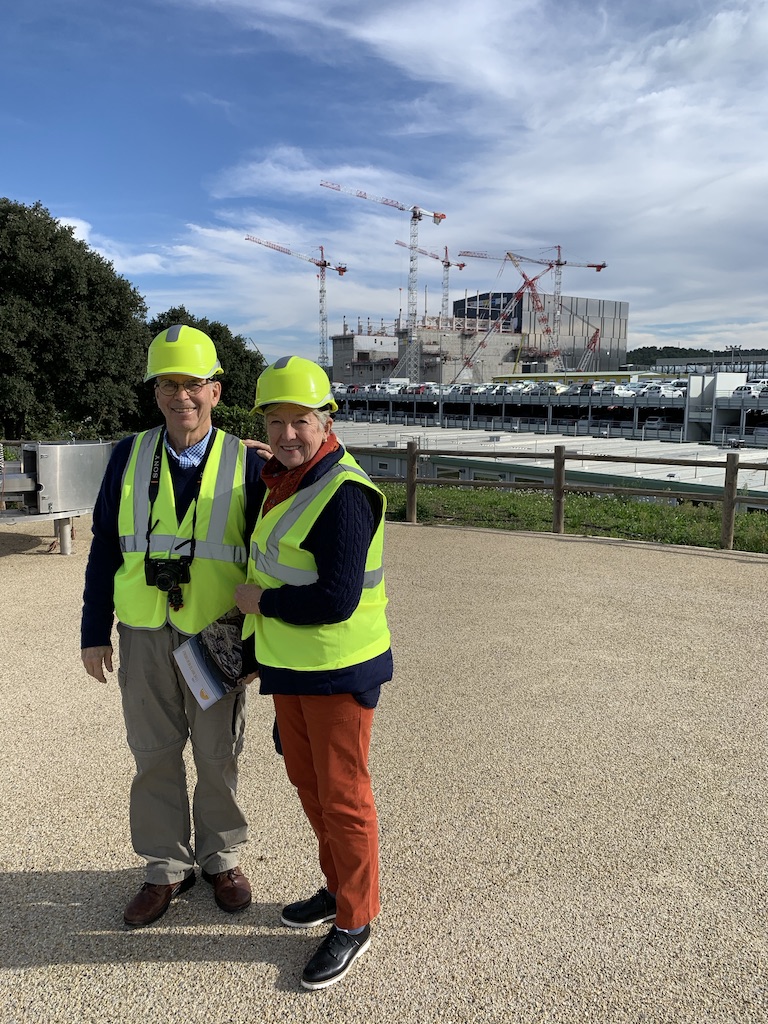
- The ITER machine will produce 500 megawatts (MW) of fusion power and be the first facility to yield more power than is used in the fusion process. The highest output of another reactor in 1997 was lower than the cost of input. ITER aims to have an output:input ratio of at least 10:1. However, as this one is an experimental unit, no power take-off will take place. The ITER complex is tied into the French power grid but only for the purpose of drawing power.
- ITER’s size and scope are geared towards experimentation and testing various technologies that must be harnessed to work together: heating, control, diagnostics, cryogenics and remote maintenance.
- The science says that the ideal mix of elements calls for deuterium and tritium in order to sustain longer periods of thermonuclear reaction–ie., fusion. The heat generated during the reaction will be captive within the plasma and that, in turn, will enable it to be sustained longer. Plasma is the fourth state of matter after solid, liquid and gas. The Sun has lots of it.
- While deuterium is common, tritium is not. A goal is to harvest tritium during the operation of the tokamak to provide for part of future “fuel.” Manufacturing tritium will be a critical element to feed fusion reactors of the future.
Aside: Does the creation of tritium, enabling ever-more fusion, push up against the immutability of the second law of thermodynamics? Jus’ askin.’ - One intention of the ITER plant is to demonstrate that fusion power has negligible environmental impacts. With safety designed into the machine and a process that does not and can not produce the hazards inherent in fission reactors, the facility has already been licensed to become a nuclear operator in France.

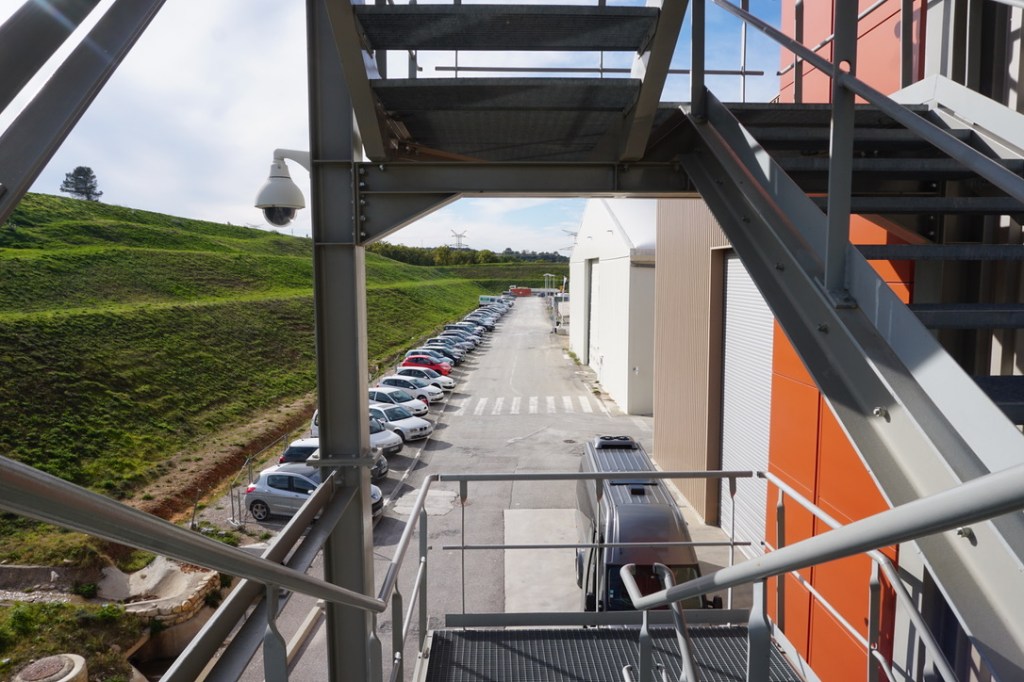
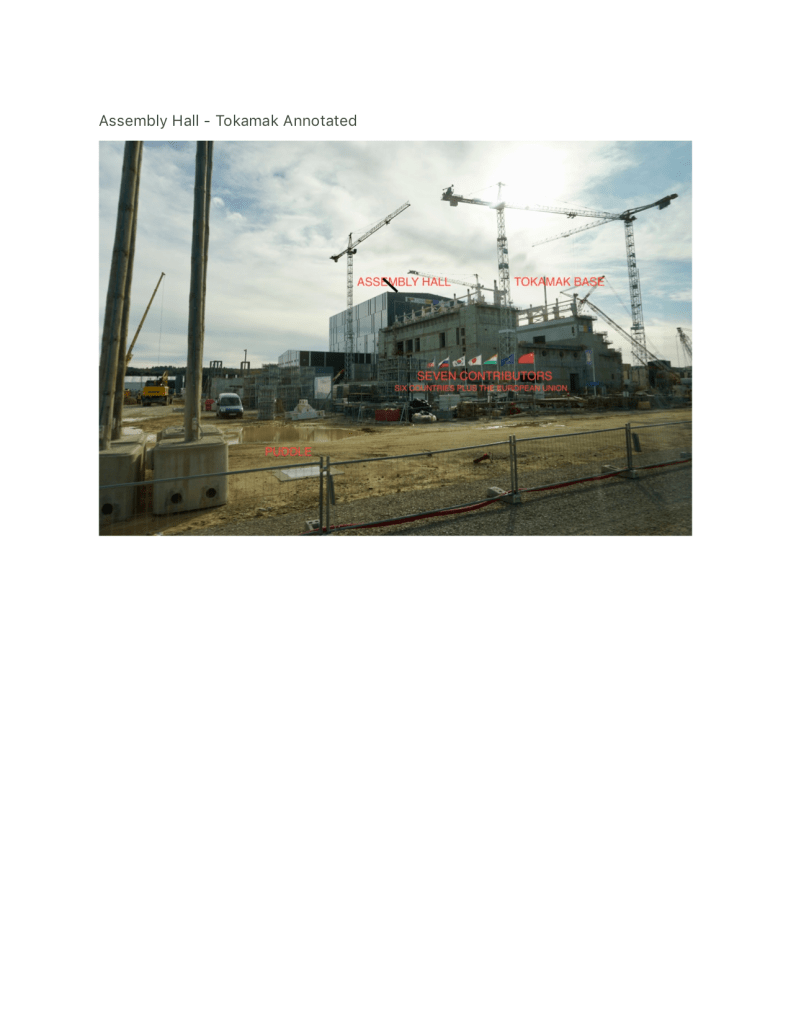
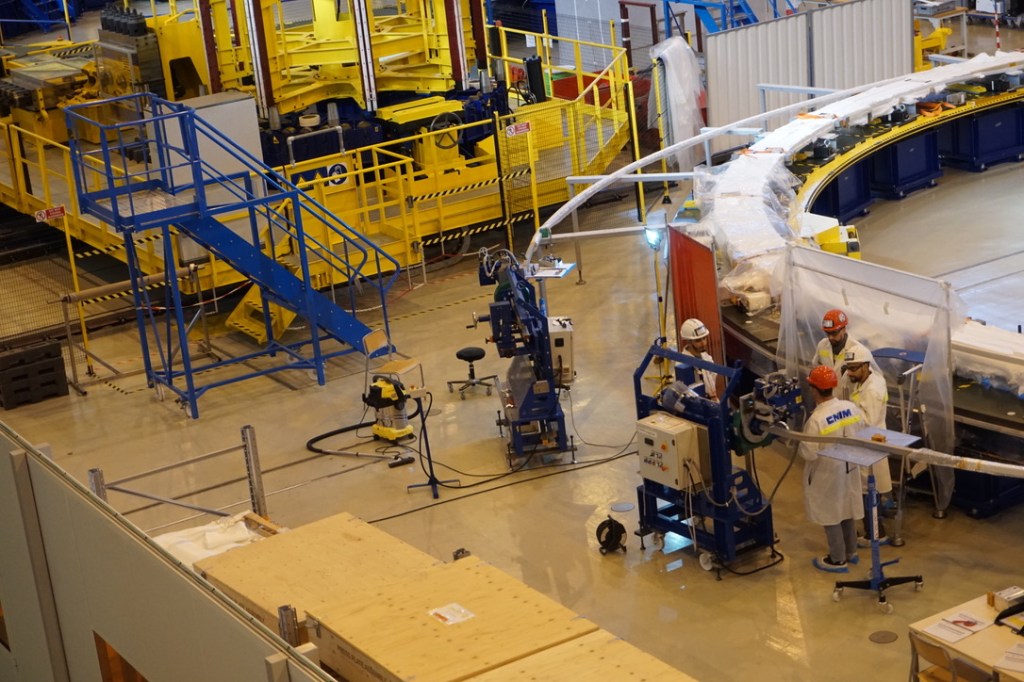
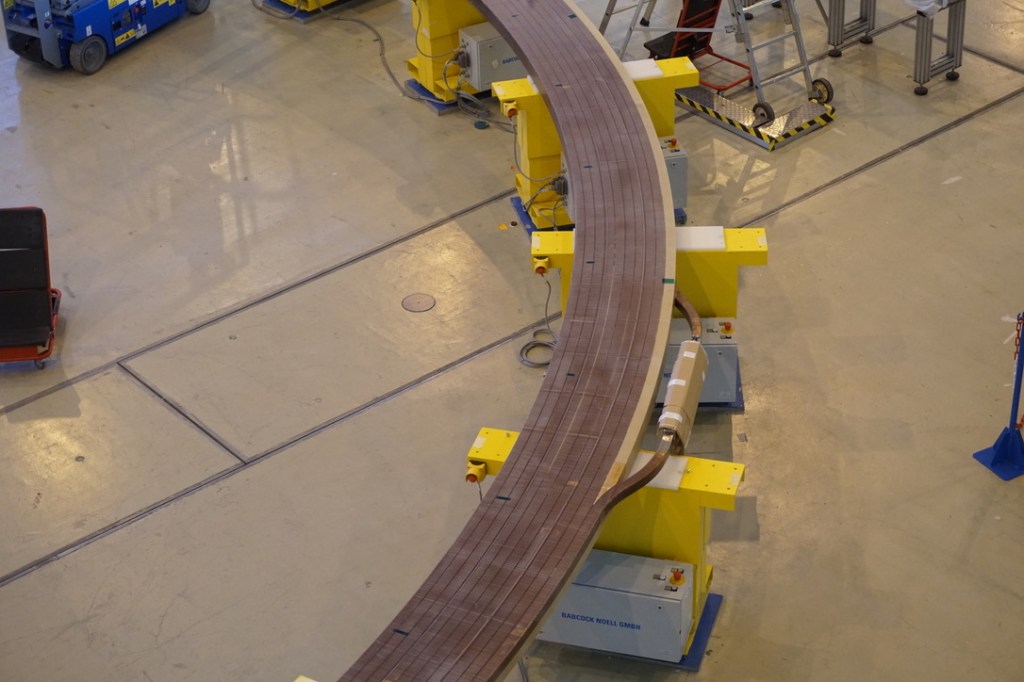
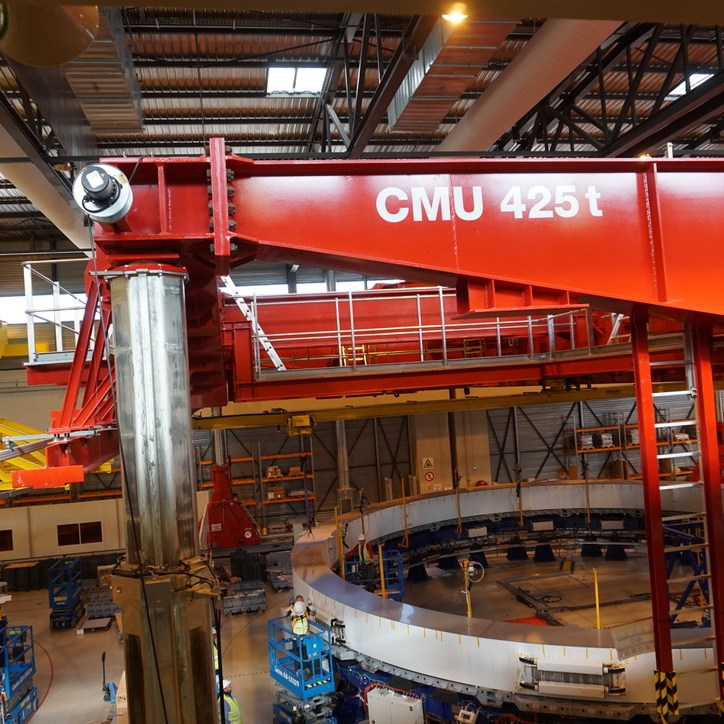

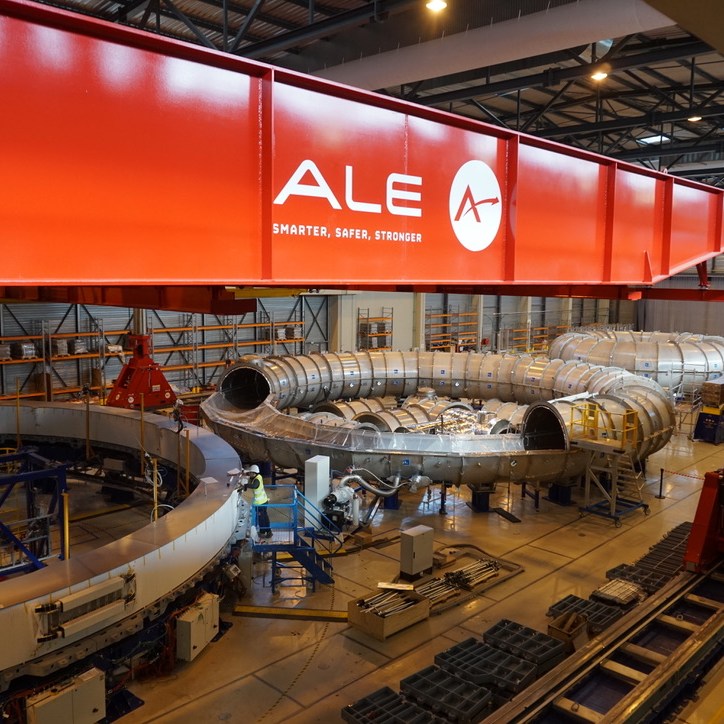
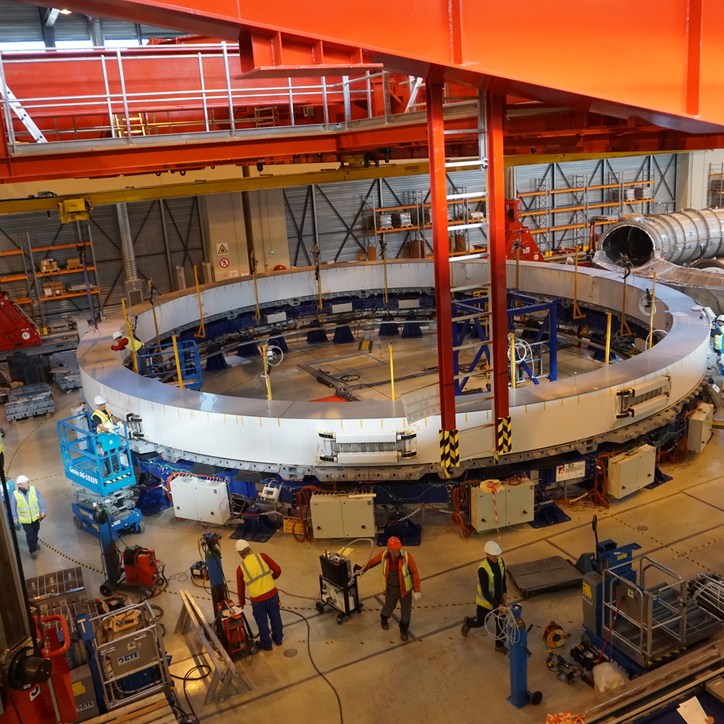
Hydraulic crane on floor tracks will load the poloidal coils onto trucks at the right-hand end of the Winding Facility for a short ride to the tokamak. Très petite, non?
- The Next, Future Project. Projected for the near future is to step beyond experiment and build the prototype for energy-producing tokamaks. It will be one-third larger and fusion energy will produce electrical current by heating water and driving turbines. It will also be studied for any refinements in the design. As prototype it may be the final design for replication or it may undergo changes towards creating a “final” design.
- Crunch the physics. E=mc2, energy equals mass times the square of the speed of light. Because the speed of light is a very large number to start with and it gets squared, the amount of fusion fuel mass needed for a sustained reaction is tiny. A few grams of material is all that is employed. The energy released is the “e” side of the equation. The mass side of the equation is the “m” of the hydrogen neutron times the speed of light times the speed of light (i.e., c2). This speed is 186,282 miles per second (300,000 kilometers per second). I don’t understand the units of a squared speed, but the value of the number itself is very large, around 90,000,000,000, or ninety billion. Multiply this times the mass of the neutron freed in the fusion reaction and that’s the energy released. It is 4,000,000 times more than the corresponding energy we get from burning a fossil fuel.
- Crunch the numbers. The efficiency is around 90%. In other words, the ratio of energy generated against energy expended is >10:1, expressed as Q>10. Or, the energy needed to power the tokamak operation including the giant magnets is 1/10th or less of the electricity generated.
- The Raison d’Etre (hey, we’re in France). As the worldwide economic growth model persists, energy demands are slated to triple by the end of the century. Urbanization in both developed and developing countries coupled with continued population growth will require sustainability both in abundance and being non-polluting. The ITER literature lists the following advantages that nuclear fusion generation has to offer.
- Abundance.
- Fusion beats the chemical reaction of burning fossils by 4,000,000 to 1.
- Fusion beats fission-generation by 4 to 1.
- These efficiencies make it ideal for carrying the forthcoming vast, basic demands.
- Sustainability.
- Deuterium is abundant and can be distilled from all forms of water.
- Tritium will be as an on-going by-product. Liberated neutrons can be made to interact with lithium to manufacture tritium. While the lithium component is not a renewable substance now the resource is sufficiently ample for a millennium.
- No greenhouse gasses.
- Neither carbon dioxide not any other greenhouse gas is released during a fusion reaction.
- No long-lived radioactive waste.
- Nuclear fusion reactors do not produce high-activity waste. Waste is not long-lived.
- Nuclear waste from fission reactors has been a monumental problem facing fission-based plants, and is still largely unresolved.
- No proliferation.
- As fissile materials play no part, there is no threat of such material falling into the wrong hands.
- No risk of melt-down
- During operation the plasma cloud reaches enormous temperatures, but as there is little mass involved, whenever there is any disturbance, the plasma cools in seconds and the reaction stops.
The ITER.org website is astonishing. It captures an astonishing project and very generously keeps you abreast of a technology that is likely to be a keystone in the portal to a sustainable future.
Who is building the ITER? Seven international entities are putting science, engineering, manufacturing, transportation and labor into the project. Six are sovereign nations and one is the European Union.
How did I first hear about it? An article in The New Yorker magazine, “A Star in a Bottle,” written by Raffi Khatchadourian, and published on March 3, 2014, three years after construction started and five years after the international agreement was inked. Beyond announcing ITER to The New Yorker reader, he gets into the weeds of the difficulty of design, engineering, cost control, worry about cost-cutting and the math. Some of the math differs from the current documents published by ITER.
Editor’s note: This was written in St. Remy but published in Paris without modifying the relative geographical references.
*Toroidal refers to the configuration of the chamber where the nuclear fusion plasma comes into being. A donut is a toroid. The chamber is a void that corresponds to a missing donut, or put another way, the interior of a donut, might also be known as the dough.

 LuLu's Outta Town
The breadth of your blog has expanded amazingly with this fascinating entry! I love the science. And it’s encouraging to hear about all the very real, very nuts-and-bolts progress made in harnessing non-carbon based energy.
LikeLike
I can understand Sam’s enthusiasm about fusion and ITER. I would want to check it out too.
LikeLike
Hi Julio, Sam wrote this post! I can’t even spell half the words, much less understand in any depth how it works! But it was fascinating to visit! Cheers,
Donna
LikeLike